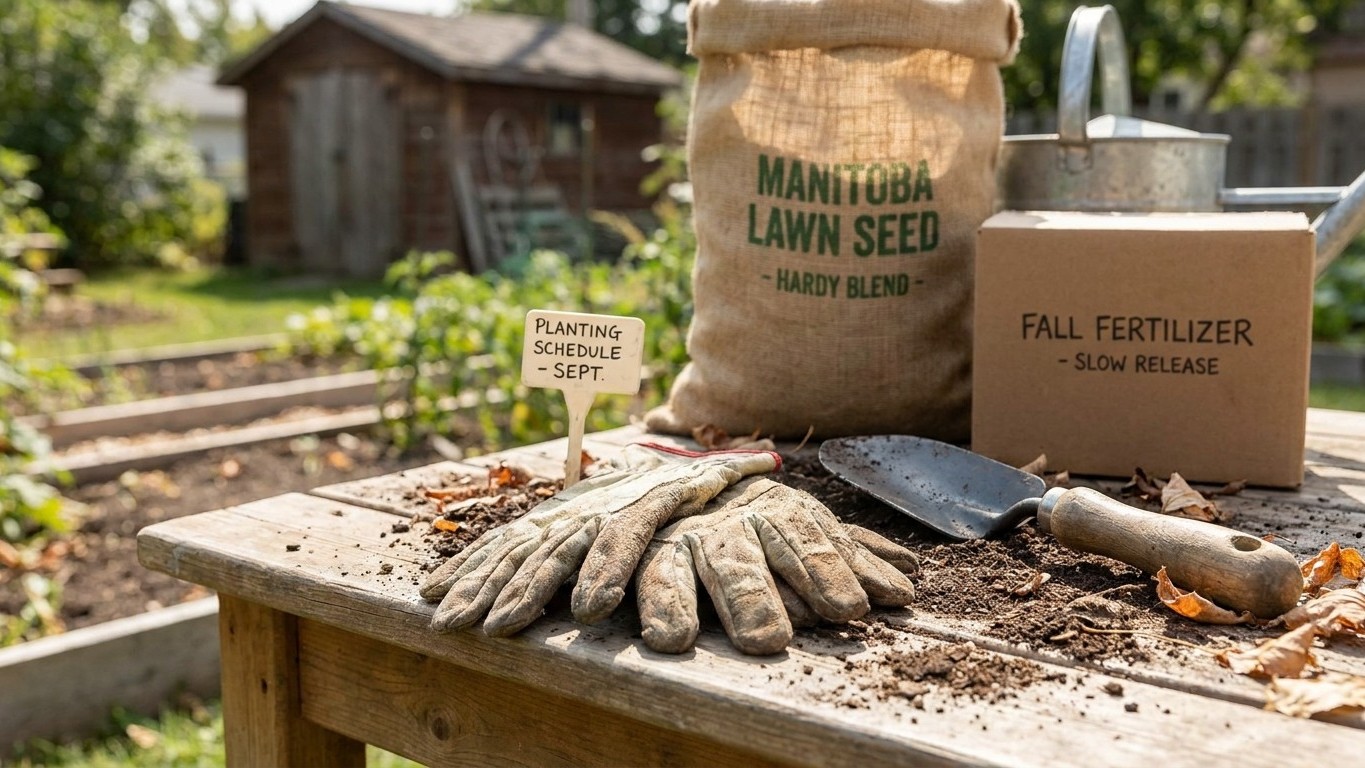

A Manitoba lawn spends five or six months under snow and the rest of the year proving whether it’s built for that cold or just tolerating it. Plant Kentucky bluegrass, fine fescue, perennial ryegrass, tall fescue or rough bluegrass, and build the whole feeding and mowing schedule around fall, not summer, because that’s when this grass actually grows.
Which grass belongs in Manitoba

The climate decides this before you pick a bag of seed. At Winnipeg Richardson Int’l A, Environment and Climate Change Canada’s 1981-2010 normals put the mean daily minimum of the coldest month at -21.4°C. That’s not a record cold snap, it’s the average low for the coldest month of a typical winter. No warm-season grass, Bermuda or zoysia included, survives a winter that cold without dying back to bare soil, which is why none of them appear on any list built for this territory.
On the heat side, the same station averages just 4.54 days a year reaching 32°C, and 13.3 days above 30°C, according to ECCC. That’s a modest count of hot days, not a measure of how long the growing season runs, and it doesn’t push the recommendation toward a warm-season lawn. It simply means summer heat stress is occasional here rather than constant, which cool-season grass tolerates fine as long as it isn’t also short of water.
Put those two figures together and the answer is a clean one, unlike a transition-zone lawn where Colorado’s lawn care has to weigh a genuinely split climate against itself. Manitoba doesn’t split. The species that hold here are the cool-season group named by Clemson Cooperative Extension’s HGIC 1214 and Penn State Extension: Kentucky Bluegrass, Fine Fescues, Perennial Ryegrass, Tall Fescue and Rough Bluegrass. Kentucky bluegrass spreads by rhizome and self-repairs after winter injury, which matters here. Fine fescue tolerates shade and thin, poor soil better than the others. Tall fescue carries the deepest root system of the group and rides out a dry August with less visible stress. Perennial ryegrass establishes fastest from seed, which is useful for patching a bare spot before the ground freezes, but it doesn’t recover from hard winters as reliably as bluegrass. Rough bluegrass wants more shade and moisture than the rest and is really a fit for wet, low-light corners of the yard rather than the whole lawn.
Most Manitoba lawns end up as a blend rather than a single species, usually Kentucky bluegrass carrying the bulk of the lawn with fine fescue mixed in for the shady side of the house. That blend spreads the risk: if one species takes winter injury in a hard year, the other is often still standing.
When to seed or sod here
Anchoring the window on frost, not the calendar
Clemson Cooperative Extension’s HGIC 1203 splits seeding season by grass type: warm-season grasses go in around May, cool-season grasses go in mid to late September. Manitoba’s lawn is entirely cool-season, so the May window in that guidance simply doesn’t apply here. What matters instead is the fall window, and that has to be anchored on a local date, not a generic month.
ECCC’s Canadian Climate Normals 1981-2010 put Winnipeg’s average first fall frost at September 22, measured at Winnipeg Richardson Int’l A. That’s a mean date, not a guarantee. In roughly half of all years the first frost arrives later than that, and in the other half it arrives earlier, so treat it as the midpoint of a window rather than a safe deadline. New seed needs several weeks of mild soil to root before the ground goes cold, which pushes the practical sowing window into late summer, well ahead of that average frost date rather than right up against it. Compare that to New Brunswick’s lawn care calendar, where the fall seeding window works on the same cool-season logic but against a different frost date entirely, because these are two different stations in two different provinces.
Sod can go down later than seed, since it arrives already rooted, but it still needs enough time before hard frost to knit into the soil beneath it. Northern districts and higher ground in Manitoba run behind Winnipeg’s date, sometimes by a couple of weeks, so a grower further north should treat the September 22 figure as optimistic for their own yard and move earlier rather than later.
The feeding calendar that fits this climate
Nitrogen timing follows what the grass is actually doing, not the month on the wall. A cool-season lawn like the ones recommended for Manitoba does almost all its root growth in spring and fall, goes semi-dormant in the heat of midsummer, and then pushes hard again once temperatures drop in September. Feeding heavily in June, when growth has slowed, wastes nitrogen and can even feed disease instead of grass. Feeding heavily in fall, when roots are actively building reserves for winter, is what actually thickens the lawn.
Clemson Cooperative Extension’s HGIC 1219, the Tall Fescue Maintenance Calendar, lays out exactly this pattern for a cool-season lawn: a series of fall applications rather than one large spring dose, with the heaviest feeding in early fall tapering off as the grass slows toward winter. The calendar gives per-application nitrogen rates in pounds of actual nitrogen per 1,000 square feet for each visit across the season, and those rates are worth reading directly rather than guessing at, since they differ from one application to the next within the same fall. The full tall fescue maintenance calendar spells out each date and rate in order.
A light spring feeding, if you do one at all, should stay conservative. Most of the season’s nitrogen budget belongs in September and into fall, timed against Manitoba’s own frost window rather than a date pulled from a warmer province’s calendar. Skip the mid-summer feeding altogether in a hot, dry stretch, since pushing top growth on a heat-stressed lawn does it no favors.
Mowing height and watering here
Height by species
Mowing height should sit at the tall end of what each species tolerates, since taller grass shades its own soil, holds moisture better, and out-competes weeds. The table below gives typical mowing ranges for the species recommended in this territory.
| Species | Mowing height | Notes |
|---|---|---|
| Kentucky Bluegrass | 2.5-3.5 in | Spreads by rhizome, self-repairs |
| Fine Fescue | 2.5-3.5 in | Best in shade and thin soil |
| Perennial Ryegrass | 2-3 in | Fastest germination, weaker winter recovery |
| Tall Fescue | 3-4 in | Deepest roots, most drought-tolerant of the group |
| Rough Bluegrass | 2-3 in | Wants moisture and shade, not full sun |
Whatever the species, follow the one-third rule: never remove more than a third of the blade in a single cut. Scalping a Manitoba lawn before a hot, dry stretch or right before a hard frost leaves it with less leaf area to recover with at exactly the moment it needs it most.
Watering
An inch of water a week, from rain and irrigation combined, is the figure most cool-season lawns are built around. What changes it here is soil and wind more than heat, since Winnipeg’s hot-day count is modest rather than extreme. Heavier clay soil, common across parts of the province, holds water longer and needs it less often but for a longer soak each time. Sandy patches drain fast and need smaller, more frequent watering to avoid drought stress between rounds. Wind across open prairie ground also pulls moisture out of the top inch of soil faster than the same lawn would lose it in a sheltered yard, so an exposed lawn needs watching more closely in a dry, windy stretch even without extra heat.
What goes wrong on lawns in Manitoba

The failures here follow directly from the climate, not from lawn problems in general. A cold winter under heavy snow cover is the setup for snow mold, which shows up as matted, discolored patches the moment the snow melts back in spring. It looks worse than it usually is. Raking the matted grass gently to let air and light back in is usually enough for the lawn to grow out of it once the soil warms.
A hot, dry stretch in midsummer, even a short one given how few days a year cross 32°C at Winnipeg by ECCC’s count, can push cool-season grass into dormancy. A dormant lawn goes brown and stops growing, but the crown at soil level is still alive. That’s a different failure than a lawn that’s actually dead, and the two get confused constantly.
Signs worth telling apart before deciding what to do:
- Uniform straw-brown color across the whole lawn, tugging test shows roots still anchored: dormancy, not death.
- Circular or irregular patches with a darker, water-soaked ring: fungal disease, often tied to a humid stretch.
- Matted, grayish or pinkish patches appearing right after snowmelt: snow mold.
- Thinning that keeps getting worse through a mild fall with no frost yet: weeds filling gaps the grass hasn’t recovered.
A mild fall that pushes the first frost later than the September 22 average buys weeds extra weeks to keep spreading before the lawn’s own growth shuts down for winter, which is one more reason not to treat that date as fixed.
Local help
Soil across Manitoba varies enough, from heavy Red River Valley clay to sandier ground elsewhere in the province, that a soil test is worth more than any general guideline. Manitoba Agriculture, the provincial extension service, handles soil testing and local advice by region. Start at Manitoba Agriculture before making a large seed, sod or fertilizer purchase for a lawn with problems.
Common questions
Can I grow Bermuda grass in Manitoba if I baby it through winter?
No, not reliably. Bermuda and other warm-season grasses are built for winters far milder than Winnipeg’s average coldest-month minimum of -21.4°C reported by ECCC. Even a well-mulched patch rarely survives that consistently, and the cool-season species named above will simply outperform it without the extra work.
My lawn is still brown in late spring, is it dead?
Probably not, especially if the ground beneath it has only recently thawed. Tug a few blades gently. If the roots resist and stay anchored, the crown is alive and the color will return as soil temperatures climb. Persistent bare, rootless patches by early summer are a better sign of real winterkill.
Should I fertilize right before the first fall frost?
A late application timed close to the average September 22 frost date at Winnipeg can still help root development, since roots keep working after top growth slows. Avoid a heavy nitrogen application very late in fall, since it can push soft top growth that has no time to harden off before real cold sets in.
Why does my lawn look worse right after the snow melts than it did in fall?
That’s almost always snow mold, which develops under snow cover over winter and only becomes visible once it thaws. Rake out the matted patches to let air in and the lawn generally recovers on its own through spring growth.
Is one heavy feeding in September enough, or does it need to be split up?
Splitting fall nitrogen into more than one application, as laid out in Clemson Cooperative Extension’s tall fescue maintenance calendar, feeds the grass more evenly across its main growth window than one large dose does. A single heavy application also carries more risk of runoff or burn than the same total nitrogen split across two or three visits.