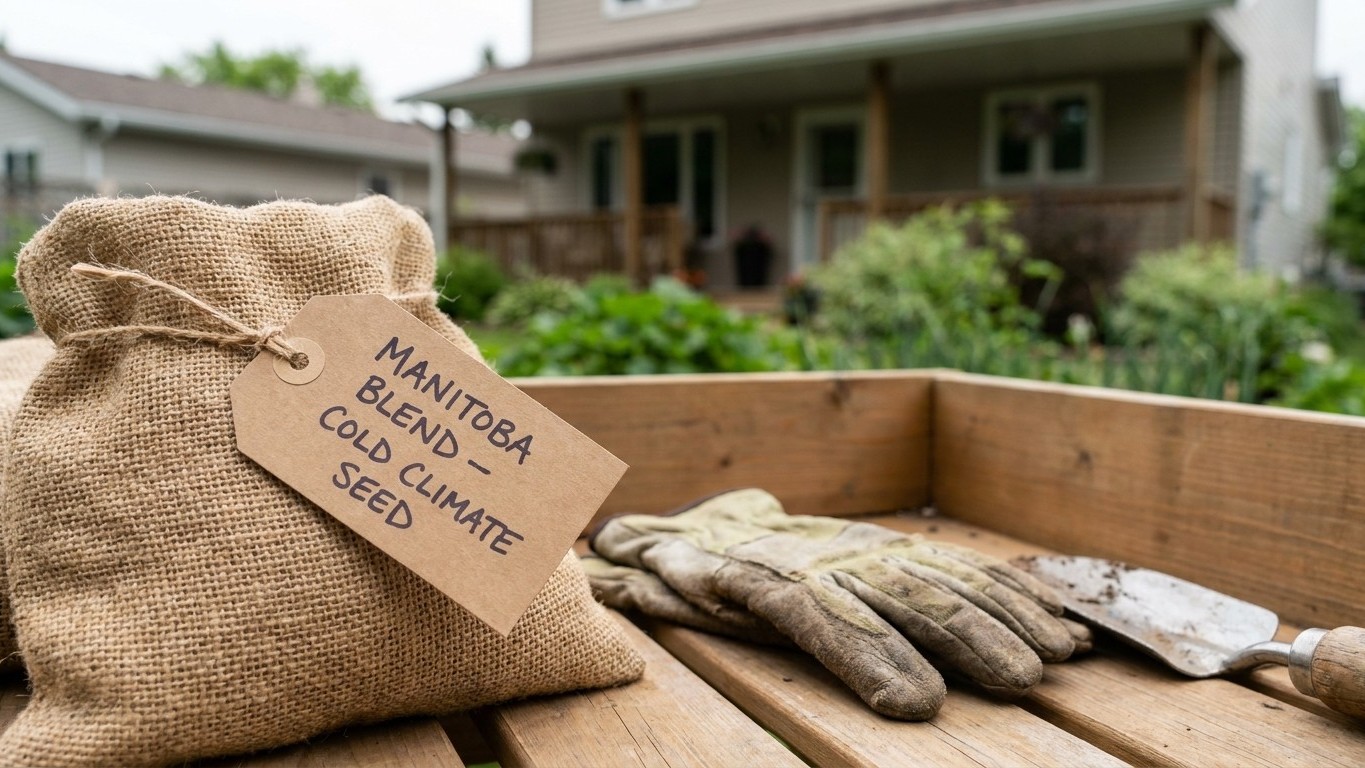

Winnipeg’s climate normals are why this decision starts by crossing names off the list, not adding them. Zoysia, bermuda, anything bred for southern heat, dies here the first hard winter no matter what the bag promises, because Manitoba sits in cool-season territory. That leaves fine fescues, Kentucky bluegrass, perennial ryegrass, rough bluegrass and tall fescue as the only real contenders, and which one wins depends on sun, traffic and how much upkeep a given yard can stand.
The short answer for Manitoba
There is no single best grass seed for Manitoba, because the answer depends on what a given yard demands of it. What is settled is the group: Manitoba is cool-season lawn territory, a classification The Homestead Post assigns from the climate normals recorded at Winnipeg, and the only species worth putting on a shopping list here are fine fescues, Kentucky bluegrass, perennial ryegrass, rough bluegrass and tall fescue. Anything sold as a warm-season grass, the zoysias and bermudas that fill southern seed catalogues, will not survive a winter here regardless of how the bag markets it.
That Winnipeg-based classification is a starting point, not a guarantee for every yard in the province. Higher, colder ground and the far north of Manitoba push conditions further toward the cool end of the spectrum than Winnipeg itself, so a species that just gets by in the capital can struggle further afield.
What the decision actually depends on
Inside that cool-season group, the real decision is which trade-off a lawn owner is willing to accept. A yard’s answer depends on:
- How much direct sun the lawn gets through a Manitoba summer day
- How much foot traffic, kids, pets or equipment, it takes
- How much time and water the owner is willing to spend keeping it dense
- Whether bare patches need to fill themselves in or can be reseeded by hand
Kentucky bluegrass answers the first three questions well if given enough sun and water. Fine fescue answers the shade question that bluegrass cannot. Before choosing a bag, it helps to have the rest of a Manitoba Lawn Care routine, soil testing and site assessment, already worked out, since seed choice is only one piece of that picture.
Working through the year

Ranked by how forgiving they are in an average Manitoba yard, the five cool-season species split into a self-repairing generalist, two workhorse fillers, and two specialists that only pay off in the right spot.
Kentucky Bluegrass

Kentucky bluegrass is the only one of the five that repairs its own bare patches, because it spreads by underground rhizomes rather than growing in fixed bunches. The cost is patience at the start: bluegrass germinates slowly, often taking two to four weeks longer than ryegrass, so a newly seeded patch needs to stay damp for longer before it fills in. It also wants full sun. In a shaded yard it thins out within a couple of seasons no matter how well it is watered.
Perennial Ryegrass

Perennial ryegrass germinates fast, often within a week to ten days, which is why it shows up in nearly every quick-fix patch mix and in blends meant to hold soil while slower species establish. It wears well under regular foot traffic and mows to a clean, dense finish. Its weak point in Manitoba is winter survival: a stand of pure perennial ryegrass is more prone to winterkill in a hard Prairie winter than bluegrass or fescue, which is why catalogues almost always sell it blended rather than alone.
Fine Fescues

Fine fescues, the group that includes creeping red, chewings and hard fescue, tolerate shade and poor soil better than any other species on this list, and they need less nitrogen and less water to stay green. The trade is density and wear: fine fescue forms a finer, looser turf that thins under heavy traffic and does not repair a bare patch the way bluegrass does. It earns its place under trees and along fence lines where bluegrass would fail from lack of light, not on a path where the dog runs every day.
Tall Fescue

Tall fescue grows in bunches rather than spreading, so it builds a deep, drought-tolerant root system but leaves any bare patch exactly as bare until it is reseeded by hand. Its blade is noticeably coarser than the other four, a texture some owners actively dislike beside a fine fescue lawn. Where it earns its keep is heat and drought tolerance through a dry Manitoba summer stretch, holding color longer than bluegrass when watering is skipped.
Rough Bluegrass

Rough bluegrass, also sold as Poa trivialis, is a specialist for wet, heavily shaded ground where nothing else stays green, spreading by surface stolons into a thin, pale green turf. It has almost no drought tolerance and struggles the moment it is asked to handle full sun or a dry week, so it belongs only in the damp, shaded corner of a yard, not scattered through a general-purpose mix.
Cool-season species like these establish best when seeded in the weeks before soil temperatures drop for the year, not once the ground is already cooling toward freezing. Environment and Climate Change Canada’s 1981-2010 climate normals put Winnipeg’s average first fall frost at September 22, but that figure is a mean, not a safe date. In roughly half of all years the first frost lands later than that, and in the other half it lands earlier, so a seeding plan built around that single date alone runs a real risk of getting caught short. For the week-by-week timing that follows from that frost window, the Manitoba Lawn Care Calendar, Month by Month lays out the spring and late-summer seeding windows in more detail than fits here.
What changes across Manitoba
Every figure on this page is anchored to Winnipeg, because that is where Environment and Climate Change Canada keeps the long-running weather station used for the province’s climate normals. Winnipeg’s fall frost average and its cool-season classification describe the Red River Valley reasonably well, but they are not a promise for the rest of the province.
North and higher ground
North of Winnipeg, and at higher elevation such as around Riding Mountain National Park, the growing season runs shorter and the ground cools earlier in the fall than the Winnipeg average suggests, which pushes the safe seeding window for cool-season grass earlier in the calendar than the Winnipeg figure implies. A lawn in one of those areas that waits for a Winnipeg-timed seeding window is seeding later than its own local frost pattern can really support.
Near Lake Winnipeg
Lake Winnipeg has something close to the opposite effect on the ground nearest its shore. Large bodies of water hold summer heat longer into the fall and release it slowly, so towns close to the lake tend to see their first frost arrive somewhat later than places the same distance north but away from the water. That is a general effect of large lakes on nearby microclimates, not a number this page can put a date to for any specific shoreline town, since the frost figure used here comes from the Winnipeg Richardson station inland, not a lakeshore one.
Soil across the province
Soil matters as much as latitude. The heavy clay common through the Red River Valley drains slowly and holds spring moisture longer, which favors bluegrass’s need for consistent water but can drown fine fescue’s shallower, drought-adapted roots in a wet spring. Sandier soil elsewhere in the province flips that balance, favoring the fescues and putting bluegrass under drought stress sooner in a dry summer.
The mistakes this climate punishes
Manitoba’s winters are unforgiving of a handful of specific errors, and each one shows its damage on a predictable schedule rather than immediately.
Common seeding and mowing mistakes
| Mistake | When the damage shows | Why it happens |
|---|---|---|
| Seeding a warm-season grass sold on general store racks | The following spring, as bare patches where nothing greens up | Warm-season species cannot survive a Prairie winter, regardless of how they performed the summer they were seeded |
| Seeding cool-season grass in the heat of mid-summer | By the following fall, as thin, patchy turf that never filled in | Cool-season seed germinates poorly once soil temperatures climb into summer heat, and seedlings that do sprout are more vulnerable to drought stress |
| Mowing too short during a hot, dry stretch | Within days of the heat wave, as browning or scalped-looking turf | Cool-season grass leans on longer blades for shade and moisture retention through heat stress, and a short cut removes that buffer right when it is needed most |
| Fertilizing heavily late into fall | The following spring, as dead or thin patches after snowmelt | A late nitrogen push encourages soft new growth that has not hardened off before freeze-up, and that tender growth is what winterkill takes first |
Treating the frost average as a deadline
Treating Environment and Climate Change Canada’s September 22 average first fall frost at Winnipeg as a hard, safe cutoff for the last possible seeding date is a common and costly assumption, because it is only the midpoint of a range. A stand of grass seeded right up against that average date, in a year when frost arrives earlier than average, never gets the several weeks of root growth it needs before the ground freezes, and the failure only becomes visible the following spring when that patch stays bare while the rest of the lawn greens up.
Confusing dormant with dead
Brown turf in July is not the same failure as brown turf in October, and treating them the same leads to the wrong fix. A cool-season lawn that browns in a dry Manitoba summer is usually dormant, not dead, and will green up again once rain or watering resumes. A lawn that stays brown after the ground has frozen and does not green up the following spring is the one that actually needs reseeding.
Checking this against your county
Every date and figure on this page comes from a single reference point, the Winnipeg Richardson International Airport weather station, and Manitoba is a large province with plenty of ground that does not match that station’s pattern. Before betting a season’s seeding on it, check the current guidance from Manitoba Agriculture, which tracks conditions specific to the district rather than the province as a whole.
That provincial resource is also the place to confirm anything that changes year to year, a wet spring that pushes seeding later, or a mild fall that stretches the window this page describes.
Common questions
Can I just buy a “contractor mix” bag of grass seed for my Manitoba lawn?
Check the label closely before you do. Contractor and utility mixes are bred for fast, cheap ground cover and sometimes include species suited to warmer regions, so confirm the bag lists cool-season species like fescue, bluegrass or ryegrass rather than assuming it matches your climate.
Is Kentucky bluegrass or fine fescue better for a shaded Manitoba yard?
Fine fescue is the better choice for shade. Kentucky bluegrass needs consistent direct sun to stay dense and thins out under trees within a couple of seasons no matter how well it is watered.
What’s the latest I can seed a cool-season lawn in Manitoba in the fall?
There’s no single safe date, because the average first fall frost at Winnipeg is a midpoint, not a guarantee, and frost can arrive earlier in half of all years. Seed with several weeks of margin before that average window rather than right up against it, and check the Manitoba Lawn Care Calendar for the seasonal breakdown.
My lawn turned brown in a dry August. Is it dead?
Probably not. A cool-season lawn that browns during a dry summer stretch is usually dormant rather than dead, and it typically greens back up once regular rain or watering resumes, unlike a lawn that fails to recover after the ground freezes for winter.