
July in Manitoba is peak-season growing, not planting season in the spring sense. Warm-season transplants are already in the ground, and the real question is what quick crops still have time to mature before the average first fall frost on September 22, plus which crops are ready to harvest right now, and what work keeps the garden productive through the hottest stretch of the year.
What goes in the ground in July

By July, Manitoba is well past the average last spring frost of May 23, so cold isn’t the limiting factor anymore. The limit is the other end of the calendar: the average first fall frost lands September 22, and that date doesn’t move because the weather feels warm in July. Every seed you put in the ground this month has to reach a usable harvest stage before that average frost arrives, and remember, that’s a mean date from Environment and Climate Change Canada, not a guarantee. In roughly one year out of two, frost shows up earlier than September 22, so treat the window as tighter than it looks on paper.
Early July still leaves room for crops that mature in 55 to 75 days: bush beans, fall carrots, beets, kohlrabi, and a last round of shelling peas planted in the first week or so. These are the crops with the most margin, and they’re worth prioritizing over anything slower.
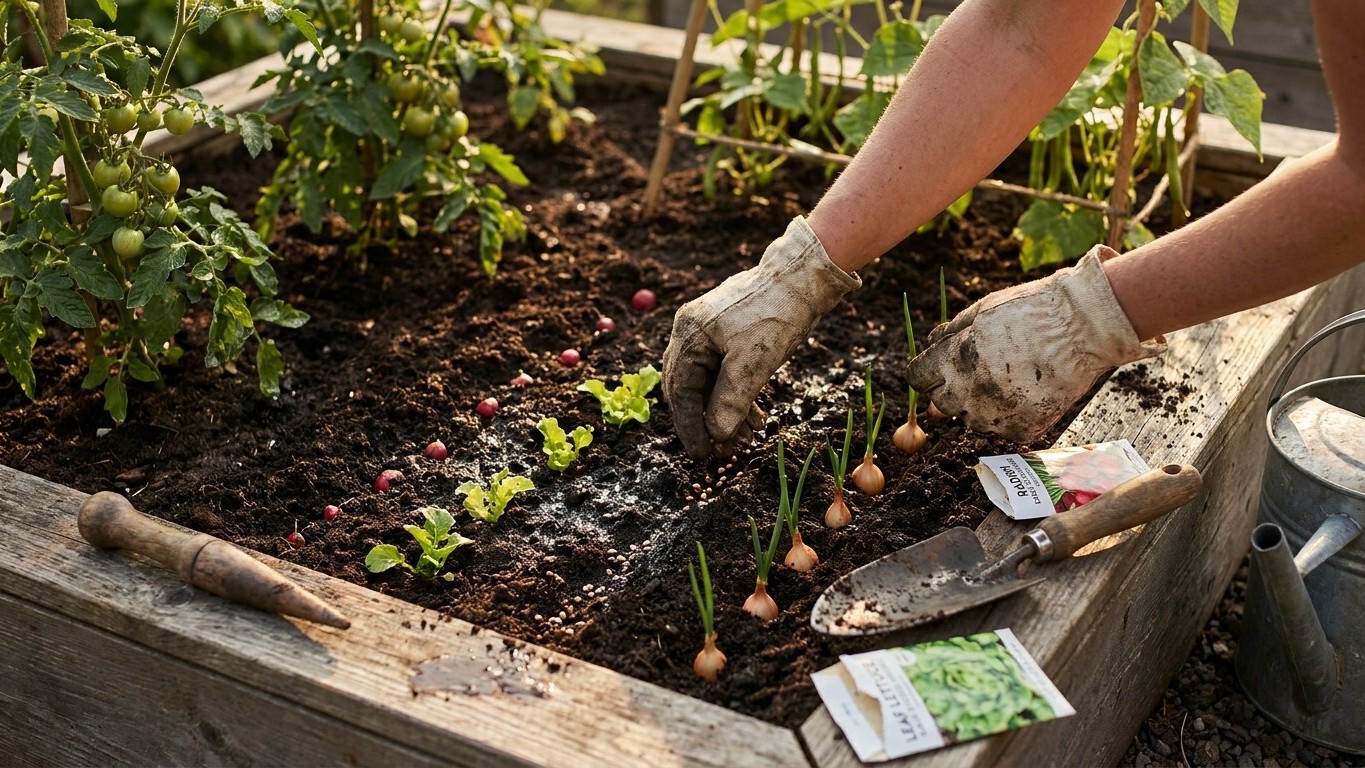
Mid-to-late July narrows things considerably. At that point, stick to fast growers only: radishes (25 to 30 days), leaf lettuce, spinach, arugula, baby salad mixes, and green onions from sets. All of these can be tucked into gaps left by spent peas or early lettuce, and most finish well within the remaining window even accounting for an early frost.
What doesn’t belong on a July planting list: tomatoes, peppers, squash, cucumbers, and other warm-season transplants. Those needed to go in weeks earlier to make full use of the frost-free stretch, and starting them now leaves too little time to produce a real harvest. Garlic is a fall-planted crop in Manitoba, not a July one, hold that job until autumn.
What to start under cover
Counting backward from the September 22 average frost is the only reliable way to decide what’s still worth starting indoors or under row cover in July. If a crop needs 8 to 10 weeks to reach a harvestable size, July gives it almost no cushion once you factor in the possibility of an earlier-than-average frost.
That reality narrows the list. The main candidate is a fall batch of lettuce or spinach started in trays and kept out of direct afternoon sun, since both germinate poorly in hot soil but transplant well once the worst heat breaks in a few weeks. A few gardeners also start a quick round of Asian greens or pak choi under light shade cloth for a September harvest, since these mature fast and tolerate the shortening days ahead.
Starting fall brassica transplants like cabbage or broccoli in early July is a gamble worth naming plainly: these need 60 to 70 days from transplant to harvest, and by the time seedlings are ready to go outside in three to four weeks, there may only be six or seven weeks of growing season left before the average frost. It can work in a mild fall, but it’s tight.
The two failure modes to watch for are opposite problems. Start too early under cover in July heat and seedlings get leggy, stressed, and prone to bolting the moment they hit the garden. Start too late and the math simply doesn’t work, the plant runs out of season before it runs out of growth left to do. When in doubt, favor the fast crop over the slow one.
What is ready to pick
July is when the garden starts paying back the spring work. Garlic scapes are one of the first signals of the month, they curl into a loop once, and that’s the moment to cut them, both for eating and because leaving them on diverts energy away from bulb formation underground.
Shelling and snap peas planted in May are typically plump and ready by early-to-mid July, and they turn starchy fast once left too long, so check pods every couple of days once flowering has finished. Leaf lettuce and spinach sown earlier in the season should be harvested before they send up a flower stalk in the heat, once bolting starts, the leaves turn bitter.
Strawberries wind down through early July while raspberries and other cane fruit pick up, and early potato varieties planted in spring can often be dug as “new potatoes” once the plants flower, well before the full crop matures. Zucchini and other summer squash usually start producing by mid-to-late July, and the rule there is to pick them young and often, since one missed week can turn a manageable zucchini into an oversized, seedy one.
Herbs like dill, cilantro, and basil are at their best cut regularly through July, both to use fresh and to delay the plants from bolting in the heat.
The jobs that matter this month
Watering rhythm matters more in July than almost any other month. Shallow, frequent watering trains roots to stay near the surface where they dry out fast; deep, less frequent watering (aiming for the equivalent of about an inch of water a week, adjusted for rainfall) builds resilience against the hottest stretches. Inconsistent watering is also the main driver of blossom end rot in tomatoes and squash and of split carrots and beets, so evening out the schedule now prevents a problem that shows up on the plate later.
Staking and caging need to happen before plants sprawl, not after. Tomatoes, peas, and vining squash left unsupported into late July become tangled messes that are hard to correct without breaking stems.
Mulching pays off directly in July: a 2 to 3 inch layer around vegetables cuts evaporation, keeps soil temperature more even, and suppresses the weeds that compete hardest for water during a dry stretch.
Succession sowing quick crops like lettuce, radish, and green onions every couple of weeks keeps the harvest window open longer than a single planting date would. Pest scouting matters too: Colorado potato beetle larvae, aphid colonies on brassicas, and cabbage worms all build up fast in warm weather, and catching an infestation in its first week is far easier than dealing with it after it’s spread across a bed.
Finally, this is the month to deadhead bolting herbs and pinch back leggy annual flowers so they keep producing rather than going to seed early.
What not to do in July
The most common mistake is treating July as still-plantable for anything and everything, including crops that needed a spring start. Squeezing in a tomato or pepper transplant in mid-July because a nursery still has stock on the shelf usually means fruit that never ripens before the average September 22 frost arrives.
A second mistake is inconsistent watering under the assumption that Manitoba’s July heat “balances out.” Letting soil dry to the point of wilting and then soaking it heavily doesn’t recover lost growth, it just adds the stress of a sudden intake of water, which is exactly the pattern that cracks tomatoes and splits root vegetables.
High-nitrogen fertilizer applied late in the season on fruiting crops like tomatoes, squash, or beans is another classic misstep. Nitrogen pushes leafy growth at the expense of flowering and fruit set, which is the opposite of what a plant needs heading into the second half of summer with a fixed frost date ahead. A balanced or lower-nitrogen feed suits July better.
Leaving garlic scapes on the plant too long is a smaller but real error, they’re easy to forget, but every extra week they stay attached pulls energy away from the bulb below ground, which is the part most gardeners are actually growing garlic for.
Checking this against your own county
The dates and figures here come from a single Winnipeg-area weather station, and Manitoba is not one climate. Elevation, proximity to lakes, and simple north-south distance can shift both the last spring frost and the first fall frost by weeks in either direction. A garden in the Interlake region or farther north should expect a shorter season than these averages suggest, while sheltered spots near the U.S. border may run slightly longer.
The Canadian plant hardiness zone of 3b cited for the Winnipeg reference area uses a different system than USDA zones used elsewhere on this site, built on seven climate variables rather than one, so it shouldn’t be compared directly. For local nuance, check Manitoba Agriculture directly.
Common questions
Is it too late to plant vegetables in Manitoba in July?
Not entirely. Fast-maturing crops like radishes, lettuce, spinach, beans, and beets planted in the first half of the month can still reach harvest before the average first fall frost on September 22. Slower crops and warm-season transplants like tomatoes or peppers are too late by this point.
Can I still start tomatoes or peppers in July in Manitoba?
Starting tomatoes or peppers from seed in July won’t leave enough time to reach maturity before the average fall frost. These need to be started indoors months earlier and transplanted outside well before summer, so July is too late for a full harvest from either crop.
When should garlic be planted in Manitoba if not in July?
Garlic in Manitoba is a fall-planted crop, typically going into the ground once soil temperatures cool in autumn, well after the July growing window discussed here. July’s garlic-related task is harvesting scapes and monitoring bulbs for the main harvest later in summer, not planting.
Why does the same July calendar not work everywhere in Manitoba?
The frost dates used here come from a single Winnipeg-area station, and conditions vary across the province with elevation, lake proximity, and latitude. Northern and low-lying areas typically see a shorter frost-free season than these averages suggest, which shifts safe planting and harvest windows by one to several weeks.