
British Columbia sits in what The Homestead Post calls a transition zone: near Vancouver, ECCC’s 1981-2010 climate normals show zero days a year at or above 90°F and a coldest-month mean minimum of 0.8 °C, numbers too mild for summer heat to rule out a cool-season lawn and too close to freezing to give a warm-season lawn an easy winter. Neither grass wins outright here, so the choice comes down to which season of ugly you’re willing to live with. See The Best Grass Seed for British Columbia Lawns for a fuller breakdown, but first test your own yard’s drainage and soil pH before buying seed, since a boggy corner or acidic patch will beat either species regardless of what you plant.
Which grass belongs in British Columbia

The numbers behind the zone
Environment and Climate Change Canada’s 1981-2010 climate normals for the Vancouver reference station put the average number of days a year at or above 90°F at 0.0, and the mean daily minimum of the coldest month at 0.8 °C. Those two figures together describe a climate too cool and short-summered to burn out a cool-season lawn, but not cold enough in winter to force a warm-season grass into the kind of hard dormancy that keeps it clean of disease. The Homestead Post reads that combination, measured against the season thresholds published by Clemson Cooperative Extension in HGIC 1214, as a transition zone: a place where no single grass species is the obvious right answer.
A trade-off, not a winner
Clemson’s guide and Penn State Extension between them name the species grown on either side of that line: Tall Fescue, Kentucky Bluegrass and Perennial Ryegrass on the cool-season side, Zoysiagrass and Bermudagrass on the warm-season side. A cool-season lawn planted here stays green through the mild, wet winter and looks its best in spring and fall, but if a genuine hot stretch does arrive it can thin and go patchy until the weather breaks. A warm-season lawn shrugs off that same heat and needs less water to do it, but it goes dormant and turns straw brown as soon as nights cool in fall, and near Vancouver’s mild winters that brown period can run from October into April.
The reference figures above come from Vancouver International Airport, and the province is anything but one climate. The wet coast rarely produces the kind of sustained heat that would push a cool-season lawn into real trouble, while interior valleys away from the coast run hotter and drier through summer, closer to what the British Columbia lawn Calendar describes for those regions the conditions that let warm-season turf hold its own. Check your own microclimate before choosing, not just the region: a south-facing slope with heat bouncing off pavement behaves nothing like a shaded, low-lying yard two streets over. Gardeners further inland, in provinces where a warm-season lawn has no chance of surviving winter at all, face a simpler call than this one, laid out in Manitoba Lawn Care: What to Plant and When to Feed It, and gardeners in climates hot enough to make cool-season grass a non-starter face the mirror image, covered in California Lawn Care: What to Plant and When to Feed It.
When to seed or sod here
Two windows, opposite reasons
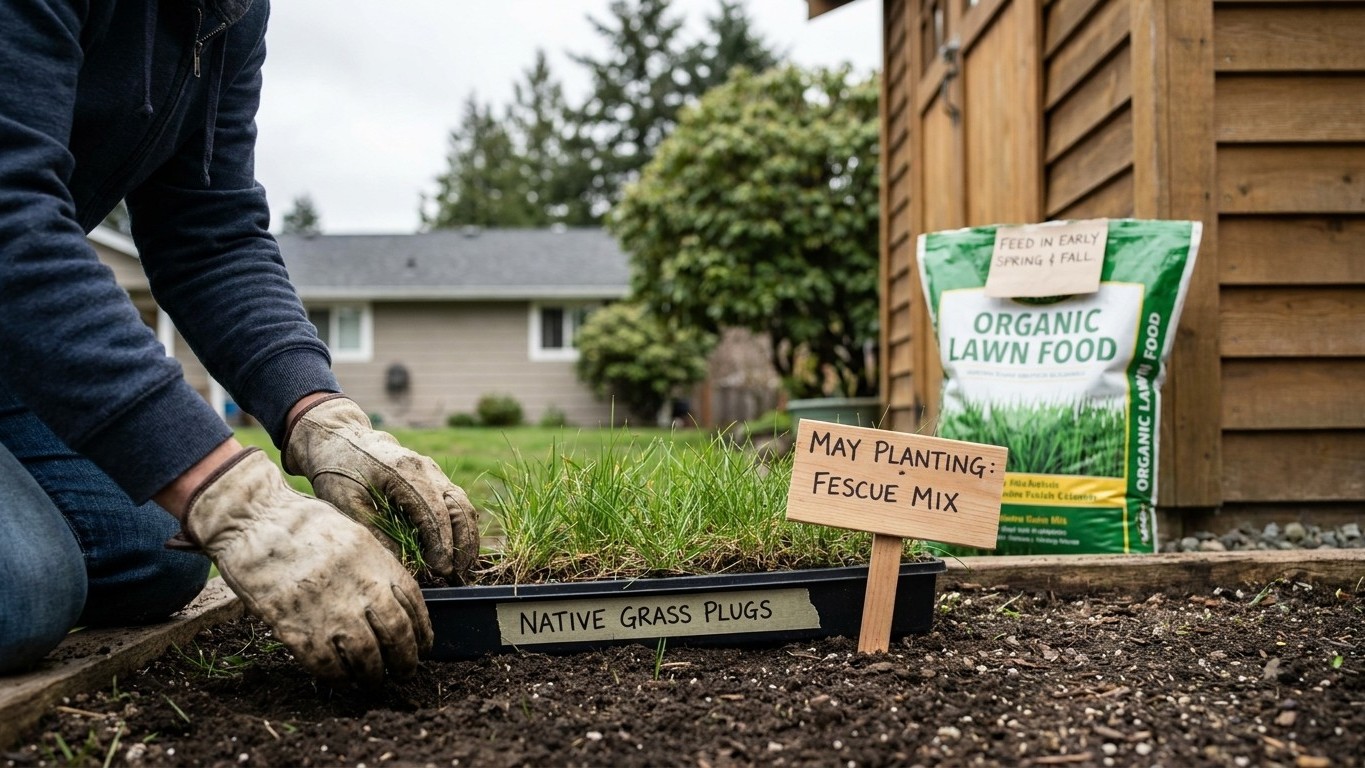
Clemson Cooperative Extension’s HGIC 1203 gives the two planting windows for opposite reasons: warm-season grasses like Zoysiagrass and Bermudagrass go in around May, once soil has warmed enough for their rhizomes to run, and cool-season grasses like Tall Fescue, Kentucky Bluegrass and Perennial Ryegrass go in mid to late September, when the ground is still warm but the worst of summer stress has passed.
For a cool-season lawn near Vancouver, that September window sits comfortably ahead of Environment and Climate Change Canada’s average first fall frost date of November 10, drawn from the 1981-2010 normals at Vancouver International Airport. That leaves close to two months of root growth before the ground turns cold. Treat November 10 as a midpoint, not a deadline: ECCC’s own figures show frost arrives later than that in one year out of two, so a late-September seeding still carries some risk in a mild, wet autumn, and an early-October seeding is not automatically doomed either.
What shifts the window
A warm-season lawn works on the opposite clock. It wants soil that has already warmed, so the May window matters more than any frost date, since by May the last frost of spring near Vancouver is long past. What actually moves either window is elevation and distance from the coast: a yard up in the hills above the city, or well inland in the Fraser Valley, warms later in spring and cools earlier in fall than the airport station the ECCC figures come from. Treat both planting windows as ranges to test against your own soil temperature, not fixed dates on a calendar.
Sod skips the germination risk that comes with seed, since it’s already an established mat of grass, but it still needs the same soil temperature and the same weeks of root establishment before frost or heat arrives. Laying it outside these windows just trades seedling failure for transplant shock.
The feeding calendar that fits this climate
Cool-season feeding
Nitrogen timing follows the grass’s own growing season, not the month on a wall calendar. A cool-season lawn does most of its root growth in fall, so its heaviest feeding falls in September, right as top growth slows and the plant pushes energy underground instead of into new blades. Clemson Cooperative Extension’s HGIC 1219 Tall Fescue Maintenance Calendar lays out the exact monthly rates in pounds of actual nitrogen per 1000 square feet, and because that rate changes month to month, it’s worth checking the figure for the specific month you’re feeding rather than applying one number all season.
Warm-season feeding
A warm-season lawn runs the opposite schedule: it feeds hardest in late spring and early summer, while it’s actively filling in, and tapers off well before dormancy sets in. Clemson’s HGIC 1216 Bermudagrass Maintenance Calendar and HGIC 1217 Zoysiagrass Maintenance Calendar both set their own month-by-month rates in the same units. Feed the calendar that matches the grass you actually planted, not the one that matches the season you’re in: running a warm-season feeding schedule on Tall Fescue pushes growth at exactly the wrong point in its year.
Because British Columbia sits in the transition zone described above, a lawn here might be either species, and the two schedules run in opposite halves of the year. Skip nitrogen altogether during dormancy, whichever grass you have. Feeding a warm-season lawn while it’s brown in winter wastes the fertilizer and can hand nutrients to weeds instead of turf. Feeding a cool-season lawn during a hot, stressed stretch in summer pushes tender new growth right when the plant is least able to support it.
Mowing height and watering here
Mowing height by species
Cut height is set by species, not by region, and it doesn’t change whether the lawn is in Vancouver or the BC interior. The table below gives the typical ranges published alongside the maintenance calendars named above.
| Grass | Season | Typical mowing height |
|---|---|---|
| Tall Fescue | Cool | 2.5 to 3.5 in |
| Kentucky Bluegrass | Cool | 2 to 3 in |
| Perennial Ryegrass | Cool | 1.5 to 2.5 in |
| Zoysiagrass | Warm | 1 to 2 in |
| Bermudagrass | Warm | 1 to 1.5 in |
Whatever the species, the one-third rule matters more than the exact number: never remove more than a third of the blade in a single cut. Scalping a cool-season lawn down toward warm-season height stresses the plant and opens the door to the weeds and disease covered below.
Watering
An inch of water a week, from rain and irrigation combined, is the common baseline for an established lawn of either type. Near the coast, that baseline needs more adjusting than it would inland: a wet spring and fall often mean a cool-season lawn needs little or no supplemental water for months, while a dry summer stretch can still dry out a shallow-rooted lawn fast even without extreme heat, especially if it hasn’t been watered deeply and infrequently to encourage roots to grow down instead of staying near the surface. Sandy, fast-draining soil common in parts of the Fraser Valley needs water more often than the same inch spread over heavier clay, which holds moisture longer but drains poorly if overwatered.
What goes wrong on lawns in British Columbia

Moss and weeds that never stop
The most common early complaint isn’t disease or drought. It’s moss, and BC’s wet, mild, low-light winters are exactly the conditions moss thrives in: acidic, compacted, poorly drained soil under a lawn that isn’t growing fast enough to outcompete it. Moss doesn’t kill grass directly, but it fills in wherever grass has thinned, and once it’s established it spreads faster than most homeowners expect.
Because winters here rarely get cold enough to force weeds into real dormancy, broadleaf weeds like clover and dandelion keep germinating through most of the year instead of stopping hard in December and starting fresh in spring. A lawn that goes into winter thin and weak stays weak through winter, since there’s no deep freeze here to reset weed pressure back to zero the way it does in a colder province.
Brown patch and mistaken dormancy
The combination of mild temperatures and high humidity that shows up through much of the coastal growing season is close to ideal for brown patch on a cool-season lawn, especially Tall Fescue and Perennial Ryegrass that’s been mowed too short or watered late in the day. It shows up as roughly circular patches of dead-looking, tan grass, sometimes with a darker, wet-looking ring at the edge in early morning.
On a warm-season lawn, the failure people report most is mistaking dormancy for death. Zoysiagrass and Bermudagrass both turn a uniform straw brown once nights turn cold in fall, and near Vancouver’s mild coastal climate that brown period can run for months rather than weeks. The grass is very often alive under that brown thatch. Digging up a patch to check for white, firm rhizomes below the crown is a better test than judging by colour alone, and tearing out an entire “dead” lawn in February often means tearing out a lawn that would have greened up on its own by May.
Compacted clay soil, common on lots that were graded during construction, adds a third failure on top of either of these: water pools instead of soaking in, roots stay shallow, and the lawn shows drought stress after only a few dry days even though the ground nearby is still damp. Aerating during the grass’s own active growing season, not in the middle of winter or dormancy, loosens that compaction enough for the roots to actually use the water going down each week.
Local help
For a soil test, a diagnosis of a specific dead patch, or advice tailored to your own municipality rather than the Vancouver airport reference figures used above, contact the British Columbia Ministry of Agriculture and Food. A soil test is the one step worth doing before buying seed or fertilizer, since it settles the pH and nutrient questions that no maintenance calendar can answer from a distance.
Common questions
Can I grow Bermudagrass on Vancouver Island or somewhere else on the coast?
It will likely survive but it will look brown far more of the year than it would somewhere with real summer heat, since coastal BC’s mild winters don’t kill it but its cool, short summers don’t push much growth either. Check with a local nursery about your specific microclimate before committing a whole lawn to it.
Can I mix a cool-season grass and a warm-season grass in the same yard?
You can plant them in separate zones of the same property, but not blended in the same patch. Their feeding and mowing calendars run in opposite halves of the year, so a mixed stand means one grass is always being fed, mowed, or watered on the wrong schedule for the other.
My cool-season lawn is brown in the middle of winter. Is that normal?
Not really, and it’s worth a closer look. Tall Fescue, Kentucky Bluegrass and Perennial Ryegrass don’t go fully dormant in BC’s mild winters the way they would somewhere with hard freezes, so winter browning here is more often a sign of disease, poor drainage, or de-icing salt runoff than normal seasonal dormancy.
Is it too late to seed a cool-season lawn if it’s already October?
Not necessarily. Environment and Climate Change Canada’s average first fall frost near Vancouver is November 10, and that’s a midpoint, meaning frost lands later than that in about half of all years. An early October seeding still has a reasonable shot, though it carries more risk than one done in the mid to late September window.
How soon can I mow after seeding?
Wait until the new grass has reached about a third taller than your normal mowing height for that species, then cut it back down by no more than a third in that first pass. Mowing too early, before the seedlings have rooted well, can pull whole plants out of loose soil.