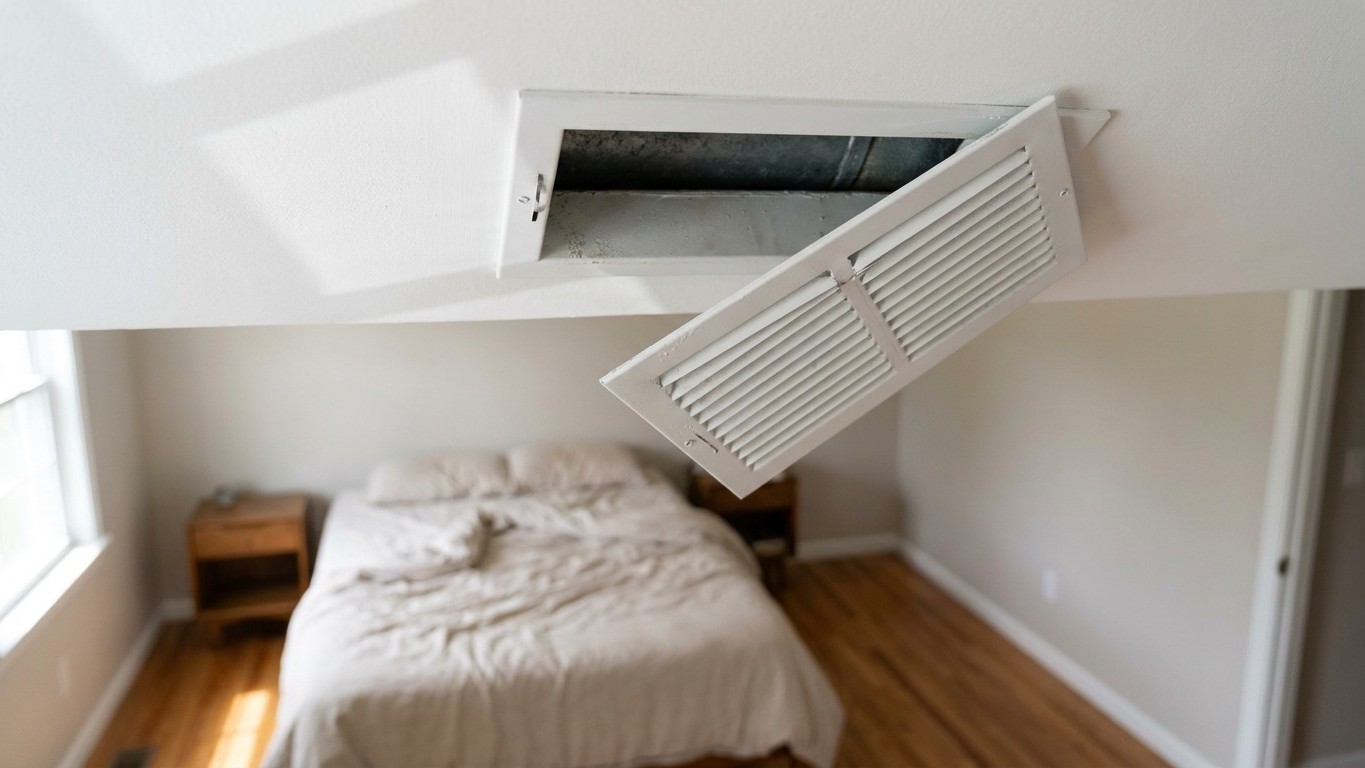

Closing a vent to save money is one of those ideas that sounds airtight until you follow the air itself. In a forced-air duct system, the fan does not adjust to a closed register. It keeps pushing the same volume of air, and that air has to go somewhere. Usually the answer is no, closing vents does not save money, and in a fair number of homes it quietly costs more. This applies to homes heated and cooled through ductwork; radiators, hot water baseboard, and ductless mini-split heads don’t have this problem because they don’t have ducts to pressurize.
The short answer, and why it is counter-intuitive

The logic behind closing a vent feels sound. A guest room sits empty most of the year. Why heat or cool air that nobody breathes? If the room stays cold, the furnace should run less, and the bill should follow. That reasoning works fine for a room with its own Thermostat and its own heating unit. It falls apart the moment the room shares a duct system with the rest of the house.
A forced-air system is built around one blower moving one volume of air through one network of ducts. The blower is sized to push a certain amount of air per minute, and it does not know or care which registers are open. Close two or three, and the blower still tries to move the same volume of air. That air now has fewer exits, so it backs up. Pressure inside the supply ducts climbs, and the whole system starts working against itself rather than for the house.
Think of it less like turning down a faucet and more like putting a thumb over part of a garden hose while the pump keeps running at full speed. The water doesn’t slow down politely. It finds the path of least resistance, and in a duct system that path is rarely the one you’d choose. This is the part homeowners miss: the equipment reacts to physics, not to intentions. Closing a register is an instruction the blower literally cannot receive.
None of this means airflow is fixed forever or that every closed vent is a disaster. A single register nudged partly shut in a small room, on a system with plenty of return capacity, behaves very differently from four or five registers closed across half the house. The difference is degree, and it’s exactly what the next two sections walk through.
What rising pressure does
Extra pressure in a duct system has to release somewhere, and ducts are rarely as sealed as people assume. According to ENERGY STAR, “In a typical house, however, about 20 to 30 percent of the air that moves through the duct system is lost due to leaks, holes, and poorly connected ducts.” That’s air already leaving the system before it reaches a single room, through gaps at joints, seams that were never sealed properly, and connections that loosened years ago.
Raise the pressure inside that same leaky duct system, and the leaks don’t stay the same size in effect. Higher pressure pushes more air through those existing gaps, faster than before. Air that was already escaping into an attic, a crawl space, or the space between floors now escapes at a higher rate. The house pays for conditioned air that never makes it to a living space, and closing vents to “save” energy can directly increase that loss.
The second consequence: not enough air moving where it needs to
Pressure isn’t the only problem. Closing registers also reduces the total volume of air moving across the equipment itself, and that equipment depends on a minimum airflow to work correctly. ENERGY STAR notes that “Airflow problems can reduce your system’s efficiency by up to 15 percent.” That’s a system running harder to deliver less, and it shows up differently depending on the season.
In winter, a furnace pulls heat from burning fuel or electric resistance and hands it to the air passing over the heat exchanger. Starve that airflow and the exchanger gets hotter than it’s designed to run, which can trip a high-limit safety switch and shut the furnace down mid-cycle. In summer, the story runs the other way. The evaporator coil needs a steady stream of warm house air passing over it to keep from getting too cold. Reduce that airflow and moisture on the coil can freeze into a layer of ice, which then blocks even more airflow and can leave the system limping along or shutting off entirely on a hot afternoon.
Either way, the system is being asked to do its job with one hand tied. The energy that would have gone toward comfortable conditioned air instead goes toward strain, leak losses, and equipment that cycles more often than it should.
And the room does not stay out of it
Here is the part that surprises most people: closing a vent does not turn that room into its own isolated zone. A bedroom or guest room shares a ceiling with the room above it, walls with the rooms beside it, and often a floor with a room below. Heat moves through all of those surfaces continuously, following temperature difference, not floor plans.
Once that closed room drops below the temperature of the rooms around it, it starts pulling heat from them. The room next door, the one still getting full airflow, now has to work a little harder to hold its own temperature because it’s losing warmth through the shared wall to the colder room beside it. The “savings” from the closed vent are partly just heat moving sideways instead of being generated in the first place.
In cold climates this can go further than comfort. A closed room that drops well below the temperature of the rest of the house can get cold enough for condensation to form on interior surfaces, particularly where a wall meets an exterior corner or a window. If that room contains a section of plumbing running through an exterior wall, an unusually cold closed room raises the odds of that pipe getting cold enough to be at risk, especially during a stretch of extreme outdoor temperatures. None of this is guaranteed in every house, but it’s a real and fairly common outcome, not a rare edge case.
What to do instead
None of this means every closed register is a mistake, or that a duct system has to run wide open in every room all winter. It means the adjustment needs to happen in a place designed to handle it, not at the register in a spare bedroom.
- Balance airflow at the trunk dampers, not at the room registers. Most duct systems have adjustable dampers on the main trunk lines, usually near the furnace or air handler, built specifically to redirect airflow between branches without starving the whole system the way a closed register does.
- Close a room partially rather than fully. Leaving a register open even a quarter of the way lets some air through, keeps pressure from spiking as sharply, and still reduces how much conditioned air lands in a room that doesn’t need much.
- Use the door, not the duct. Closing a door and leaving the vent open lets the room run a little warmer or cooler than the rest of the house without choking the duct system that serves it and every other room.
- Consider zoning or a separate unit for a room that genuinely needs different treatment. A converted garage, a sunroom, or a home office with unusual heat gain is a legitimate case for a zoning damper system with its own Thermostat, or for a small ductless unit dedicated to that one space, rather than fighting the main system room by room.
There is an honest exception worth naming. A system with generous return-air capacity, professionally balanced ductwork, and one or two registers closed in rarely used rooms is a different situation from a house where half the rooms are shut down to save on a bill. The line falls somewhere around how much of the system’s total airflow gets blocked, not a fixed number of rooms. A duct contractor doing a load and airflow check can tell you where that line sits in a specific house. Guessing at it room by room, without that check, is how good intentions turn into a stressed furnace or an iced-up coil.
Common questions
Does closing one vent really make a measurable difference?
One register closed on a system with strong return airflow rarely causes a noticeable problem. The risk grows with each additional register closed, because the reduction in total airflow adds up across the whole duct system rather than staying isolated to one room.
Is it different for a two-story house with separate zones?
A house with true zoning, meaning separate thermostats and dampers Controlled independently for different zones, is built to redirect airflow safely between areas. A single-zone system with all rooms sharing one Thermostat and one blower does not have that flexibility, which is exactly why closing registers there causes the pressure and airflow problems described above.
Should I close vents in rooms with a window air conditioner instead?
If a room already has an independent cooling source and doesn’t need the central system’s airflow at all, that’s closer to true zoning than to the guest-room scenario. It still helps to leave the central register partly open rather than fully sealed, to avoid pressure buildup elsewhere in the ducts.
Can a professional check whether my system can handle closed vents safely?
Yes. A duct contractor can measure static pressure and total airflow across the system, which tells you directly whether the return capacity and duct sizing can absorb a few closed registers without strain. That measurement replaces guesswork with an actual number specific to the house.