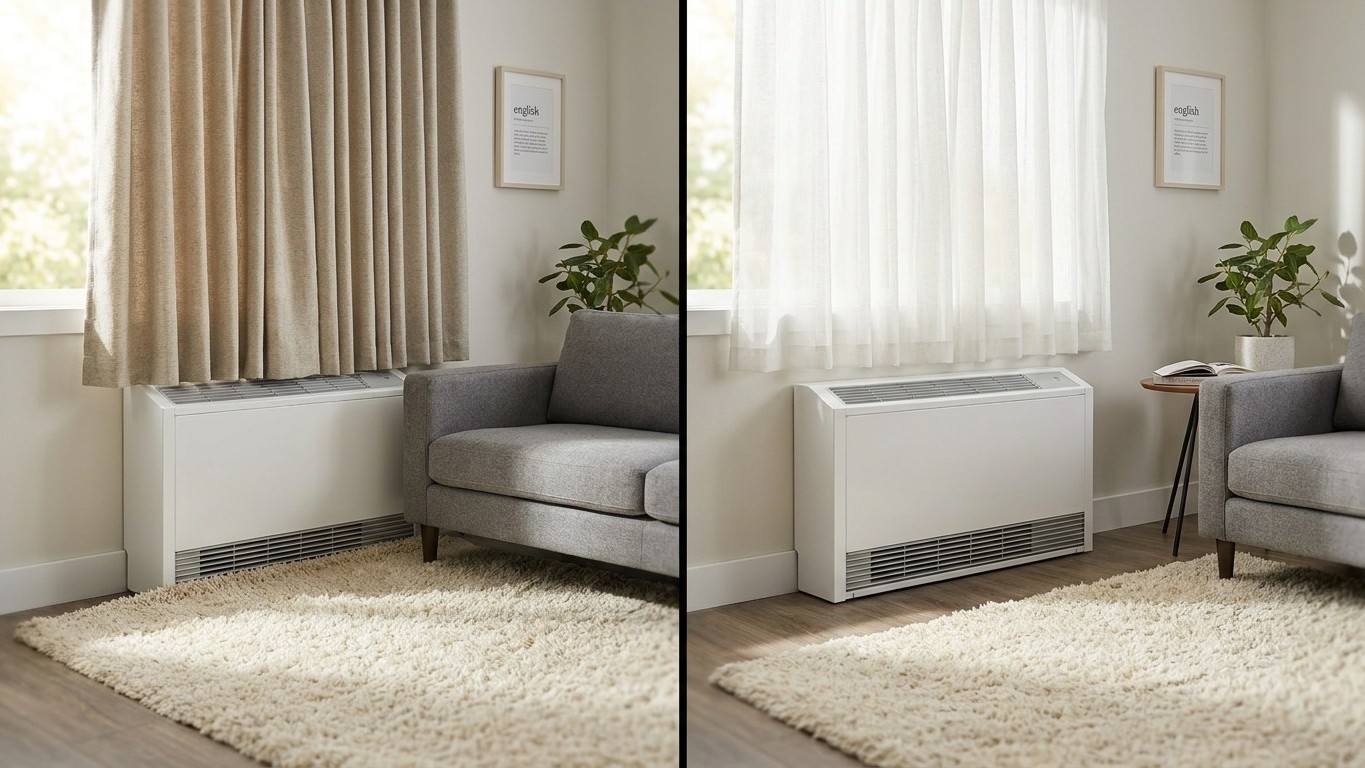

Nothing should sit close enough to a Baseboard Heater to block the air moving in at the bottom or out at the top. That rules out sofas and beds pushed flush against the wall, curtains that hang past the sill, rugs that creep over the lower vent, and shelving built above the unit. Furniture with open legs, placed further down the same wall, can sometimes work. The actual clearance number belongs on the heater’s own label, not on this page, because electric and hydronic units are built and rated differently.
How the appliance breathes
A baseboard heater doesn’t blow air the way a furnace vent does. It works by convection: room air at floor level is cooler and denser, so it slides in through the louvered opening along the bottom of the unit. Inside, it passes across the heated fins, whether those fins are warmed by an electric resistance element or by hot water running through a copper tube, and it expands as it warms. Warm air is lighter, so it rises and exits through the slot at the top, then drifts out into the room. Cold air in, hot air out, on a loop that never stops as long as the heater is calling for heat.
Why both openings matter equally
People tend to assume the top opening, the one that actually releases visible warmth, is the one that matters. The bottom opening does just as much work. Starve the intake and there is no air left to heat, no matter how hot the element or the water running through it gets. Cap the outlet and the heated air has nowhere to go, so it backs up inside the enclosure instead of reaching the room.
This is why blocking either opening causes two problems at the same time, not one. First, the room stops getting the heat it’s supposed to get, because the convection loop has been interrupted. Second, the heat that would have entered the room instead stays concentrated right at the point of the blockage, against fabric, against upholstery, against whatever wood or plastic happens to be sitting there. That second effect is the one that turns a comfort question into a fire safety question, and it’s the reason clearance around a baseboard heater isn’t a matter of taste or floor plan convenience. The appliance was designed to breathe from both ends, and anything placed in the way changes what it does with the heat it makes.
The distance this page will not invent
There’s no single clearance figure that applies to every baseboard heater, and this page won’t manufacture one just to give a tidy answer. The number that matters is printed on the appliance itself and repeated in its installation manual, and it exists because the manufacturer tested that specific unit for that specific purpose. A figure pulled from a different brand, a different length, or a different fuel source isn’t a safe substitute, even if it sounds reasonable.
Part of the reason there’s no universal number is that “baseboard heater” actually covers two different appliances that happen to share a name and a shape. An electric baseboard heater is a resistance element sealed inside a metal enclosure, wired directly into the home’s electrical system at line voltage and Controlled by a Thermostat rated for that voltage. A hydronic baseboard is something else entirely: a finned copper tube that acts as an emitter for a boiler loop, carrying hot water rather than carrying current. Their heat output, their recovery time, and the way they respond to being blocked are not the same, so their listed clearances aren’t either.
There’s a third wrinkle worth knowing about. Some units sold and marketed as “hydronic” baseboards are actually electric heaters filled with a fluid that helps distribute heat evenly along the enclosure. There’s no boiler, no water loop, and no plumbing involved. It’s an electric appliance wearing a hydronic-sounding name, and it should be treated with the same respect for its electrical rating as any other electric unit.
Finding the real clearance distance usually means looking at the unit itself. Most manufacturers print it on a label fixed inside the front cover, near one end, along with wiring or piping information. If that label has worn off or was removed at some point, the model number is often still visible, and the original installation manual can usually be tracked down from that. Guessing at a number here isn’t a shortcut, it’s a gap in judgment that the appliance itself was built to close.
What people put there
Most of the trouble with baseboard heaters isn’t dramatic. It’s ordinary furniture, arranged the way most rooms get arranged, without much thought for a strip of metal running along the floor. The table below covers what typically ends up too close, which opening it interferes with, and what that actually does to the heater’s performance and to the object itself.
| What’s placed there | Opening affected | What happens |
|---|---|---|
| Long curtains hanging past the windowsill | Top outlet | Warm air is trapped behind the fabric instead of reaching the room, and the fabric itself sits directly in the path of concentrated heat. |
| A sofa or bed pushed flush against the wall | Both openings | Airflow is cut off at both ends, the room heats unevenly, and upholstery or bedding rests against a heat source designed to run for hours at a time. |
| A rug that laps over the bottom louvers | Bottom intake | Cool air can’t get drawn in, so the convection cycle slows, and the edge of the rug sits in a spot that stays warmer than the rest of the floor. |
| A shelf or radiator cover built over the unit | Top outlet | Heat collects under the shelf instead of dispersing into the room, and anything stored on that shelf sits in a pocket of trapped warm air. |
| Boxes or storage pushed into the gap behind furniture | Both openings | The heater is boxed in on more than one side, often out of sight, which makes it easy to forget it’s running at all. |
None of this happens because people are careless. It happens because a baseboard heater looks like a piece of trim, not an appliance, and rooms get furnished around trim without a second thought. Recognizing a room in that list is usually the first step toward rearranging it.
Arranging a room that has one along a wall
The constraint here is real, and it deserves some sympathy rather than a lecture. Baseboard heaters run along the exact walls where a bed headboard, a sofa back, or a bookshelf would naturally go, because that’s often the only long, uninterrupted wall in the room. Working around that takes a little more planning than working around a standard outlet, but it’s rarely impossible.
- Keep the heater’s wall clear first, then plan the rest of the room around it. Treat the wall with the baseboard heater as fixed and unavailable for large furniture, the same way you’d treat a wall with a fireplace or a door swing.
- Shorten curtains instead of tucking them behind the unit. Curtains that stop above the heater’s top opening solve the airflow problem completely, while curtains pushed or tucked out of the way tend to drift back down within a week.
- Choose furniture with open legs when it has to go nearby. A chair, table, or console with visible clearance beneath it lets air continue moving underneath, unlike a piece with a solid base or a skirt that reaches the floor.
- Recognize when the honest answer is relocating the heater, not the furniture. In small bedrooms and cramped additions, no amount of rearranging solves the problem if the only usable wall is the one the heater sits on. At that point, moving the unit is the more durable fix, and it’s covered in detail in this site’s guide to relocating a baseboard heater.
None of these steps require guessing at a clearance distance. They just require treating the heater as a fixed, breathing appliance rather than as a strip of baseboard trim that furniture can be pushed up against.
Common questions
Can I put a couch in front of a baseboard heater?
Not directly against it. A couch pushed flush against the wall blocks both the intake and outlet openings, which slows the heater’s performance and holds heat against the upholstery. Check the clearance printed on the unit’s own label before deciding how far away is far enough.
How far should curtains hang above a baseboard heater?
There’s no universal figure that applies to every model, since electric and hydronic units are rated differently. Curtains should stop well above the top opening, with the exact distance determined by the label on that specific heater rather than a general rule.
Is it safe to store boxes or bins near a baseboard heater?
Storage pushed into the gap behind furniture or directly against the unit blocks airflow on more than one side and is often out of sight, which makes it easy to forget the heater is still running. That combination is worth avoiding regardless of what’s inside the boxes.
Does blocking a baseboard heater waste energy?
Blocking either opening interrupts the convection cycle the appliance relies on, so heat doesn’t reach the room the way it’s meant to. The heat doesn’t disappear, though, it collects near the obstruction instead, which is a performance problem and a safety one at the same time.