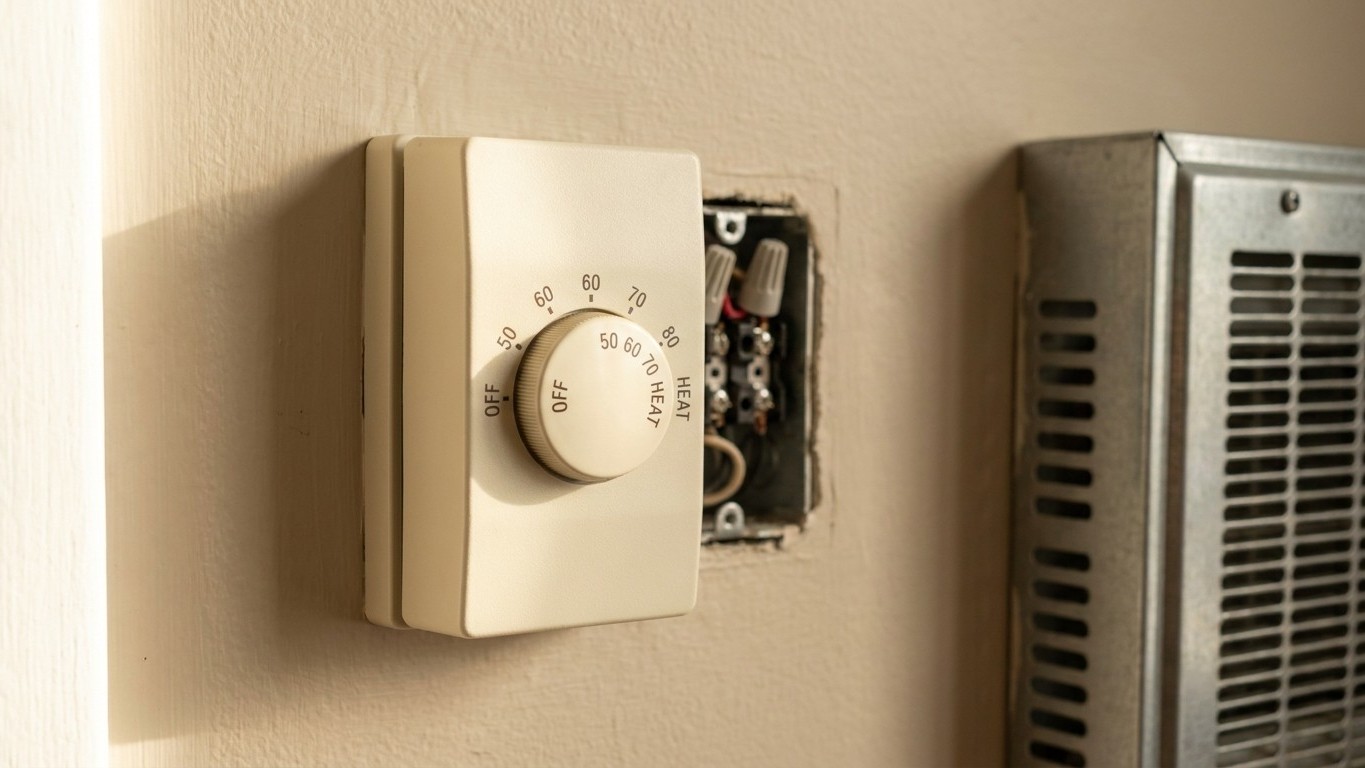

A line-voltage Thermostat carries the full electrical current of the heater it controls, because on an electric baseboard there is no furnace or boiler standing between the switch and the heat. This only applies to electric baseboard. A hydronic baseboard, the kind fed by hot water from a boiler, is switched by an ordinary low-voltage thermostat that talks to the boiler and a circulator, not by anything rated for line voltage. Know which one is on your wall before reading further.
Why the usual thermostat does not fit
Most thermostats sold at hardware stores are low-voltage devices. They close a small circuit that tells a furnace, a boiler, or a heat pump to fire up somewhere else in the house. The thermostat itself never carries the current that heats anything. It is a messenger, not a switch for the load.
An electric baseboard heater has no messenger to send. The resistance element inside the metal enclosure needs 120 or 240 volts delivered directly to it, and something has to make and break that circuit. That something is the thermostat. A line-voltage thermostat is wired in series with the heater itself, so the same current that heats the room passes through the thermostat’s switch. Try to wire a low-voltage stat into that circuit and nothing happens safely: the device isn’t built to switch that current, and the control wiring it expects (a few low-voltage wires to a furnace board) doesn’t exist on a baseboard circuit at all.
This is also where the naming gets confusing. Some electric baseboard heaters are filled with a heat-transfer fluid and marketed with the word “hydronic” because the fluid moves heat along the length of the unit the way water does in a real hydronic system. It is still an electric resistance appliance, wired at line voltage, and it still needs a line-voltage thermostat. The fluid inside changes nothing about the wiring. If the nameplate lists a voltage and a wattage rather than a boiler connection, treat it as electric, full stop.
A true hydronic baseboard, running hot water through finned copper tube from a boiler loop, is a different appliance entirely. It’s typically controlled by a standard low-voltage thermostat that operates a circulator pump or a zone valve, and repairs on that system involve boiler and plumbing skills rather than electrical ones. The two systems share a shape and a name and almost nothing else. Anyone shopping for a “baseboard heater thermostat” needs to settle which appliance they actually have before comparing products, because the shelf of options for each one doesn’t overlap.
On the heater, or on the wall
Electric baseboard heaters are controlled one of two ways: a thermostat built into the end of the unit itself, usually a small dial, or a separate line-voltage thermostat mounted on the wall at a normal switch height. Both are electrically the same kind of device. They differ in where they sense temperature and how they get wired.
The built-in unit thermostat is cheap to manufacture and requires no separate wall box or extra wiring run, which is why it shows up on lower-cost heaters and in rental units where a contractor wants the fastest install. Its sensor sits inches from a hot metal enclosure, low to the floor, in the exact spot where the air is least representative of the room as a whole. That’s the root of the common complaint: the heater reads warm air rising off its own case and shuts off before the rest of the room catches up, or it reads a cold draft along the floor and keeps running well past the point where the room feels comfortable.
A wall-mounted line-voltage Thermostat Reads the air where people actually sit and stand, generally 48 to 60 inches up, away from the direct heat plume of the unit. It requires its own electrical box and a wire run back to the heater or breaker, so it costs more to install, particularly if there’s no existing wall box to reuse. In exchange, it tracks room temperature the way a homeowner expects a thermostat to behave.
Comparing the two arrangements
| Feature | Built-in unit thermostat | Wall-mounted line-voltage thermostat |
|---|---|---|
| Location | End of the heater, near floor level | Wall box, standard switch height |
| What it senses | Air near the hot enclosure and the floor | General room air |
| Installation | No extra wiring; built in at the factory | Requires a wall box and a wire run |
| Common complaint | Overshoots or undershoots room comfort | Tracks room temperature more consistently |
Swapping a built-in dial for a wall unit is one of the more common upgrades homeowners make on electric baseboard systems, precisely because the location of the sensor, not the quality of the thermostat, is usually what’s driving the discomfort.
Scheduling Electric Baseboard Heat
The U.S. Department of Energy states plainly: “You can save as much as 10% a year on heating and cooling by simply turning your thermostat back 7-10 F for 8 hours a day from its normal setting.” That figure applies broadly, across heating and cooling, for a specific setback (7 to 10 F, held 8 hours a day). It isn’t a per-degree number, and it isn’t specific to electric resistance heat.
What is specific to electric baseboard heat is how the setback behaves once the thermostat calls for warmth again. A boiler-based system has to heat water and push it through the loop before the room feels any difference, and a heat pump often has to run a compressor cycle, sometimes backed up by auxiliary resistance heat, before it catches up to the new setting. Both introduce lag between the thermostat’s call and the room’s actual temperature.
An electric baseboard has neither of those steps. The resistance element inside the heater reaches temperature almost immediately once current flows, and there’s no separate backup stage waiting in reserve. The heater simply runs at full output until the thermostat is satisfied, then stops. That directness is why a scheduled setback on electric baseboard heat tends to produce a more predictable recovery than on systems with more mass or more stages between the thermostat and the heat itself. It doesn’t change the percentage the Department of Energy cites; it just means the mechanism behind that percentage plays out with less delay on this type of system than on most others.
Replacing one
Swapping a line-voltage thermostat on an electric baseboard is a job many homeowners can prepare for and hand off with confidence, but the load-matching step is not a DIY guess. Here is the order that keeps the process safe and organized:
- Cut power at the breaker serving the heater circuit, then confirm with a non-contact voltage tester (or a multimeter at the wires) that the circuit is actually dead before touching anything.
- Note exactly how the existing thermostat is wired, including how many wires land on it and where they run, before disconnecting anything. A phone photo of the terminals is worth more than memory.
- Check whether the heater itself is rated for 120 or 240 volts, and whether the existing thermostat is single-pole or double-pole. This determines what kind of replacement will physically work in that circuit.
- Match the replacement thermostat to the load the heater actually draws. This is the whole question on any line-voltage swap, and it isn’t something to eyeball from the old unit’s label or a general rule of thumb. An electrician can confirm the load and specify a thermostat rated to handle it safely.
Everything else about physically mounting a thermostat, wiring in a wall box, and setting a schedule once it’s installed follows the same general steps common to any thermostat replacement covered elsewhere on this site. The part unique to baseboard heat is the load-matching step above, and that’s the one to get an electrician’s confirmation on rather than assume.
Common questions
Can I put a smart thermostat on an electric baseboard heater?
Only a smart thermostat specifically built to switch line voltage will work. A standard smart thermostat designed for a furnace or heat pump uses low-voltage control wiring and cannot be wired into a baseboard circuit at all.
Why does my baseboard heater run constantly without warming the room?
If the thermostat is the built-in dial at the end of the unit, it’s likely reading a cold draft along the floor rather than the room’s actual air temperature. A wall-mounted thermostat placed at a normal height often resolves this.
Is a thermostat labeled “hydronic” on an electric heater the same as a boiler-fed baseboard?
No. A fluid-filled electric baseboard is still an electric resistance appliance wired at line voltage, and it needs a line-voltage thermostat. A true hydronic baseboard runs on hot water from a boiler and uses a standard low-voltage thermostat instead.
Does a programmable line-voltage thermostat save more on electric baseboard heat than on a furnace?
The Department of Energy’s savings estimate isn’t specific to electric baseboard heat. What differs is how quickly the room responds once the setback ends, since resistance heat has no mass to warm up and no backup stage to wait on.