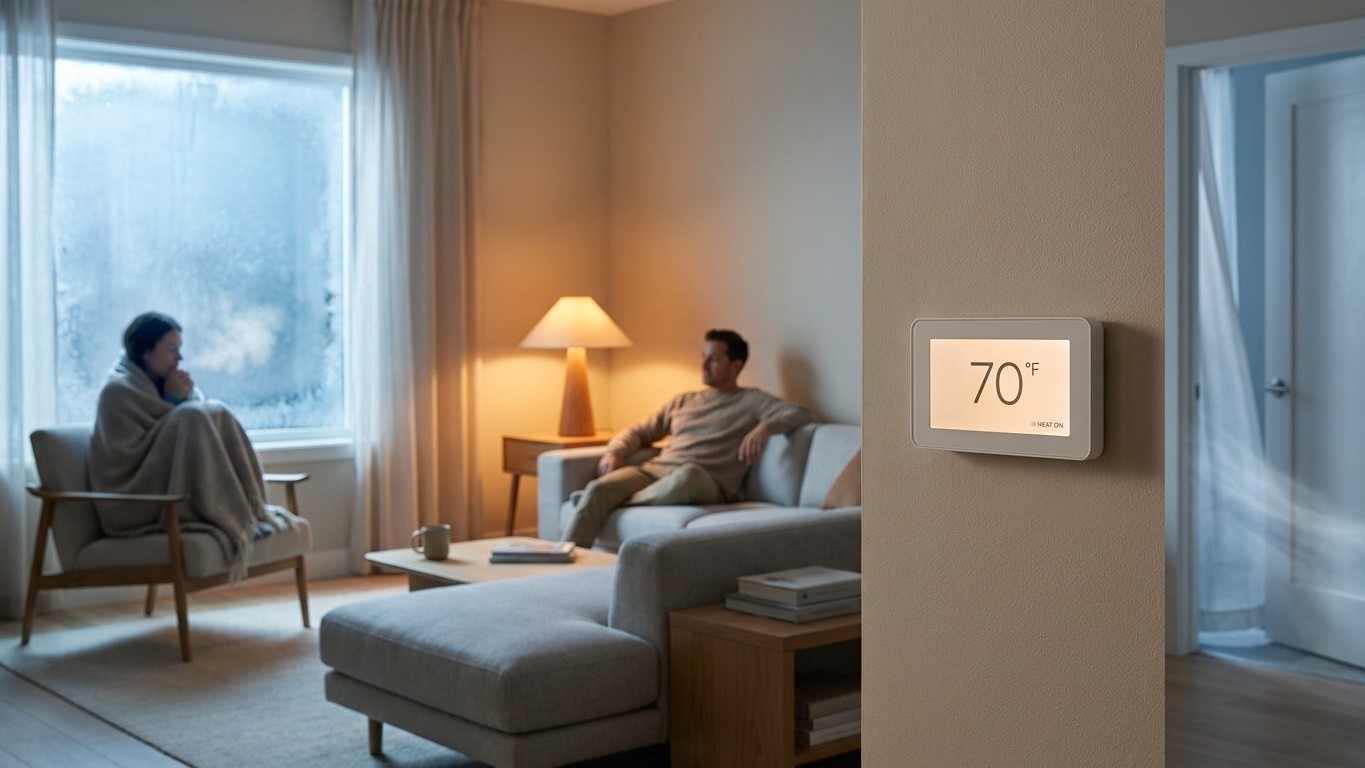

Nine times out of ten, the thermostat is telling the truth. It just isn’t telling the truth about the room you’re sitting in. The number on the display reflects the air right at that spot on the wall, not the air six feet away by the couch or the drafty window seat where the actual complaint lives. The fix isn’t a new thermostat. It’s understanding what that little sensor can and can’t see.
It is probably measuring correctly
Here’s the part that trips people up: “it says 70 and I’m freezing” isn’t usually a malfunction. It’s a measurement problem, and the measurement is working exactly as designed. A thermostat samples the air within a few inches of its own sensor. That’s it. It doesn’t know about the couch by the window, the reading chair in the corner, or the stretch of hallway that never gets warm air circulation.
Air temperature at chest height, in the middle of an interior wall, is a very specific data point. It is not the same as the air temperature at ankle height near a exterior door, or the air brushing past a single-pane window at 9pm in January. Rooms are not uniform temperature zones. A well-mixed room might vary two or three degrees from floor to ceiling and wall to wall on an ordinary day; a room with a big window or a chronically drafty door can vary far more than that.
This is why two people standing ten feet apart in the same house will disagree about whether it’s cold, and both be right. One person is closer to a cold surface. The thermostat, meanwhile, is reporting on neither of them. It’s reporting on itself.
None of this means the thermostat is useless. It means the number it produces is a proxy for comfort, not a direct measurement of it. The gap between “what the thermostat reads” and “what a person feels” is the single most common thermostat complaint, and it’s the one people are least likely to think of as a placement issue rather than a broken device. Before assuming a sensor has failed or drifted, it’s worth asking a more basic question: is the room the thermostat is in actually representative of the room the person is complaining about?
Often it isn’t. A thermostat mounted in a central hallway will read differently than the primary bedroom down the hall, especially if that bedroom has an exterior wall, extra windows, or a door that’s kept closed most of the day, cutting it off from the air the thermostat samples.
The five things that fool it
Once the placement question has been asked and answered, real interference is worth ruling out. A handful of specific conditions push the reading away from the actual room temperature, and each one pushes it in a predictable direction.
| What’s happening | Direction of error | Why |
|---|---|---|
| Direct sunlight hitting the unit | Reads too warm | The sensor heats up faster than the surrounding air, so it reports a temperature higher than the room actually is. |
| A draft from a nearby door or stairwell | Reads too cold | Cold air pooling or moving past the sensor gives a lower reading than the average room temperature. |
| A lamp, TV, or other heat source below or near it | Reads too warm | Rising heat from electronics or bulbs warms the immediate air around the sensor. |
| A supply vent blowing directly at the unit | Reads whatever the vent is delivering | The sensor measures conditioned air straight from the duct instead of the room’s ambient air. |
| Warm air rising through an unsealed wall cavity behind it | Reads too warm | A gap in the wall plate lets air from inside the wall, often warmer, drift past the sensor from behind. |
The first four are the usual suspects, and most homeowners eventually notice at least one of them if they think about where the thermostat actually sits. A thermostat on a wall that catches afternoon sun through a nearby window will consistently read a few degrees warmer in the late afternoon and then cool off after sunset, which can look like a fault when it’s really just light.
The fifth one gets overlooked constantly, and it deserves its own sentence: many thermostats are mounted over a hole cut for low-voltage wiring, and if that hole isn’t sealed, warm air from inside the wall cavity, often pulled from a warmer part of the house or from around ductwork, drifts out behind the faceplate and skews the reading upward. It’s invisible, it’s inside the wall, and it’s one of the few causes on this list that isn’t obvious just by looking at the room.
Warm air, cold walls
Sometimes the thermostat reading is accurate, the placement is fine, and the room still feels cold. That’s not a contradiction. It’s a different mechanism entirely, and it has nothing to do with the thermostat’s sensor.
A body loses heat to cold surfaces nearby regardless of what the air temperature happens to be. This is radiant heat loss, and it’s why sitting near a single-pane window or an uninsulated exterior wall can feel chilly even when the air reading says 70. The skin and the cold glass or wall are exchanging heat directly, and the air in between doesn’t get a vote. Air can be perfectly warm and comfortable ten feet from that wall while the spot right next to it still feels cool.
This explains a frustration a lot of people run into without ever naming it: raising the setpoint doesn’t seem to help. The furnace runs longer, the air genuinely gets warmer, and the room still feels off. That’s because the air temperature climbed, but the surface temperature of that cold window or wall barely moved. The body is responding to both signals at once, air and radiant, and no amount of extra warm air fixes a cold surface sitting a few feet away.
It’s worth being clear about what this is and isn’t. It isn’t a case for tearing out walls or replacing windows on the spot; it’s simply the explanation for why a “correct” thermostat reading and an “uncomfortable” room aren’t mutually exclusive. Older homes, homes with large single-pane windows, and rooms with an exterior corner (two outside walls meeting) are the most likely places to notice this effect, because they have the most cold surface area relative to room size. Recognizing the mechanism at least answers the mystery: the thermostat isn’t lying, and the furnace isn’t failing. The two feelings, air temperature and surface temperature, are just measuring different things, and only one of them shows up on the display.
Checking it, and moving it
With placement and interference ruled out as possibilities, the next step is to actually test the thermostat rather than guess.
- Set an independent thermometer, a basic indoor/outdoor unit works fine, right beside the thermostat, at the same height, and leave it there for about an hour undisturbed.
- Compare the two readings. A difference of a degree or so is normal sensor variance. A gap of three or more degrees, held consistently, points to a real calibration issue rather than noise.
- Check whether the thermostat has a built-in offset or calibration setting, most modern models do, buried in an installer or advanced menu. This lets the displayed temperature be nudged to match the independent thermometer without touching any wiring.
- If the offset doesn’t solve it, or if the room the thermostat is in simply isn’t representative of where people actually spend time, consider whether the unit is in the wrong location altogether.
That last option is where a lot of people stall out, and reasonably so. Moving a thermostat isn’t just unscrewing it and sticking it somewhere else. It means fishing low-voltage cable through the wall to a new location, patching the old hole, and confirming the new spot doesn’t have its own version of the same problems (sun, drafts, vents) that caused the move in the first place. That’s wall work, not a settings change, and it’s exactly the point where a lot of homeowners reasonably decide to call in an electrician or HVAC technician rather than open up drywall themselves.
If any part of this troubleshooting involves opening the thermostat’s faceplate or touching its wiring at all, even briefly, cut power at the breaker first. And before disconnecting anything, take a photo of the wire terminals exactly as they sit. It costs nothing, takes ten seconds, and saves real guesswork if the wires need to go back exactly where they came from.
Common questions
Can a thermostat just wear out and start reading wrong on its own?
Sensors do drift slightly with age, but a sudden or large jump in error is more often caused by something external, sunlight, a draft, a nearby heat source, than by the sensor itself failing outright.
Does a smart thermostat fix this problem automatically?
Not on its own. A smart thermostat still relies on its built-in sensor unless it’s paired with a remote room sensor placed elsewhere in the home; the smarts are in the scheduling and control, not in seeing around corners.
Why does one room always feel colder even when the thermostat reads normal?
That’s almost always radiant heat loss to a cold surface nearby, a window, an exterior wall, a corner with two outside walls, rather than a difference in air temperature that the thermostat could ever detect.
Is it safe to just move the thermostat myself to a better wall?
The thermostat side is simple, but relocating it means running low-voltage wire through the wall and patching the old hole, which is where many homeowners choose to bring in an electrician rather than take it on solo.