
In Manitoba, sow pumpkin seed directly in the garden in late May to early June, once the soil itself has warmed to 65°F, typically a week or two after the region’s average last spring frost of May 23. Because pumpkins need 45 to 55 days from flowering, not from seeding, to ripen, and Manitoba’s average first fall frost lands around September 22, gardeners here are working with a narrow but manageable window if they track soil temperature rather than the calendar alone.
The short answer
Start with the end of the season, not the beginning. Manitoba’s average first fall frost lands around September 22, according to Environment and Climate Change Canada’s 1981-2010 climate normals for the Winnipeg Richardson International Airport station. That date isn’t a guarantee. It’s a mean, which means in one year out of two, frost actually arrives later than that, and in the other half, it comes earlier. Treat September 22 as the midpoint of a window, not a line you can plan against with confidence.
Now count backward. A pumpkin needs 45 to 55 days from the moment its flower opens, not from the day the seed goes into the ground, to finish as a fully ripe, hard-skinned fruit, according to Utah State University Extension. Subtract 45 to 55 days from September 22 and the flower has to open somewhere between late July and the first week of August at the very latest for that fruit to have a real shot at coloring up before a hard frost ends the season.
That stretch, late July into early August, is the true deadline Manitoba growers are working against, not the sowing date itself. Everything else, when the seed goes in, how warm the soil gets, whether row cover gets used, exists to serve one goal: get flowers open by early August.
That’s a tighter margin than it sounds. In a season where frost slips later than September 22, which happens roughly half the time by definition of a mean, the flowering deadline pushes later too, and a vine still setting fruit in mid-August gets more runway to finish. But planning around an early frost, one that lands before September 22, means the flowering window has to close sooner still, sometime in July rather than August.
This is why counting 45 to 55 days from a seed packet’s sowing date and calling it done doesn’t work here. A vine still putting out its first female flowers in late August, past that early-August cutoff, is racing a clock it’s very unlikely to beat. The fruit may keep swelling for a while, but there won’t be enough warm days left to harden the rind or finish coloring before frost arrives to close out the season.
When to sow here
Working out a sowing date in Manitoba means separating two thresholds that get confused constantly: the last frost date and the date the soil actually warms enough to plant. They are not the same, and treating them as one is the most common reason pumpkin seed rots in the ground here instead of sprouting.
- Let the frost date pass first. Manitoba’s average last spring frost falls around May 23, per Environment and Climate Change Canada’s normals for the Winnipeg Richardson station. As with the fall date, this is a mean, not a promise, so late May is the earliest air temperatures are reliably safe, not a green light on its own.
- Wait for the soil, not just the air. Pumpkin seed needs soil at 65°F to germinate reliably, according to Utah State University Extension, and soil under Manitoba’s heavier ground typically lags well behind the air even after the last frost has passed. A calendar that says late May can still mean cold, wet soil that rots seed rather than sprouting it.
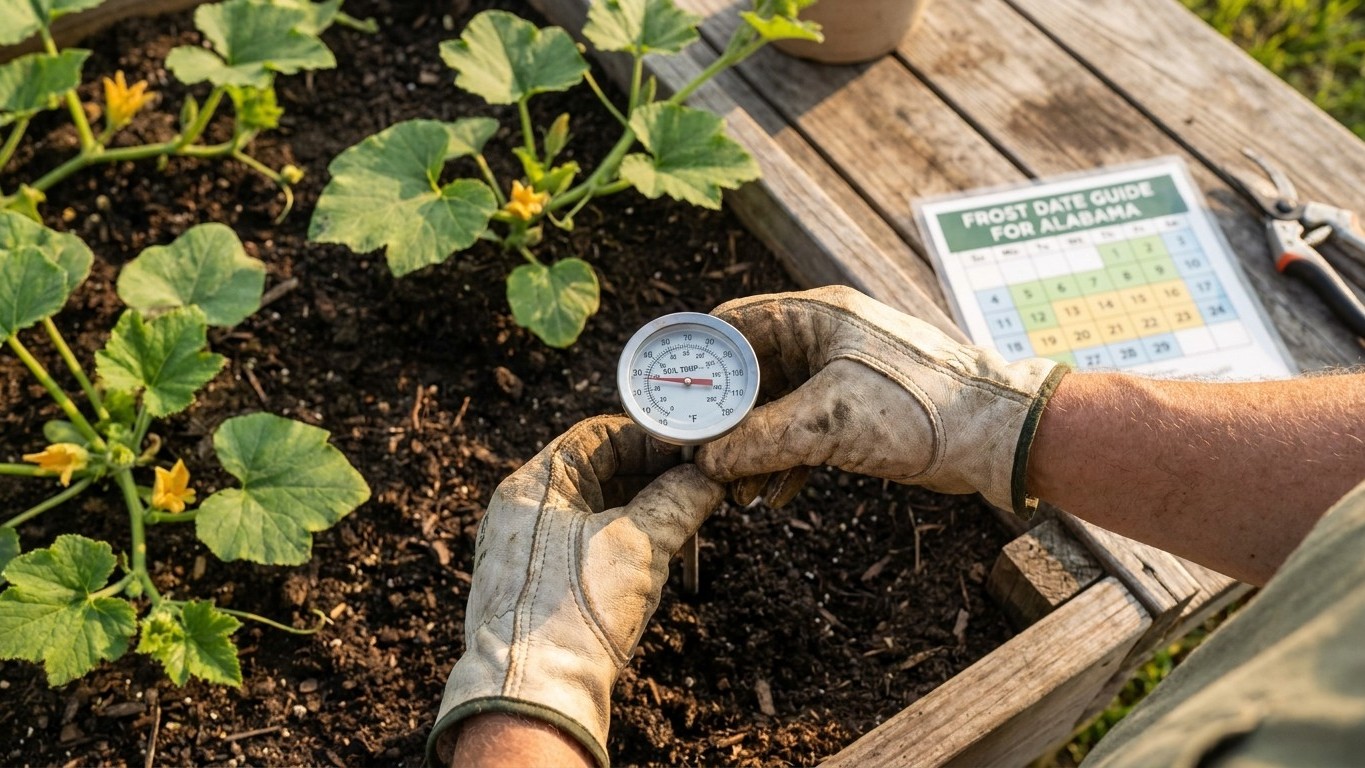
- Check with a thermometer, not a guess. A simple soil thermometer pushed a couple inches down, checked over several mornings, is the only reliable way to know the ground has actually cleared 65°F. Air temperature swings faster than soil does, so a run of warm afternoons doesn’t mean the ground underneath has caught up.
- Use row cover to buy time. Clear or black row cover laid over the bed can warm the soil roughly two weeks faster than bare ground left to the sun on its own, which matters directly given how tight the back end of the season already is. That’s two extra weeks pushed onto the front of the calendar, without moving the date the vine still has to flower by.
- Sow direct, not indoors. Pumpkins put down a taproot fast and resent transplanting, so once soil hits 65°F, seed goes straight into its final spot in the garden rather than into a tray to be moved later.
Put together, most Manitoba gardens aren’t sowing in mid-May no matter what a seed packet’s zone map suggests. The realistic window sits in late May to early June, later if row cover isn’t used, earlier only if the soil has been warmed ahead of time under cover.
What goes wrong here
- A flower that opens too late to ever color up. If a vine’s first female flowers don’t open until late August, the fruit is racing a 45-to-55-day clock against a frost date averaging September 22. The fix is upstream, not downstream: sow the moment soil clears 65°F, and lean on row cover early in the season to pull flowering forward rather than trying to rescue a late-set fruit in September.
- A fruit caught by frost before the rind has hardened. A soft-skinned pumpkin left on the vine past frost won’t finish ripening in the field, and it won’t keep well either. Utah State University Extension’s guidance is to harvest with the stem still attached and move the fruit somewhere it won’t freeze. That source doesn’t publish a storage temperature or a specific keeping time beyond that, so don’t attach a number to how long a fruit holds or how cold is too cold.
- A vine that dies back before the skin has a chance to harden. Vines weakened partway through the season by squash bugs or cucumber beetles often collapse before the fruit’s rind has toughened up, even when frost isn’t the immediate cause. Both pests have their own coverage on this site for identification and control.
Growers working a season this tight sometimes lean toward smaller, historically quicker-growing pumpkins. Names like Jack Be Little, Baby Bear, Sugar Pie, Cinderella, Casper, Lumina, Howden, Connecticut Field and Big Max show up often in Manitoba seed catalogs, though no maturity length, size or color figures are given here, since those details vary by seed source and by season.
Common questions
Can I start pumpkin seeds indoors in Manitoba to get a head start?
Pumpkins put down a fast taproot and generally handle transplanting poorly, so most guidance favors direct sowing outdoors once soil reaches 65°F rather than starting trays indoors and moving seedlings later.
What happens if frost hits before the pumpkin’s skin hardens?
A fruit whose rind hasn’t hardened before frost won’t finish ripening on the vine and won’t store well. Harvesting with the stem attached and moving fruit somewhere it won’t freeze is the extent of the published guidance; no specific storage temperature or keeping time is given.
How do I know for sure the soil has reached 65°F?
Use a soil thermometer pushed a couple of inches into the bed, checked over several mornings rather than relying on air temperature alone, since soil warms more slowly and lags behind a run of warm days.
Does the September 22 average frost date mean I’m safe until then?
No. It’s a mean from Environment and Climate Change Canada’s climate normals, not a guaranteed cutoff. In roughly half of all years, frost arrives later than September 22, and in the other half, it arrives earlier, so it should be treated as a midpoint for planning, not a safe date to count on.