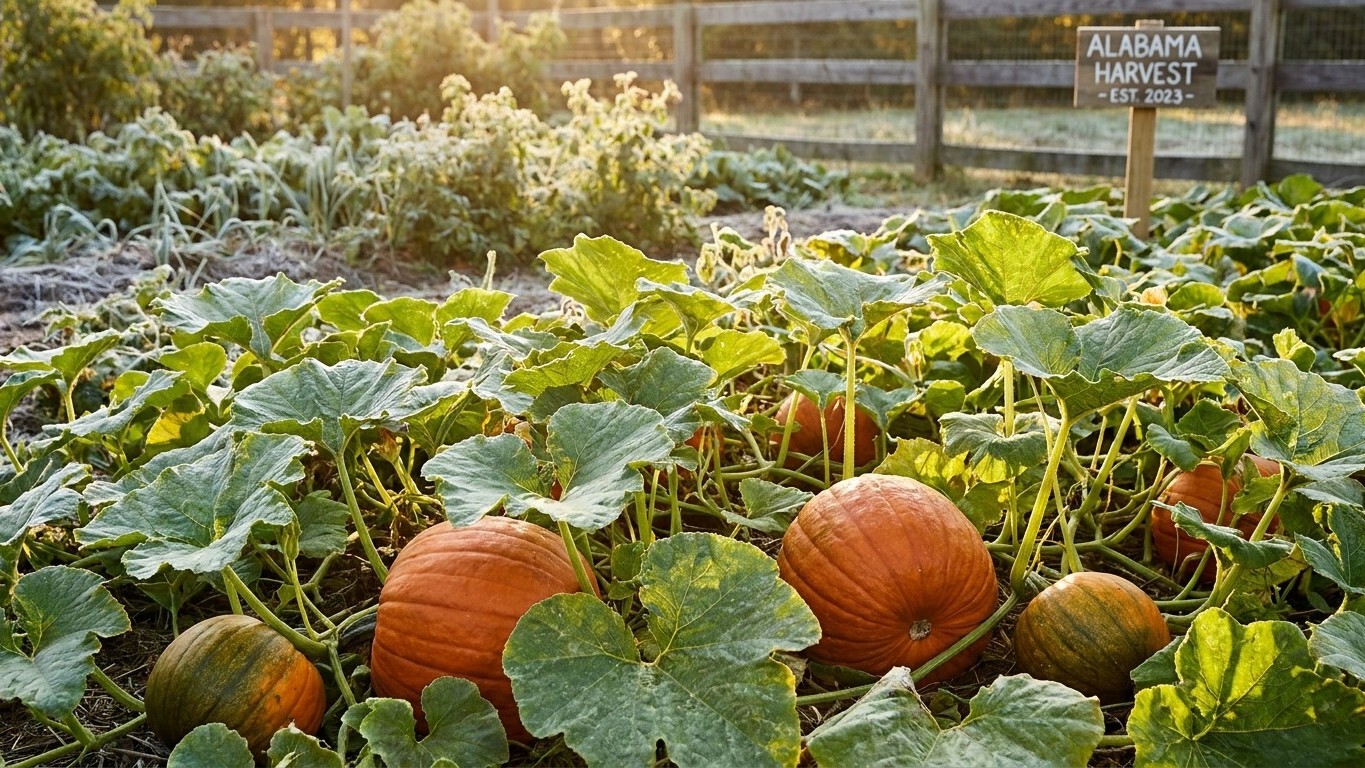

Manitoba pumpkins can Ripen Before Frost in an average year, but only if the flowers open early enough. Winnipeg’s mean first fall frost lands September 22, and a pumpkin needs 45 to 55 days after its flower opens to color up and harden its rind. That puts the last safe flowering date somewhere between July 29 and August 8. Push later than that, and plenty of vines will still be holding green fruit when the first cold night hits.
The short answer
Start with the frost date itself. September 22 is a mean, drawn from Environment and Climate Change Canada’s 1981-2010 climate normals at the Winnipeg Richardson International Airport station. A mean is not a guarantee. In roughly one year out of two, the first fall frost at that station arrives later than September 22, and in the other half, it arrives earlier. Treat the date as the middle of a window, not a line you can plan against with confidence.
Work backward from that midpoint using the 45-to-55-day figure from Utah State University Extension, and you land on a flowering window of July 29 to August 8. Any pumpkin flower that opens inside that window has a fair shot at finishing before frost in a typical year. A flower that opens after the first week of August is racing the calendar, and a flower that opens in mid-August is very likely to leave you with a fruit that never fully colors.
Notice what this window is built on: flowering date, not seeding date, not transplant date. Two vines planted the same week can flower a week or more apart depending on soil fertility, spacing, and how much stress the plants took early on. Walking the patch and marking the date the first female flowers open, the ones with the small swollen bulge behind the petals, gives a far more useful number than counting back from the packet’s planting instructions.
The window also isn’t the same everywhere in the province. The Winnipeg Richardson station describes conditions around Winnipeg specifically. Northern Manitoba, low-lying frost pockets, and higher-elevation districts routinely see their first frost weeks ahead of that reading. A gardener in one of those areas working off the Winnipeg mean date is working off a number that doesn’t apply locally, and the safe flowering window there closes earlier than late July.
One more variable sits underneath all of this: the 45-to-55-day range assumes reasonably warm weather through the whole stretch. A flower that opens right on July 29 still needs seven-plus weeks of decent growing conditions to finish. A cool, wet August slows that clock down even when the calendar says there’s time left.
When to sow here
- Let the mean last spring frost pass first, then keep watching the sky. Manitoba’s mean last spring frost is May 23, drawn from the same Environment and Climate Change Canada normals as the fall date. Same caution applies: it’s a midpoint, and in about half the years frost shows up after May 23. Treat it as a rough marker, not a green light.
- Stop trusting the calendar and start checking the soil. Utah State University Extension states that pumpkins are sown once soil temperature reaches 65 F. Soil temperature and air temperature are not the same clock. Soil lags behind air by weeks, so the ground can still be too cold for pumpkin seed well after the mean frost date has come and gone. A soil thermometer pushed a few inches down, checked over several consecutive mornings, is the only reliable way to know where things stand.
- Expect the 65 F mark to arrive well into the growing season, not right on the heels of May 23. In much of Manitoba, cool spring soils, especially heavy clay ground that holds moisture and warms slowly, don’t consistently hit 65 F until sometime in June. Sowing by the last-frost date alone, without checking the ground, risks seed rot or a stalled germination in soil that’s still too cold to support it.
- Use row covers or clear plastic mulch to move that date up. Warming the soil artificially with covers or mulch can buy roughly two weeks compared with bare, exposed ground. For a gardener trying to squeeze a full flowering-to-frost window out of a short season, those two weeks matter.
- Count forward from the actual sowing date, not backward from a hoped-for harvest. Once seed goes in on warm soil, track germination, then the weeks of vegetative growth before the first flowers appear, then apply the 45-to-55-day figure from that first flower. Only then compare the projected finish date against the September frost window to see whether the math actually works for this season.
What goes wrong here
- A flower opens too late and the fruit never colors. Flowers opening after the first week of August are already behind the 45-to-55-day clock relative to the mean frost date. If it happens, pinching off new blossoms and vine tips so the plant’s remaining energy goes into the fruit already set can sometimes push a borderline pumpkin over the line, though a fruit that’s still solid green by mid-September is more likely headed for the soup pot than the porch.
- Frost catches a fruit before the rind has hardened. A pumpkin can reach full size and mostly full color and still have a soft, thin rind that frost damage will spoil within days. Since the mean frost date is only a midpoint, and frost can legitimately arrive earlier than September 22 in any given year, harvesting a slightly under-finished but mostly colored pumpkin ahead of a forecast cold night, then finishing the cure indoors somewhere it won’t freeze, beats leaving it on the vine and gambling.
- The vine dies back before the fruit is ready. Squash bugs and cucumber beetles are common causes of vines collapsing weeks earlier than they should, cutting the ripening period short even when the frost date is still far off. This site covers both pests on their own Manitoba pages, including squash bugs in Manitoba and cucumber beetles in Manitoba, worth a look at the first sign of wilting leaves.
- A grower assumes the mean frost date is a safe date. Because it’s a midpoint, planning a harvest for September 21 and hoping for the best ignores that frost lands after that date about half the time at the Winnipeg station, and considerably more often away from it. Building in a buffer, aiming to have fruit essentially finished by early-to-mid September rather than banking on the last possible week, is the simplest fix for this one.
Common questions
What if my pumpkin flower opens after August 8?
It can still finish in a mild, late fall, but the odds drop the further past that date the flower opens. A flower opening in mid-August is working against both the mean frost date and the chance of an early frost showing up ahead of it.
Does the mean frost date mean I’m safe until September 22?
No. It’s the midpoint of Environment and Climate Change Canada’s 1981-2010 normals for the Winnipeg Richardson station, meaning frost arrives later than that in roughly half of all years, and earlier in the rest. It’s a planning reference, not a promise.
Can row covers replace waiting for 65 F soil?
Not entirely. Covers speed up warming and can buy about two weeks, but Utah State University Extension’s guidance still ties sowing to the soil actually reaching 65 F, not to the calendar or to the cover alone.
How should I store a pumpkin harvested ahead of frost?
Harvest with the stem attached, and keep the fruit somewhere it won’t freeze. That’s the extent of what Utah State University Extension publishes on the subject, without a specific temperature or keeping-time figure attached to it.