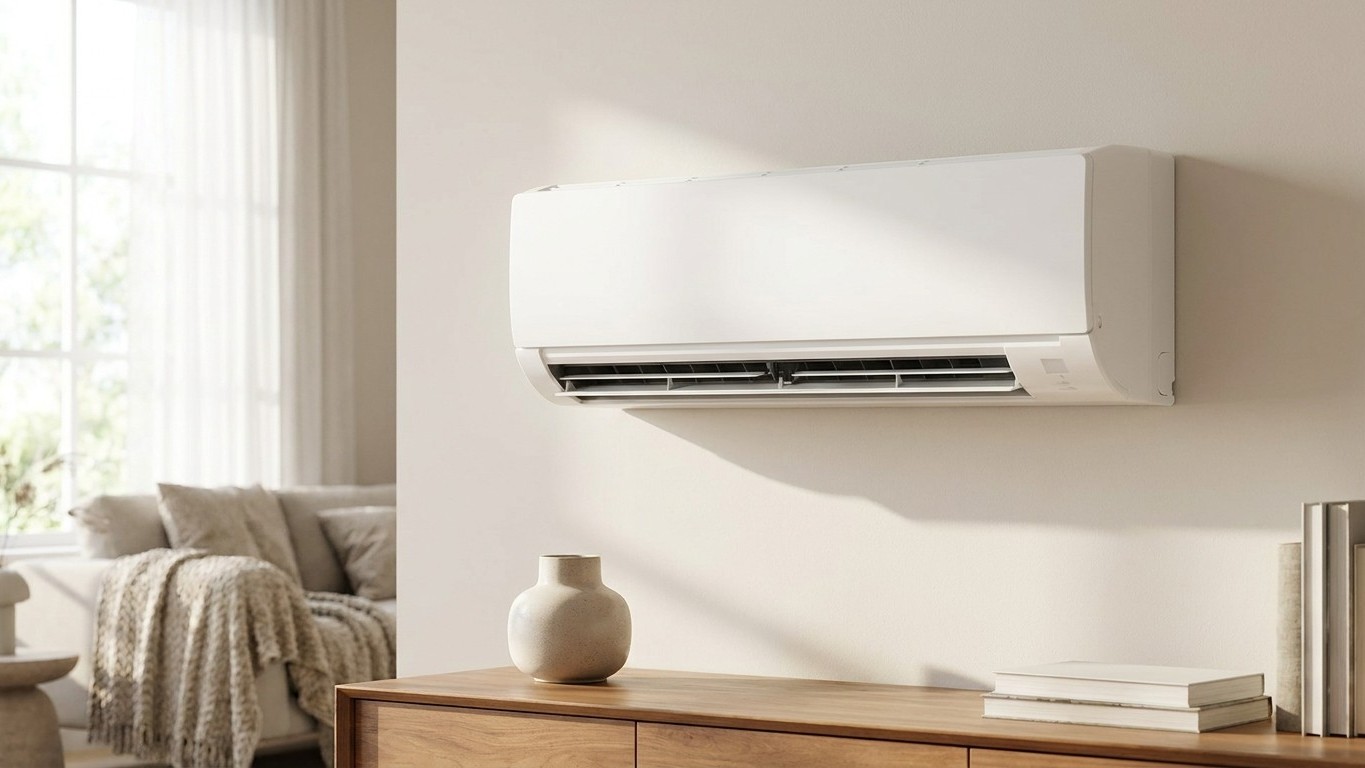

DRY mode runs the Mini-Split‘s cooling cycle at a slower pace, pulling moisture out of the air while barely lowering the temperature. It’s the setting for a sticky, damp room that doesn’t actually need to feel cooler, just less clammy. COOL is for heat, DRY is for humidity, and mixing the two up is the most common reason people feel let down by a mode that was working exactly as designed.
Four modes, four different machines

| Mode | What the compressor does | What the indoor fan does |
|---|---|---|
| COOL | Runs at whatever speed is needed to hit the set temperature, cycling on and off or modulating on inverter-driven units | Matches the cooling demand, usually faster when the room is far from the setpoint |
| HEAT | Reverses the refrigerant cycle to pull heat from outside air and push it indoors | Runs steadily, often with a delay on startup so it doesn’t blow cold air before the coil warms up |
| DRY | Runs slowly and intermittently, just enough to condense moisture on the coil without dropping room temperature much | Runs at low, fixed speed regardless of what you’ve set elsewhere |
| FAN | Off entirely. No refrigerant cycle, no heating or cooling | Circulates room air only, for mixing or a light breeze |
| AUTO | Decides for itself whether to run COOL or HEAT based on the room temperature it reads | Adjusts speed to whichever mode it has chosen |
A ductless Mini-Split has no ductwork at all. There’s an outdoor unit, one or more indoor heads mounted in the rooms you’re conditioning, and a line set running between them carrying refrigerant, power, and a condensate drain. That matters here because every mode above is doing something to the compressor and the coil inside that indoor head, not to air moving through a duct system somewhere in the walls. If you’ve read advice about duct leaks or changing a furnace filter, that’s a different kind of equipment. It doesn’t apply to what’s happening in the room where your head is mounted.
DRY is the mode that confuses the most people because it looks like a weaker version of COOL. It isn’t. The unit is deliberately slowing itself down so the coil stays cold long enough to condense water vapor out of the air passing over it, without running fast enough to also chill the room by several degrees. Think of it as the Mini-Split choosing to dehumidify instead of cool, even though both processes use the same coil. The indoor fan speed gets locked to low so air moves across that cold coil slowly, giving moisture more time to condense and drip into the drain line instead of blowing back into the room as humid air.
AUTO is the mode people either love or actively turn off. It reads the room temperature and decides on its own whether to run COOL or HEAT to reach the setpoint. In peak summer or dead winter that’s harmless, since the answer is obvious either way. The trouble shows up in shoulder season, when a room might swing from a chilly morning to a warm afternoon. AUTO can flip from HEAT to COOL and back within the same day, and each flip means the compressor stops, reverses its refrigerant cycle, and starts again. Some owners find that unpredictable and prefer picking COOL or HEAT manually so they know exactly what the unit is doing at any given moment.
When DRY is the right answer
The situation DRY was built for is specific: a day that’s humid but not particularly hot, where running full COOL would leave the room feeling cold and clammy at the same time. A basement in a rainy stretch of weather is the classic case. So is a bedroom on an overcast, humid morning where the thermometer reads a comfortable 74°F but the air still feels heavy enough to make sheets and towels feel damp. In both cases, the goal isn’t to drop the temperature further. It’s to make the existing temperature feel less sticky.
The trade-off is real and worth saying plainly: DRY removes moisture but does very little cooling. Run it on a genuinely hot afternoon and you’ll be disappointed, because the slow fan speed and reduced compressor output mean the room won’t cool down at anywhere near the rate COOL would deliver. DRY is not a substitute for a portable dehumidifier in a space that has no cooling source at all, either. It only dehumidifies the air that’s already being pulled across the indoor coil, which means it works within a conditioned room, not as a standalone drying solution for an unconditioned garage or crawlspace.
A short list of situations makes the choice easier:
- A muggy day with temperatures in the mid-70s and high humidity: choose DRY.
- A hot, humid afternoon above 85°F: choose COOL, since DRY won’t bring the temperature down fast enough.
- A damp basement after a stretch of rain, with no strong heat load: choose DRY.
- A stuffy room with no excess moisture, just stale air: choose FAN instead of DRY.
- A room that swings between cool mornings and warm afternoons: choose COOL or HEAT manually rather than leaving it on AUTO if the switching bothers you.
Fan speed and where the air is aimed
Fan speed and vane position are the two settings most people set once during installation and never touch again, which is a shame because they change how a room feels more than almost anything else on the remote. Fan speed is usually offered as LOW, MEDIUM, HIGH, and AUTO. AUTO lets the unit modulate its own speed based on how far the room is from the setpoint, running harder when there’s a big gap and easing off as it gets close. Leaving the fan pinned on HIGH sounds like a way to cool faster, but on an inverter-driven system it mostly means air keeps moving fast even after the compressor has backed off, which can make a room feel draughty without actually delivering more cooling capacity. AUTO fan speed tends to feel more comfortable over the course of a day for exactly that reason.
Vane position matters more than people expect
The vane, the horizontal flap at the bottom of the indoor head, controls whether air gets thrown up toward the ceiling or down toward the floor. In COOL mode, pointing the vane up sends cool air across the ceiling first, letting it mix and settle naturally rather than falling directly onto whoever’s sitting underneath. In HEAT mode, the opposite logic applies: warm air rises on its own, so pointing the vane down pushes heat toward the floor where people actually are, instead of letting it collect near the ceiling. Most heads also offer a horizontal swing setting, which sweeps air side to side, useful in a wide room the head can’t otherwise reach across evenly.
The single most common reason a correctly sized head still feels unpleasant is a vane pointed directly at where people sit or sleep. A steady stream of 60°F air aimed straight at a couch or a bed reads as cold and drafty even when the room’s average temperature is exactly on target. Angling the vane so air disperses across the room, rather than as a direct beam, usually fixes the complaint without touching the thermostat at all.
Timers, and the setting that costs money
Most mini-split remotes include a timer function, letting you schedule the unit to turn on before you get home or shut off overnight. Used lightly, that’s a reasonable way to avoid conditioning an empty house. The setting that works against the system, though, is the deep on-off habit some people bring over from other types of equipment: cranking the temperature down hard while away, then blasting COOL to recover fast once someone’s back in the room.
A ductless system’s compressor is built to modulate, running at a low, steady output for long stretches rather than cycling fully on and fully off the way older single-speed equipment does. That gentle, continuous operation is where the unit performs at its best. Ask it instead to recover a room that’s drifted far from the setpoint, and the compressor has to ramp up to something close to full output to catch up quickly, running harder and longer than it would have if the room had simply been held near a steady temperature the whole time.
This is also where the furnace-filter comparison breaks down, and it’s worth saying plainly why. A central forced-air furnace or air conditioner cycles a filter and blower on a rhythm tied to duct airflow, and habits that suit that kind of on-off cadence get carried over by force of habit. A ductless head has no filter tied to duct static pressure and no comparable blower cycle. It has an indoor coil and a modulating compressor that would rather ease along steadily than repeatedly chase a room back down from a wide swing. Setting a timer for a night setback of a few degrees, rather than a deep swing, keeps the compressor working the way it’s designed to.
Common questions
Does DRY mode use the same fan speed as COOL? No. DRY locks the indoor fan to a low, fixed speed so air moves slowly across the cold coil, giving moisture more time to condense. COOL mode’s fan speed follows whatever setting you’ve chosen, including AUTO.
Can I leave a mini-split on AUTO all the time? You can, and many people do without issue. The mode simply decides between HEAT and COOL based on room temperature. Some owners switch to manual COOL or HEAT during shoulder-season weeks specifically to avoid the unit flipping between the two more than they’d like.
Will DRY mode fix a musty smell in a room? It can help if the smell is tied to excess humidity in an otherwise conditioned space, since it removes moisture from the air passing over the coil. It won’t address a musty smell coming from an unconditioned area like a crawlspace, since DRY only dehumidifies air the indoor head is actively pulling in.
Why does my room feel drafty even though the temperature is right? This usually comes down to vane position rather than temperature. A vane aimed directly at seating or a bed creates a noticeable draft even when the room’s average reading matches the setpoint. Angling the vane so air disperses more broadly across the room typically resolves it.