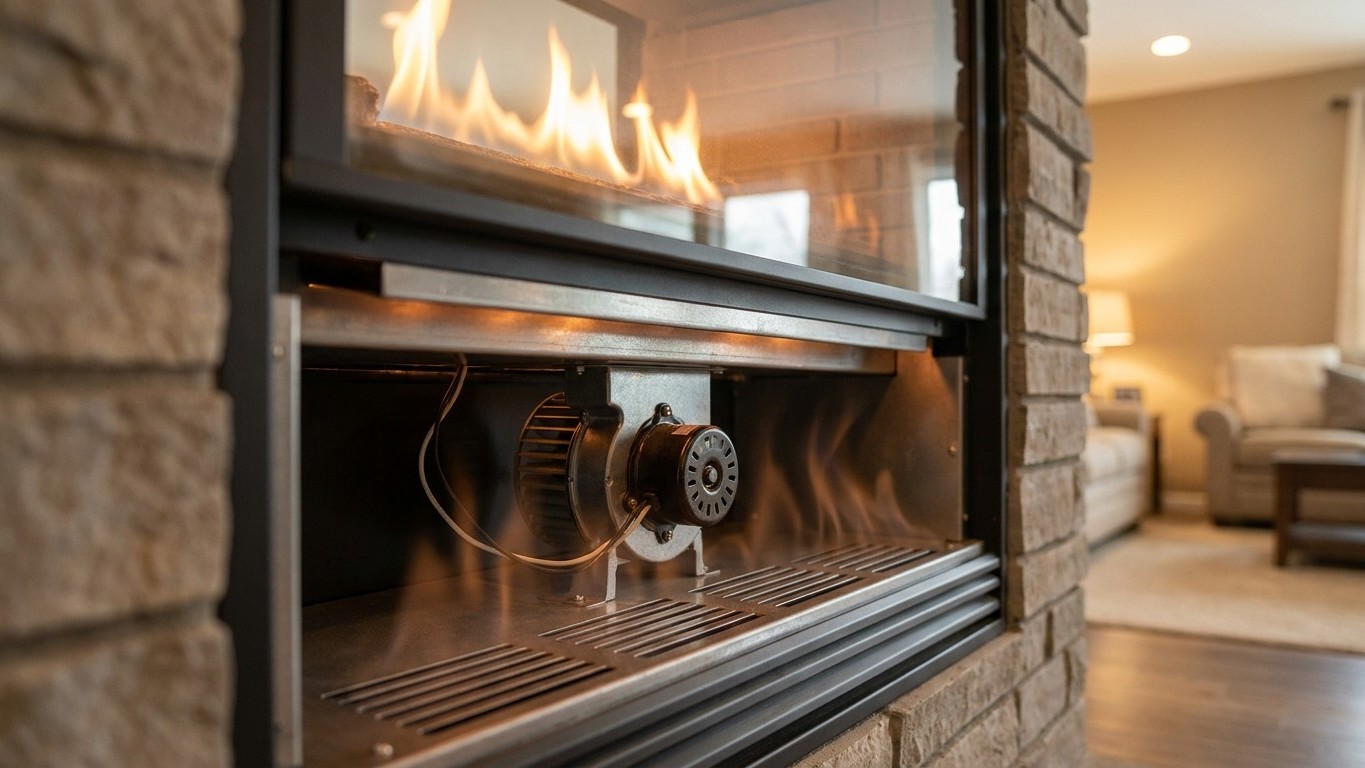

a Gas Fireplace blower is a small fan that pushes heated room air out into the space, so the fireplace warms a room faster and more evenly instead of just radiating heat near the glass. It doesn’t touch the flame or the gas line. When it’s noisy or won’t run, the fireplace still burns fine; only the extra circulation is affected. That distinction is the answer to most “is this dangerous” questions about blower noise.
It moves room air, not combustion air

On a direct-vent gas fireplace, the blower sits behind or beneath the firebox and pulls cool room air across the outside of that sealed firebox, then pushes the now-warm air back into the room through vents in the surround. It never enters the combustion chamber. The flame gets its air from outside through the sealed vent pipe, and the exhaust leaves the same way. The blower is a comfort accessory bolted onto a system that already works without it.
Room air versus combustion air
This separation matters because the two air paths never mix. A dead blower motor, a stuck fan blade, or a burnt-out capacitor means the glass stays warm to the touch and the room heats up slower, but the appliance keeps burning at the same rate and the same air-fuel mix. Nothing about the blower’s condition changes how much carbon monoxide the burner produces or how it’s vented outside. If a fireplace only “throws heat” for a few feet in front of the glass and the blower has stopped, that’s the entire problem, and it’s a repair or replacement job for the fan, not the gas system.
Where this gets confused is with vent-free (unvented) units, which work on a completely different principle and typically don’t rely on a circulation blower the same way. A vent-free appliance has no flue and no outside air source; it draws combustion air from the room and releases everything it produces, including water vapor, back into that same room. According to the U.S. Consumer Product Safety Commission, currently manufactured unvented gas-fired room heaters carry an oxygen depletion sensor under the industry’s voluntary standard, which shuts off the gas before carbon monoxide can reach a life-threatening level. The agency also notes that inadequate room ventilation or a maladjusted burner on an unvented appliance can still let dangerous levels build up, since there’s no outside vent for the byproducts to escape through.
| Venting type | Where combustion air comes from | Where exhaust goes |
|---|---|---|
| Vented | Room or chimney draft | Outdoors through a flue |
| Direct-vent | Outside, through a sealed pipe | Outdoors through a sealed wall terminal |
| Vent-free | Room air | Released into the room |
Whichever type is installed, the U.S. Fire Administration’s standing advice applies regardless of blower condition: “Keep anything that can burn at least 3 feet from all heat sources including fireplaces, wood stoves, radiators, space heaters or candles.”
Rattles, hums and what they mean
Most blower noises trace back to a handful of causes, and none of them involve the gas side of the appliance. The usual suspects:
- A rattle that gets louder as the fan speeds up, usually a loose mounting screw or a fan blade that’s picked up debris.
- A hum with little or no air coming out, often a seized or failing motor bearing that’s still drawing power but can’t spin freely.
- A squeal right at start-up that fades after a few seconds, typically a dry bearing or a belt-driven unit needing lubrication.
- A blower that keeps running well after the flame is off, or one that seems to start on its own.
The thermal switch, explained
That last symptom looks alarming but is usually normal. Gas fireplace blowers are wired through a thermal switch (sometimes called a fan control or snap-disc switch) mounted near the firebox. It senses heat, not the flame itself, and turns the fan on automatically once the firebox reaches a set temperature, then shuts it off once things cool back down. That’s why a blower often keeps humming for ten or fifteen minutes after the gas valve closes: the firebox is still hot, and the switch hasn’t dropped below its cutoff point yet. The fireplace isn’t malfunctioning; the switch is doing exactly what it’s built to do.
What isn’t normal is a blower that runs cold, before there’s any heat to sense, or one that never shuts off even hours after the fire is out. That points to a stuck or failed thermal switch rather than the blower motor itself, and it’s worth having checked, since a switch stuck in the “on” position can eventually wear out the motor from constant use. A squeal that never goes away, or a rattle that shows up right after installation, is more often a shipping clip or packaging piece left inside the blower housing than a defect.
Dust is what kills them
The blower housing sits low, usually right under or behind the firebox, in the exact spot where dust, pet hair, and lint settle after being pulled in with the room air it’s circulating. Over months and years, that buildup coats the fan blades, unbalances them (which is where a lot of that growing rattle comes from), and eventually chokes the motor enough that it works harder, runs hotter, and fails sooner. Fireplace blower failure is, more often than not, a dust problem wearing a mechanical one’s clothes.
How to Clean It
Cleaning the blower is simple and is the bulk of what blower maintenance actually involves. The fireplace needs to be completely cold and the gas supply off before opening any access panel; most manufacturers put the blower access on the lower front or side of the unit. From there, a vacuum with a brush attachment on the fan blades and housing, plus a soft cloth to wipe down the visible dust, is usually enough. Blowers with removable fan assemblies can be pulled and cleaned more thoroughly, but that’s worth checking against the owner’s manual rather than guessing, since motor housings vary by manufacturer.
This kind of upkeep fits into the broader annual service a Gas Fireplace needs, not a replacement for it. As the U.S. Fire Administration puts it, homeowners should “maintain heating equipment and chimneys by having them cleaned and inspected each year by a professional.” A full walkthrough of what that yearly service should cover, beyond just the blower, is laid out in our gas fireplace maintenance guide. And regardless of how clean or quiet the blower is, a working carbon monoxide alarm is the only way a household detects the gas, since it’s colorless and odorless and gives no other warning. If a gas smell ever shows up while working near the fireplace, the fix is to leave the house and call from outside, not to keep troubleshooting.
Common questions
Can a Gas Fireplace run without the blower working?
Yes. The blower only circulates room air for comfort; it isn’t part of the combustion or venting path, so the fireplace burns and vents normally with a dead blower.
Why does the blower keep running after I turn off the fireplace?
It’s controlled by a thermal switch that responds to firebox temperature, not the flame directly. It keeps the fan on until the firebox cools below its cutoff point, which can take several minutes after shutdown.
Is a rattling blower a fire or gas hazard?
Not on its own. A rattle almost always means a loose part, debris, or dust buildup on the fan, none of which affects the gas valve or venting. A gas smell, separate from blower noise, is the sign that requires leaving the house and calling from outside.
How often should the blower be cleaned?
There’s no fixed interval given by the appliance makers or fire agencies; it depends on dust and pet hair in the home. Checking it during the annual professional inspection, alongside the rest of the fireplace, is the practical baseline.