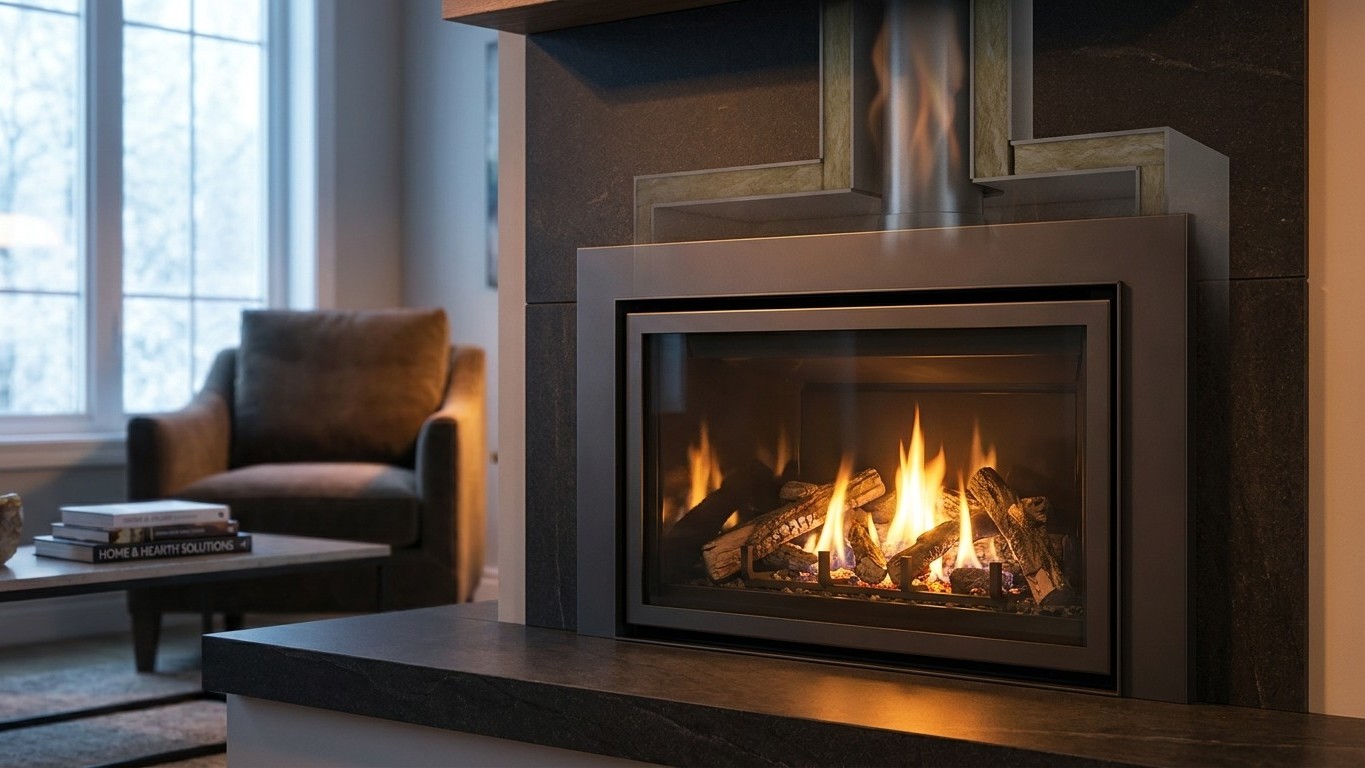

Gas fireplace efficiency almost never means what the sales tag implies. A unit rated at 80 or 90 percent efficient is describing how completely it burns fuel at full output, not how much of that heat ends up warming your living room. The real number that affects your gas bill is usually 15 to 30 points lower, and it depends entirely on whether the appliance vents outdoors, vents through a wall, or vents nowhere at all.
Two ratings, and only one is useful

Every gas appliance carries what’s called a steady-state efficiency rating. It’s measured in a lab, with the burner running flat out, capturing how much of the fuel’s energy converts to heat at that single moment. It’s the number printed on spec sheets and repeated in showrooms. It’s also almost useless for predicting your winter heating bill.
What actually matters is a seasonal, delivered-to-the-room figure, one that accounts for cycling on and off, standby losses when the pilot or igniter is idle, and, critically, how much heat escapes up a flue before it ever reaches your hands. A decorative vented gas log set can post a respectable steady-state efficiency and still lose most of its output straight up the chimney, because an open flue is designed to carry combustion byproducts outside, and it doesn’t discriminate between exhaust gas and the warm air sitting right next to it.
Why the gap exists
Think of steady-state efficiency as a car’s rated highway mileage and delivered efficiency as what you actually get commuting in stop-and-go traffic with the AC running. The lab number isn’t false. It’s just measuring a condition your living room rarely experiences. A fireplace that ignites, runs for forty minutes, then sits idle for two hours behaves nothing like the continuous full-burn test used to generate the marketing figure.
This is why two appliances with nearly identical efficiency percentages on their labels can produce very different amounts of usable heat over a season. The one with an open flue and a damper that has to stay cracked for combustion air is fighting a structural disadvantage no burner design can fully overcome. The one that seals its combustion chamber from the room, or skips venting altogether, keeps more of what it produces where you want it.
That structural difference, not the printed percentage, is the first thing worth understanding before comparing models.
Vented, direct-vent, vent-free
Three venting approaches exist, and they perform in a predictable order once you measure heat actually delivered per unit of fuel burned. A vented appliance sends combustion products outdoors through a flue, the same way a traditional wood fireplace does, and that open path pulls conditioned room air out along with the exhaust. A direct-vent unit draws combustion air in from outside and exhausts through a sealed wall terminal, so the firebox is closed off from the room air entirely. A vent-free appliance has no outside vent at all: everything it produces, heat, moisture, and combustion byproducts, stays in the room.
Ranked by heat delivered per unit of fuel, vent-free comes out highest simply because nothing escapes outdoors. Direct-vent sits in the middle, sealed and efficient but still losing some heat through the exhaust terminal. An open vented appliance ranks lowest, since its flue is built to exhaust freely and takes warmed room air with it.
That ranking comes with a cost, and it’s the same cost you’re getting the heat from. A vent-free appliance releases its combustion products, water vapor included, directly into your living space. The U.S. Consumer Product Safety Commission notes that unvented appliances have no outside vent for combustion products and rely on ordinary room ventilation, and that inadequate airflow or a maladjusted burner can allow dangerous levels to accumulate. Currently manufactured unvented gas-fired room heaters carry an oxygen depletion sensor under the industry’s voluntary standard, designed to shut off gas flow before carbon monoxide reaches a life-threatening level in the room. The CPSC revoked its own mandatory standard for that sensor back in 1984, by which point 95 to 100 percent of manufacturers had already built it in voluntarily.
Carbon monoxide has no color and no smell, so a working CO alarm is the only way a household detects a problem before it becomes a symptom. That single fact should weigh as heavily in a purchase decision as any efficiency percentage on the label.
If you’re still deciding between a sealed direct-vent unit and an unvented model, the tradeoffs around moisture, ventilation requirements, and where each is permitted deserve a closer look on their own terms.
What to ask a showroom
Walking into a showroom with the right three questions will tell you more than any brochure. First: which efficiency figure is being quoted, steady-state or a seasonal delivered number. Salespeople default to the higher steady-state figure because it’s the one manufacturers print, but ask directly whether it reflects continuous full burn or actual seasonal performance. If nobody can answer clearly, treat the number with skepticism.
Second: what is the appliance’s input rating in Btu. This tells you the maximum fuel energy it consumes per hour, and it’s the figure your gas utility and your wallet will care about regardless of how the efficiency percentage is calculated. Two units with the same efficiency rating but different Btu inputs will cost noticeably different amounts to run over a season, and a unit sized well beyond what your room needs wastes fuel no matter how efficient its burn is.
Don’t forget the blower
Third: is a blower included, or is it an accessory sold separately. A blower circulates warmed air into the room instead of letting it rise and stall near the ceiling, and it can meaningfully change how much of that rated output you actually feel. Some units bundle it standard; others list it as an add-on that shows up as a separate line item once you’re ready to buy. Ask before you compare prices, not after.
Beyond the numbers, ask about maintenance requirements, since neglected equipment loses efficiency regardless of its original rating. The U.S. Fire Administration advises to “maintain heating equipment and chimneys by having them cleaned and inspected each year by a professional,” and that inspection also catches the kind of burner misadjustment that can turn a vent-free unit’s safety sensor into your last line of defense rather than a backup. The Fire Administration also recommends to “keep anything that can burn at least 3 feet from all heat sources including fireplaces, wood stoves, radiators, space heaters or candles,” a rule worth applying regardless of which venting type you choose.
One more thing no showroom can quote you: if you ever smell gas near any appliance, efficiency questions wait. Leave the area and call from outside.
Common questions
Does a higher efficiency percentage always mean a lower gas bill?
Not by itself. A high steady-state percentage on the label doesn’t account for flue losses or cycling behavior, so two appliances with similar labeled efficiency can produce very different heating costs depending on how they vent.
Are vent-free fireplaces less efficient than direct-vent models?
The opposite, in terms of heat kept in the room: since nothing exits outdoors, vent-free units deliver more of their output as usable heat. That gain comes with the tradeoff of releasing combustion byproducts and moisture into the living space, which is why ventilation and a carbon monoxide alarm matter more with this type.
Why do vented fireplaces lose so much heat?
Their open flue is built to carry combustion products outdoors, and that same open path draws warmed room air out with it, whether the appliance is decorative logs or a more substantial unit.
What’s the single most important question to ask before buying?
Ask whether the efficiency figure quoted is steady-state or seasonal delivered performance. It reframes every other number on the spec sheet and prevents comparing two appliances on mismatched terms.