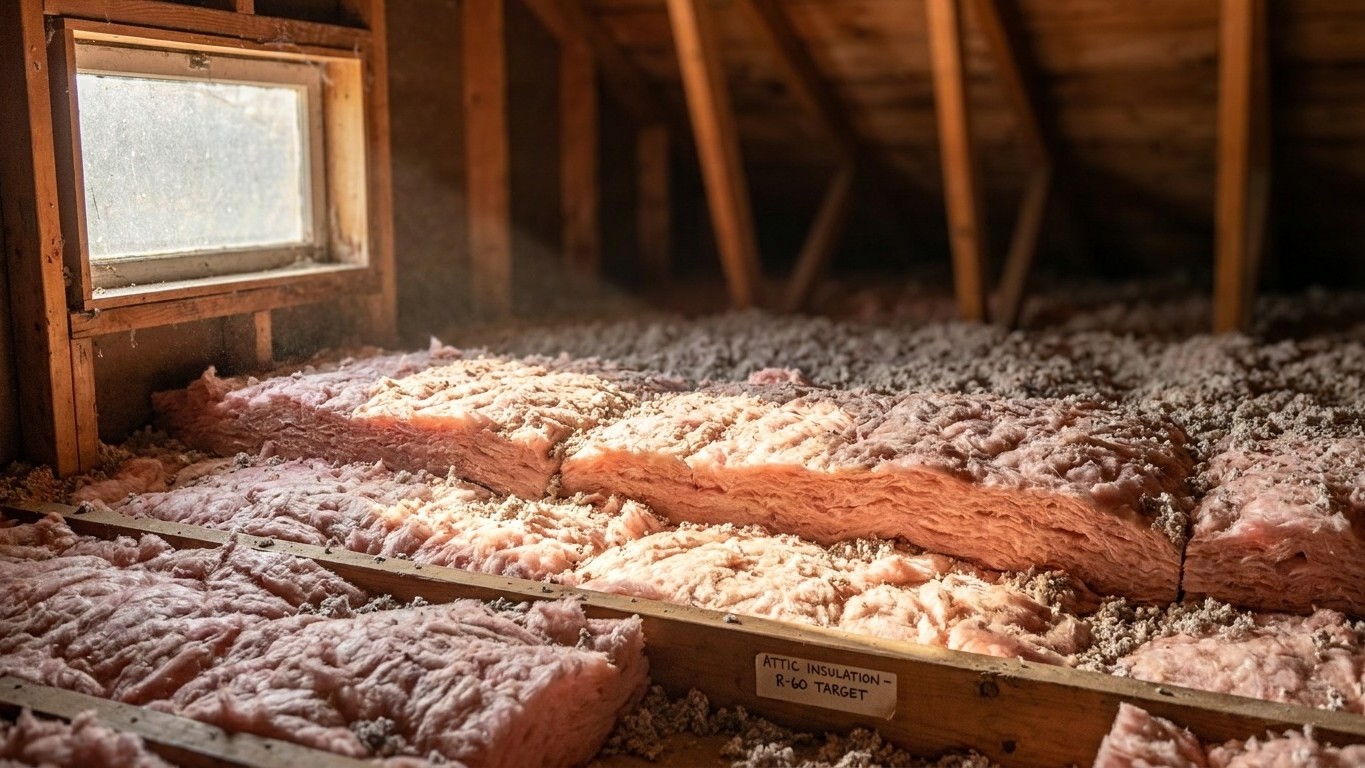

Louisiana’s Insulation numbers aren’t one-size-fits-all: the state’s 64 parishes fall into two different IECC climate zones, and the recommended attic and floor levels shift depending on which side of that line a home sits. The zone a parish carries decides which row of the ENERGY STAR table applies.
Which climate zone Louisiana is in

There’s no single climate zone for Louisiana. Of the state’s 64 parishes, 37 sit in zone 2A and 27 sit in zone 3A, according to the 2021 International Energy Conservation Code’s county-by-county table (parishes are Louisiana’s equivalent of counties in that federal table). That’s not a rounding error or a technicality: it means close to half the parishes in the state buy a different floor-Insulation number than the other half, even though the attic numbers happen to line up.
| IECC Zone | Parishes in this zone |
|---|---|
| 2A | 37 |
| 3A | 27 |
Worth repeating: a count of parishes is not a share of population. Thirty-seven parishes in one zone doesn’t automatically mean most of the state’s residents live there, and 27 in the other doesn’t mean a minority does either. This table describes geography, not headcount, so treat it as a map of the rule, not a poll of the people living under it.
A climate zone number is a shorthand for how demanding the heating and cooling season is at that location, with higher numbers meaning colder winters and lower numbers meaning milder ones. The letter that follows the number describes moisture, not temperature: A means moist, B means dry, C means marine, and zones 7 and 8 don’t carry a letter at all. Every parish in Louisiana carries an A, which fits a state that sits on the Gulf and deals with humidity in both its warm and its cooler months. That letter matters because the ENERGY STAR Insulation table groups some zones together by letter (4A and 4B share a row, while 6, 5, and 4C share another), so dropping it or guessing at it can point a reader to the wrong section of the chart entirely.
None of this tells an individual reader which zone their own parish falls into, and that’s on purpose. The safest way to find out is to check ENERGY STAR’s published zone map or the parish-by-parish IECC table directly, rather than assume based on a neighboring parish or a rough sense of “north” versus “south” Louisiana. A parish just across a zone boundary can carry a different letter or number than the one next door, and buying Insulation based on a guess means buying either too little material for the winters or paying for more than the code recommends.
The insulation levels that apply here
ENERGY STAR’s recommended retrofit levels are built for existing wood-framed homes, based on the 2021 IECC, and they’re organized by climate zone. The table below reproduces the two rows that apply somewhere in Louisiana, exactly as published, with their column labels intact.
| Zone | Attic if UNINSULATED | Attic if you ALREADY HAVE 3-4 inches | Floor |
|---|---|---|---|
| Zone 2 | R49 | R38 | R13 |
| Zone 3 | R49 | R38 | R19 |
Read that header carefully, because it’s easy to misread. “Add Insulation to Attic” is a merged heading covering two separate situations, an attic with no insulation at all and one that already has 3-4 inches sitting in it. The third figure in each row isn’t a third attic value; it’s the floor, a completely different part of the house. Three numbers per zone, but only two of them describe the attic.
For the 37 parishes carrying a zone 2 designation, that means an uninsulated attic should reach R49, a partially insulated one (with that existing 3-4 inches) should be topped up to R38, and floors over unconditioned spaces should land at R13. For the 27 parishes in zone 3, the attic numbers match exactly, R49 for an uninsulated attic and R38 for one with a partial start, but the floor number climbs to R19. That six-point jump in the floor recommendation is the one place where a homeowner in, say, a parish near the Arkansas line and one near the coast are shopping for genuinely different amounts of material, even though their attic project looks identical on paper.
Don’t average those two rows to land on a single Louisiana number, and don’t interpolate between them. There isn’t a “zone 2.5” figure hiding in between R13 and R19 floor insulation, and a page that invents one is guessing. These figures also apply to retrofitting an existing home, not to new construction, which follows its own code requirements and isn’t the subject here. And nowhere in this table does a depth in inches appear, because the same R-value takes up a different thickness depending on the material, a number that’s printed on the product’s own packaging rather than derived from the R-value itself.
Sealing comes before insulating
ENERGY STAR treats air sealing and insulation as two steps of the same project, not two separate options, and its own guidance puts attic air sealing before attic insulation. That order isn’t arbitrary. Insulation slows heat moving through a material, but it does nothing to stop air moving around it. Lay a fresh layer of insulation over a gap, a wiring penetration, or a bypass around a chimney chase, and the insulation hides the leak without closing it. It looks finished. It isn’t.
The practical sequence ENERGY STAR lays out, and the one that makes the insulation numbers above actually deliver what they promise, runs in this order:
- Seal air leaks in the attic first, including bypasses, penetrations, and gaps around fixtures
- Add attic insulation up to the level called for by the zone
- Seal and insulate the rim joist
- Address the floor over a crawlspace or an accessible basement
- Only then move to wall insulation
Skipping straight to step two and treating it as the whole project is the most common way this work underdelivers. A homeowner who insulates a leaky attic can end up disappointed by the results, not because the insulation failed but because the air movement it was supposed to help control never stopped. That’s also why the savings figures published for this kind of work, covered further down, are attached to the sealing-and-insulating combination and not to either piece done alone.
For the mechanics of each of these steps, the how-to detail on sealing a specific bypass or choosing a rim-joist material, the national insulation guides on this site walk through the individual tasks. This page is about which numbers apply in Louisiana, not the technique for reaching them.
What the winter here actually asks for
At New Orleans International Airport, the 1991-2020 NOAA climate normal comes to about 1,176 heating degree days a year, against roughly 3,206 cooling degree days. Heating degree days measure demand, not temperature: for every day of the year, they add up how far the average temperature fell below 65°F. A number in the low thousands, paired against cooling degree days nearly three times as high, tells the real story of a Gulf Coast winter: short, and mild enough that the summer cooling load dominates the year’s energy use far more than the heating season does. That doesn’t make the heating season irrelevant, especially for the 27 parishes carrying the higher zone 3 floor number, but it puts the state’s priorities in perspective compared with a colder climate zone.
What Louisiana homes actually heat with matters just as much as how cold it gets. State-level figures from the EIA’s Residential Energy Consumption Survey show 57% of homes relying on a furnace and 21% on a central heat pump as their main heating equipment, with 62% of homes using electricity and 33% using natural gas as the heating fuel. Steam or hot-water boilers came back as “none reported” in that survey, and propane came back “not reported” with the estimate suppressed, neither of which means zero households use them, only that the sample wasn’t large enough to publish a reliable figure.
Furnaces and heat pumps both typically move heated air through ductwork, and that detail changes what an insulation project should prioritize here more than in a state running mostly on boilers and radiators. Ducts running through an unconditioned attic lose conditioned air straight into that space, and no amount of ceiling insulation fixes a leaky duct sitting above it. A sensible order of priorities for a Louisiana home looks like this:
- Check and seal ductwork running through the attic or crawlspace, since most homes here move heated and cooled air through ducts
- Seal attic air leaks before adding insulation
- Bring attic insulation up to the level for the parish’s zone (2 or 3)
- Address the floor over a crawlspace at the level that matches the same zone
The duct guides on this site go into the specific sealing and insulating steps for ductwork in an unconditioned attic, which is worth a closer look given how many Louisiana homes run heat through exactly that setup.
What the work is worth
ENERGY STAR’s own published estimate is specific enough to quote directly: “EPA estimates that homeowners can save an average of 15% on heating and cooling costs (or an average of 11% on total energy costs) by air sealing their homes and adding insulation in attics, floors over crawl spaces, and accessible basement rim joists.” Both numbers matter, and they’re not interchangeable: 15% applies to the heating and cooling portion of an energy bill specifically, while 11% applies to the total energy bill, which includes things like water heating and appliances that insulation doesn’t touch.
These are averages drawn from energy modeling of a “typical” existing U.S. home, not a guarantee for any particular house in Ascension Parish or anywhere else. A home with newer windows, a tighter building envelope to begin with, or ductwork that’s already sealed will see a different result than the model home the estimate is built on. The estimate also names precisely where that modeled work happened: attics, floors over crawl spaces, and accessible basement rim joists. It doesn’t extend to walls, windows, or doors, even though those are common places homeowners assume are included.
It’s also worth keeping this figure separate from two others that sound similar but aren’t the same claim. ENERGY STAR’s own program landing page mentions “up to a 10% savings on your annual energy bills” for the same category of work, which is a different, capped figure on a different denominator. And the Department of Energy’s often-cited 10% figure has nothing to do with insulation at all; it’s tied to a thermostat setback of 7-10°F held for eight hours a day. Three real numbers, three different claims, and only one of them, the 15%/11% pairing above, is the ENERGY STAR estimate for sealing and insulating attics, crawlspace floors, and rim joists.