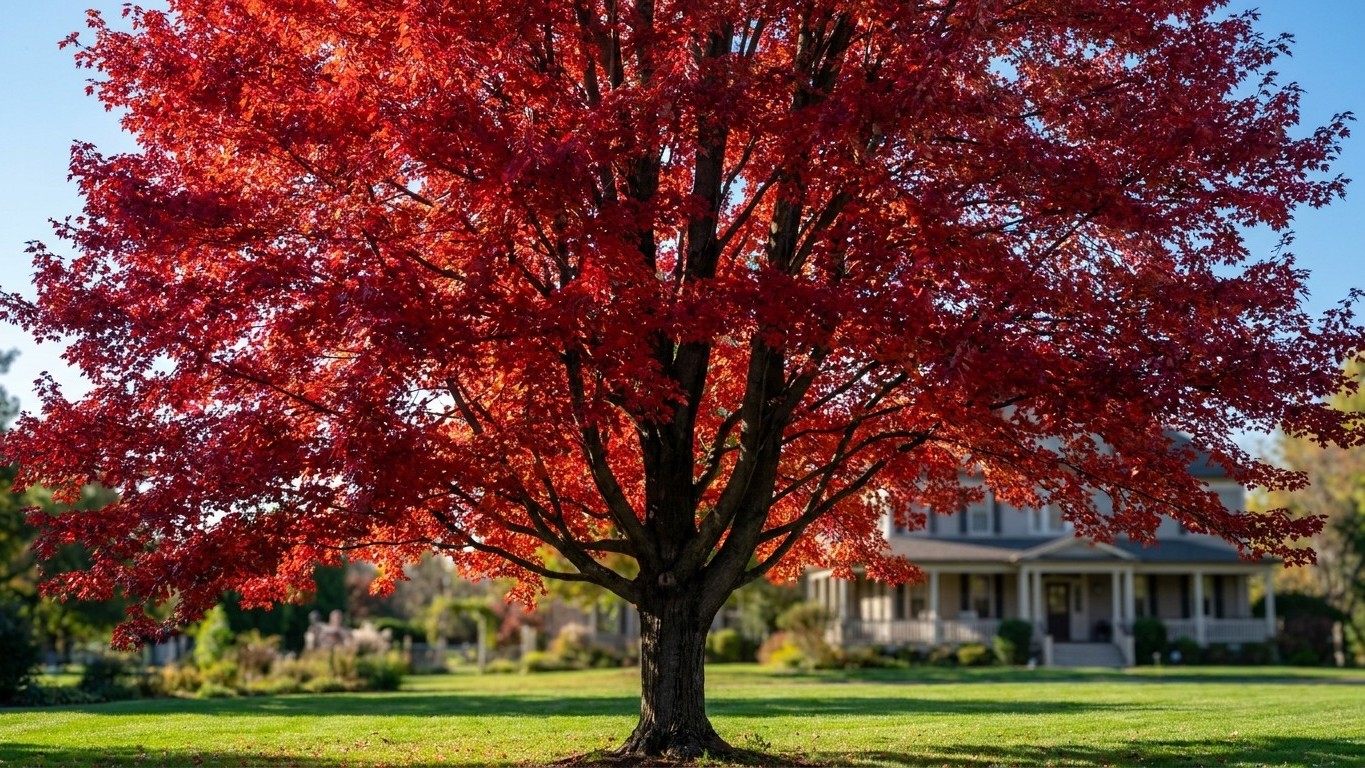

Acer rubrum, known under several common names including Red Maple, Swamp Maple, Scarlet Maple, Soft Maple, and Carolina Maple, is a deciduous native tree hardy across USDA zones 2a-9b. It tolerates a wide range of soils and light levels, grows at a rapid rate, and needs more than 60 feet of space once mature. That last figure decides more landscape plantings than climate ever does. Whether this tree belongs in a given yard hinges less on winter cold than on what’s already occupying the ground above and below the spot where it goes in.
Where it will and will not survive

The USDA hardiness range for Acer rubrum is 2a-9b, one of the widest ranges given to any tree on this site. A range describes where the plant can survive winter cold, not where it thrives. A red maple rated hardy to zone 9b is not necessarily comfortable through a 9b summer, and one at the 2a edge isn’t putting on its best growth there either.
Below the bottom of this range, the tree won’t reliably survive winter. Above the top, sustained heat pushes past what the species tolerates, regardless of how well the soil and light match its other preferences. Neither end is a gray area worth testing with a single specimen you care about.
Hardiness zones don’t follow state lines. They shift with elevation, distance from large bodies of water, and local microclimates a national map can’t capture at the county level. Guessing your zone from memory of “where you live” is exactly how gardeners end up with a tree planted a zone or two outside what it can handle.
The reliable move is to look up your own zone rather than assume it, using the hardiness zone guide on this site, which breaks the USDA map down to the county level. Once you have your actual zone number, checking it against 2a-9b takes ten seconds and settles the survival question before you spend money on a tree.
One more distinction worth holding onto: the data behind this plant profile comes from the North Carolina Extension Gardener Plant Toolbox. The USDA hardiness range it reports is universal. But that same source also publishes regional advice specific to North Carolina’s coastal plain, piedmont, and mountain regions, and that guidance doesn’t travel. If you’re gardening outside North Carolina, the zone range applies to you; the regional planting notes do not.
The mistake that costs the most: space
Acer rubrum needs more than 60 feet of space at maturity. Not room to look nice for a few years, but room for a canopy and root system that will eventually claim a footprint wider than most suburban lots are deep. That number should shape where the hole gets dug, not become an afterthought once the tree is already taller than the house.
The trouble with getting this wrong is timing. A red maple planted six or eight feet from a foundation looks perfectly reasonable for its first decade. The mistake doesn’t announce itself until roots start lifting a driveway or a canopy starts dropping limbs onto a roof during storms. By then the fix isn’t a prune, it’s a removal, which costs far more, in every sense, than the ten minutes it takes to plan spacing correctly at planting time.
Space at maturity also isn’t only about trunk-to-wall distance. A tree needing more than 60 feet of room throws shade across that entire radius, and its root system generally extends at least as far underground as the canopy does above it. That matters for septic drain fields, buried utility lines, and foundations alike, none of which mix well with an aggressive, rapidly growing root system.
Checks to run before digging
- Look up: note any overhead wires or power lines within the tree’s eventual canopy spread, not just its current young height.
- Look down: locate septic fields, water lines, and buried cable or gas lines before the shovel goes in, since roots will eventually reach that far.
- Measure the radius: with more than 60 feet of mature space needed, mark out that full distance from any structure, not just a rough guess.
- Trace the shadow: consider which direction the canopy will shade as it grows, and whether that shade will land on a garden bed, a neighbor’s yard, or a window you rely on for winter light.
The site it actually wants
Acer rubrum is unusually flexible about where it will grow, and the source’s data reads less like a single ideal site and more like a list of what the tree tolerates. A tree that tolerates both clay and sand isn’t one that demands rich, amended loam; it’s one that adapts to whatever a yard already offers.
| Condition | What this tree accepts |
|---|---|
| Light | Full sun (6+ hours direct) or partial shade (2-6 hours direct) |
| Soil texture | Clay, high organic matter, loam/silt, or sand |
| Soil pH | Acid (below 6.0) or neutral (6.0-8.0) |
| Drainage | Good drainage, moist, occasional flooding, occasionally dry, or occasionally wet |
That drainage tolerance is unusual for a shade tree of this size. The species handles ground that floods on occasion just as well as ground that dries out between rains, part of why “Swamp Maple” is one of its common names.
Checking your own site without equipment
Drainage is easy to test without buying anything: dig a hole about a foot deep, fill it with water, and see how long it takes to drain. If water is still standing after several hours, the site leans toward the wetter end of what this tree accepts, and it can handle that. If it drains almost immediately and stays dry between rains, that also falls within its tolerance, though a new planting will need more supplemental water while roots establish.
Soil pH is harder to eyeball, but a basic home soil test kit or a sample sent to a local extension office will give a reading. Given that this species accepts anything from acidic to neutral, most residential soils fall somewhere inside its range already. Where a site runs more alkaline than neutral, that’s the one condition this tree’s tolerance list doesn’t cover, and it’s worth confirming before planting.
Planting it so it establishes
Getting Acer rubrum through its first year or two comes down to a handful of steps done in order.
- Choose the planting season using the frost date guidance on this site rather than picking a calendar month, since frost timing shifts by location.
- Dig the hole wide, roughly two to three times the width of the root ball, rather than deep.
- Find the root flare, the point where the trunk widens into roots, and keep it level with or slightly above the surrounding grade.
- Tease out any roots that are circling the root ball before backfilling, so they don’t continue growing in a spiral once in the ground.
- Backfill with the same soil that came out of the hole rather than swapping in amended soil, so roots don’t stay confined to a richer pocket.
- Water deeply and infrequently rather than a little every day, encouraging roots to grow downward and outward in search of moisture.
- Mulch in a flat ring two to three inches deep, keeping it several inches clear of the trunk itself.
- Check the root flare again after settling, a few weeks in, since backfill can shift and bury it deeper than intended.
The two mistakes that kill more young trees than anything else are planting too deep, so the root flare ends up buried, and piling mulch up against the bark in a mound. Both smother trunk tissue and invite rot, and both are entirely avoidable at planting time.
It’s also worth being clear about what “drought resistant” means here. That tolerance applies to an established tree with a root system that’s had time to spread. A tree in its first season still needs regular deep watering while its roots are limited to the original root ball. Skipping that because the species is generally drought-tolerant is a common way to lose a tree in its first summer.
What it resists, and what it does not
Resistance, on any plant label, means a tendency, not a guarantee. “Deer resistant” means deer browse it less often than more palatable plants nearby, not that they never touch it, and a hard winter with little else to eat can change that calculation fast.
The source used for this profile tracks resistance across nine categories for red maple: deer, fire, heat, drought, wet soil, pollution, compaction, black walnut, and urban conditions. For every one of those categories, the data is listed as unspecified. That’s a gap worth naming plainly rather than filling in with a guess. No rating is given on any of those nine fronts, which means a reader shouldn’t assume strong resistance to deer browsing, drought, compaction, or the rest based on this profile alone.
| Category tracked | What the data shows |
|---|---|
| Deer, drought, heat, wet soil | Unspecified, no rating given |
| Pollution, compaction, urban conditions | Unspecified, no rating given |
| Fire, black walnut | Unspecified, no rating given |
What the source does specify clearly is growth rate and maintenance level: rapid growth, low maintenance. Those two figures predict more about the years ahead than a resistance list would anyway. A rapid grower reaches its more-than-60-foot mature spread sooner rather than later, so spacing decisions made at planting time matter on a shorter timeline than with a slow-growing species. Low maintenance suggests the tree doesn’t demand frequent pruning to hold its shape once established, but rapid growth into limited space is still rapid growth, gutters, wires, and all.
Common questions
Is Acer rubrum the same tree as sugar maple?
No. The source notes that its sap yields only about half the sugar quantity obtained from sugar maple (Acer saccharum), and the two are distinct species, though both produce a sap that can be boiled down into syrup.
What does “Native Plant” mean for this species?
In the source’s classification, native refers to the southeastern United States specifically, not to every region where the tree is now planted or has naturalized.
When does it flower and produce seed?
Bloom time falls in winter and spring, shifting with latitude and elevation. The winged samara fruit follows, described in the source as red, pink, or yellow and about three-quarters of an inch long, maturing to tan or brown before dropping.
Can I plant it close to a patio for shade?
Given more than 60 feet of space needed at Maturity and a rapid growth rate, a spot within a few feet of a patio will outgrow that space well within the tree’s lifetime, and moving or removing an established shade tree is far costlier than planting it correctly the first time.