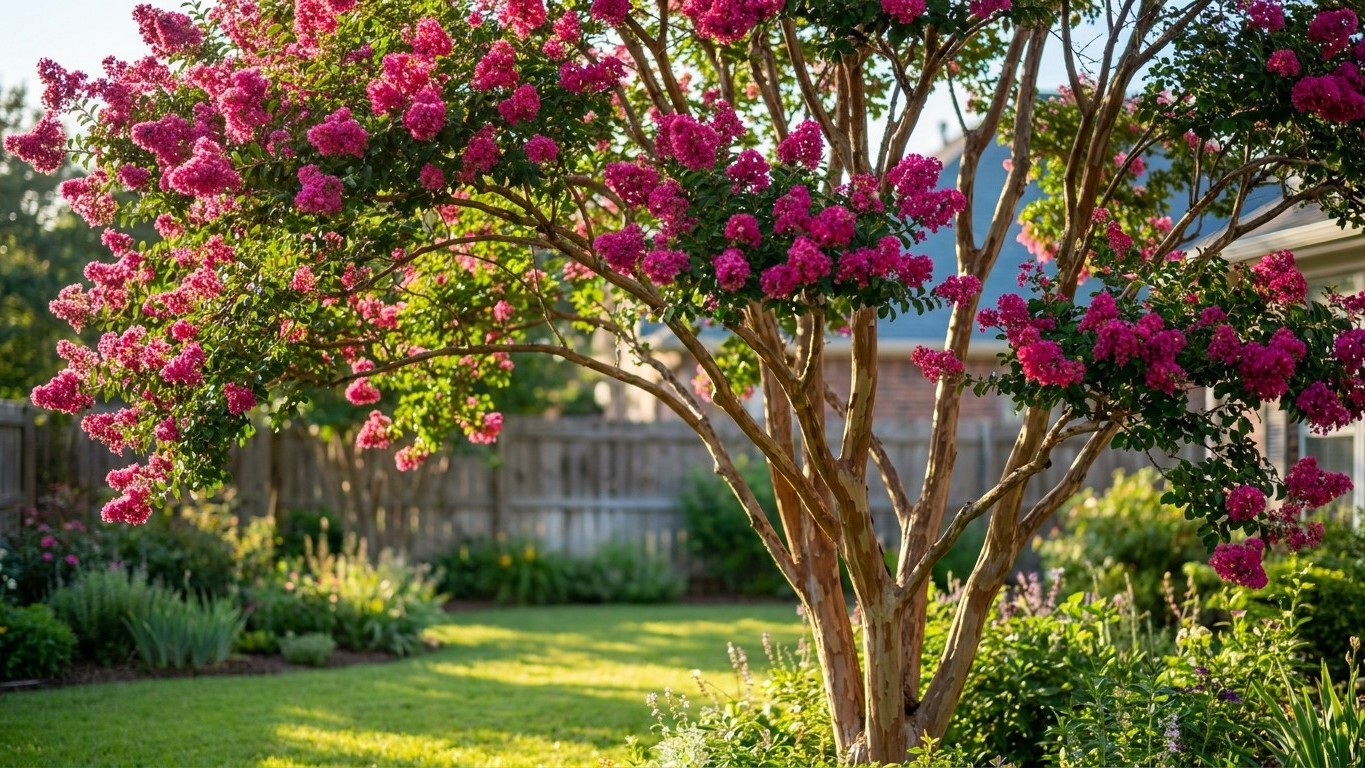

Lagerstroemia indica, better known as crape myrtle, survives in USDA hardiness zones 6a-9b, tops out at 12-24 feet at maturity, and wants full sun with at least six hours of direct light a day. It tolerates a wide range of soils and drainage patterns, which makes the light requirement and the mature size the two facts that actually decide whether a given spot works.
Where it will and will not survive

The USDA hardiness range for Lagerstroemia indica is 6a-9b. That’s the number that matters more than any planting tip in this article, because it draws a hard line. Below the bottom of that range, winter cold will kill the plant outright or cut it back so severely, year after year, that it never behaves like the tree described here. Above the top of it, the plant may survive, but summer heat and humidity extremes push past what the species was measured against.
A range like this describes survival, not comfort. A crape myrtle rated hardy to zone 9b will likely live through a zone 9b winter, but that doesn’t mean 9b conditions suit it best, the way the description of a rapid grower with a dense, multi-stemmed habit suggests. The same caution runs the other way at 6a: surviving the coldest nights on record for that zone is not the same as thriving there every year, particularly in a rough winter with an early freeze or a late one.
Check your own zone before you check anything else
None of this is useful without knowing your own zone first, and guessing is a bad habit to start a planting project with. Zones shift by elevation and by microclimate as much as by latitude, so a county-level lookup beats a general sense of where you live. This site’s hardiness zone guide breaks zones down by state, and that’s the place to confirm where you actually fall before you decide anything else about this plant.
One more note on the source behind these numbers: the growing data here comes from the North Carolina Extension Gardener Plant Toolbox, and the USDA hardiness range it cites is a national standard, so it applies wherever you garden. But that same source also gives region-specific advice for North Carolina’s coastal plain, piedmont, and mountains, and that regional guidance is local to North Carolina. It should not be read as advice for a different state, even one that shares a hardiness zone number.
The mistake that costs the most: space
Crape myrtle reaches 12 to 24 feet at maturity, and that single figure causes more regret than winter cold ever does. Cold either kills a plant or it doesn’t, and you find out within a season or two. Space is different. A crape myrtle planted too close to a house looks perfectly reasonable for its first five or six years, then keeps growing, because the growth rate here is rated rapid. By the time it’s crowding a wall, leaning into a driveway, or tangled in overhead wires, it’s not a small plant anymore, and cutting it back hard to fix a spacing mistake usually ruins the vase-shaped habit that makes crape myrtle worth planting in the first place.
That’s the real cost: the mistake doesn’t show up on planting day. It shows up ten or fifteen years later, when the fix isn’t a prune, it’s a removal. A shrub or small tree that’s outgrown its spot next to a foundation or a septic field doesn’t get smaller with pruning, and by then the root system is established enough that moving it isn’t realistic either.
Run these checks before you dig
- Look straight up. Is there a power line, eave, or roof overhang within what would become a 12- to 24-foot spread?
- Check what’s underground. Septic lines, drain fields, and utility runs don’t mix well with an expanding root system over a decade or two.
- Measure out from the planting spot in every direction, using the full mature spread, not the size of the nursery plant in front of you.
- Think about which way the canopy will shade. A dense, multi-stemmed crown will eventually block sun to whatever sits on its north or east side, depending on your layout.
- Confirm the distance to any wall, drive, or fence line, since a multi-trunked habit widens at the base as much as it does higher up.
None of this requires special tools, just fifteen minutes of walking the site with the mature size in mind, before the shovel comes out.
The site it actually wants
The North Carolina Extension Gardener Plant Toolbox lists a wide set of conditions this plant tolerates, not one narrow ideal. That distinction matters, because plenty of planting advice flattens a list like this into “likes rich, well-drained soil,” which throws away the useful part: this species handles far rougher ground than that.
| Condition | What Lagerstroemia indica tolerates |
|---|---|
| Light | Full sun (6+ hours of direct sunlight a day) |
| Soil texture | Clay, high organic matter, loam (silt), sand, shallow rocky soil |
| Soil pH | Acid (below 6.0), neutral (6.0-8.0), alkaline (above 8.0) |
| Drainage | Good drainage, moist, occasionally dry, occasionally wet |
The one non-negotiable item on that list is light. Everything else is a tolerance range wide enough to cover clay soil in one yard and sandy soil in another, both fine, so long as full sun is available.
Reading your own site without a lab test
Soil texture is easy to check by hand: squeeze a moist handful into a ball. Clay holds a tight shape and feels sticky; sand falls apart almost immediately; loam holds together loosely and crumbles with light pressure. All three are listed as acceptable here.
Drainage is just as simple. Dig a hole about a foot deep, fill it with water, and see how long it takes to empty. Water that’s gone within a few hours signals good drainage; standing water after half a day points to a wetter site, which this plant can still handle given the “occasionally wet” tolerance listed above, though it isn’t the same as a swamp.
pH is the one item worth a real test if you want precision, since it isn’t something you can eyeball. A home soil test kit gives a rough number, and given how wide the acceptable range runs here, from acid to alkaline, most home landscapes will already fall somewhere inside it without any amendment at all.
Planting it so it establishes
Getting a crape myrtle through its first year matters more than anything you do afterward, and most of the risk comes down to two mistakes that are easy to avoid once you know to look for them.
- Pick the planting season using the frost guidance on this site rather than a calendar month, since frost timing shifts by zone and by year.
- Dig the hole wide, roughly two to three times the width of the root ball, but no deeper than the root ball itself.
- Find the root flare, the point where the trunk widens into roots, and keep it level with or slightly above the surrounding grade.
- If the plant came from a container, tease out any roots that are circling the root ball before it goes in the ground.
- Backfill with the same soil that came out of the hole, without swapping in amended soil that creates a different texture pocket underground.
- Water deeply right after planting, then settle into a schedule that’s infrequent but thorough rather than a light daily sprinkle.
- Mulch in a wide ring around the base, two to three inches deep, keeping it pulled back from the trunk itself.
The two errors that kill young trees more than anything else are planting too deep and piling mulch against the bark. A trunk buried even a few inches below grade can rot at the base over time, and a mulch volcano stacked against the bark holds moisture against the trunk and invites the same problem from the outside in. Neither mistake shows up right away, which is exactly why they’re so common.
One more point worth saying plainly: the growing conditions data lists this species as drought tolerant, but that rating describes an established plant with a developed root system, not a tree in its first season. A newly planted crape myrtle needs regular, deep watering through that first year regardless of what the mature plant can handle later. Skipping that step because “it’s drought resistant” is a common and avoidable way to lose a young tree.
What it resists, and what it does not
Resistance is a tendency, not a guarantee. When a source lists a plant as deer resistant, that means deer browse it less often than they browse more palatable species nearby, not that deer will never touch it. A hard winter with little else to eat changes that calculation fast, and the same logic applies to drought and pollution tolerance.
| Challenge | What resistance means here | What you’d actually see |
|---|---|---|
| Deer | Listed as a resistance, meaning lower browsing pressure than many nearby ornamentals | Occasional browsing is still possible, especially on young growth in lean seasons |
| Drought | Applies once the plant is established with a mature root system | A first-season plant still needs regular watering regardless of this rating |
| Pollution | Tolerates roadside and urban air conditions better than many species | Suitable for street-side or urban plantings without special siting |
The growth rate here is rated rapid, and maintenance is rated medium. Those two facts together predict what the coming years look like more than any resistance rating does. A rapid grower with a dense, multi-stemmed, vase-shaped habit fills its allotted space quickly, which is exactly why the spacing decision earlier in this article carries so much weight. Medium maintenance generally points to some routine pruning and cleanup, particularly given the persistent seed capsules this species produces through winter, rather than a plant you can ignore entirely once it’s in the ground.
Put together, a rapid grower that resists deer browsing, tolerates drought once established, and handles pollution reasonably well is a low-drama plant in most years, but “low-drama” still means it needs the room it was given credit for at planting time.
Common questions
Is Lagerstroemia indica the same plant as crape myrtle?
Yes. Crape myrtle, crepe myrtle, common crape myrtle, and a few other common names all refer to the same species, Lagerstroemia indica. The botanical name is used here because the common names are listed alphabetically in the source data with no single one treated as primary.
Does crape myrtle lose its leaves in winter?
Yes. It’s classified as deciduous, so it drops its foliage seasonally rather than holding leaves year-round like an evergreen.
When does crape myrtle bloom?
Bloom time is listed as summer. Exact timing shifts with latitude and elevation, so a garden further south or at lower elevation will typically see blooms earlier in the season than one further north or higher up.
Is crape myrtle considered a native plant?
The source classifies it as a native plant, but that designation refers to native status in the southeastern United States specifically, not nationwide. Gardeners outside that region should treat it as an introduced ornamental rather than a native species for their area.