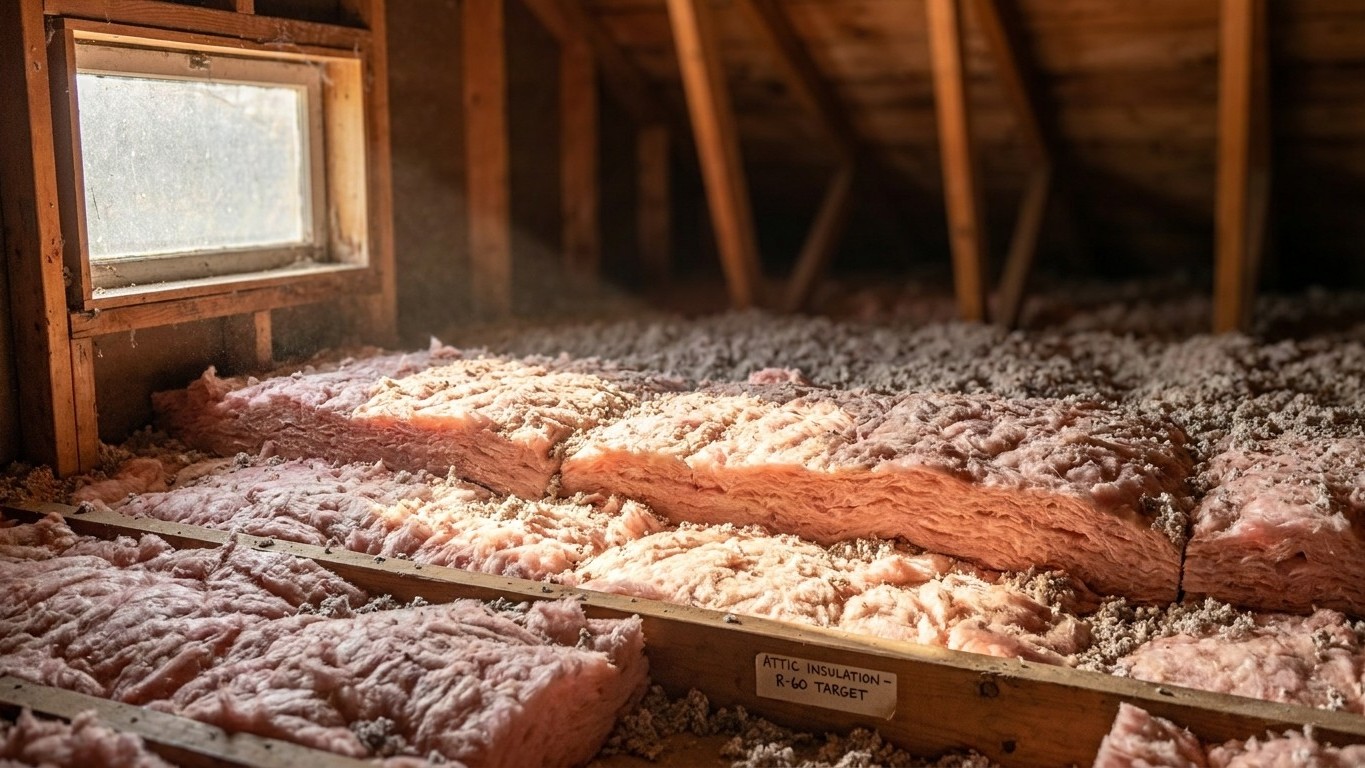

Alabama doesn’t have one insulation answer. The state splits across two IECC climate zones, so the right R-value depends on which of the 67 counties a home sits in, not on a single statewide rule. The ENERGY STAR retrofit table below gives the exact figures once you know your zone, and a county lookup or the ENERGY STAR map settles that first question.
Which climate zone Alabama is in

The 2021 International Energy Conservation Code puts Alabama’s 67 counties into two zones: 58 counties fall in Zone 3A, and 9 counties fall in Zone 2A. That’s the split, full stop. There is no single zone for “Alabama” the way there is for some states, and a guide that hands you one number for the whole state is guessing for roughly a seventh of its counties.
Here’s where the county-count caution matters. Nine counties sounds like a rounding error next to fifty-eight. But those nine include Mobile County and Baldwin County, two of the most populated counties on the Gulf Coast. A count of counties tells you geography, not how many people live under each zone. Write it as “9 counties of 67,” not as “a small slice of the state” and definitely not as “most of Alabama,” because population and county count don’t move together here.
What the zone number and letter mean
A climate zone number is a shorthand for how demanding the local climate is on a building’s envelope. Lower numbers mean milder heating needs; Alabama’s zones (2 and 3) sit toward the mild end of the national scale used for insulation guidance. The letter after the number is a moisture regime, not a decoration: A means moist, B means dry, C means marine, and zones 7 and 8 (found in much colder states) carry no letter at all. That letter changes which row of the insulation table applies, because the ENERGY STAR chart groups some zones together by letter (4A and 4B share a row; 6, 5, and 4C share another). For Alabama’s 2A and 3A counties, the letter confirms these are moist-climate zones, which matters for how a home handles humidity as much as for R-value.
None of this tells an individual reader which zone covers their own address. That’s deliberate. The zone determines how much material goes into an attic, a floor, or a crawlspace, and getting it wrong in either direction wastes money or leaves a home underprotected. The reliable way to find your own zone is the official ENERGY STAR climate zone map, or a county-by-county reference built from the same IECC table used above. Once you know whether you’re in 2A or 3A, the next section gives the actual numbers.
The insulation levels that apply here
ENERGY STAR publishes recommended insulation levels for retrofitting existing wood-framed homes, based on the 2021 IECC. The table has a header that’s easy to misread: “Attic” actually splits into two separate figures, one for an attic that currently has no insulation at all, and one for an attic that already has 3 to 4 inches in place. Floor is a third, separate column. Three numbers per zone, not three attic values.
| Zone | Attic if UNINSULATED | Attic if you already have 3-4 inches | Floor |
|---|---|---|---|
| Zone 1 | R30 | R25 | R13 |
| Zone 2 | R49 | R38 | R13 |
| Zone 3 | R49 | R38 | R19 |
| Zones 4A and 4B | R60 | R49 | R19 |
| Zones 6, 5, and 4C | R60 | R49 | R30 |
| Zones 7 and 8 | R60 | R49 | R38 |
For Alabama, only two rows ever apply. The 9 counties in Zone 2A follow the Zone 2 row: R49 for an uninsulated attic, R38 if 3-4 inches are already there, and R13 under the floor. The 58 counties in Zone 3A follow the Zone 3 row: the same R49 and R38 attic figures, but R19 under the floor instead of R13. The gap between the two rows is small on attic insulation and shows up mainly in the floor recommendation, but it’s a real difference, and a homeowner in Mobile is not shopping for the same floor insulation as one in a Zone 3A county further north or inland.
These figures are for retrofitting an existing wood-framed home, not new-construction code minimums, and they’re not something to average across the state to get one convenient number. Averaging a 2A and a 3A figure produces a value that matches no actual requirement anywhere in Alabama. Depth in inches isn’t listed here on purpose: it depends entirely on the insulation material used, and manufacturers print that figure on their own packaging.
Sealing comes before insulating
ENERGY STAR treats air sealing and insulation as two parts of a single project, and its own guidance sequences attic air sealing before attic insulation. That order isn’t arbitrary. Insulation slows heat moving through a material, but it does nothing to stop air moving around gaps, cracks, and penetrations. Lay batts or blown-in fiberglass over an unsealed attic floor and you haven’t closed those leaks, you’ve just hidden them under material that makes them harder to find and fix later.
The practical sequence, in order:
- Seal air leaks in the attic (penetrations, top plates, chimney chases, recessed lighting)
- Add attic insulation up to the recommended level for your zone
- Seal and insulate rim joists
- Address floor insulation over crawl spaces or unconditioned basements
- Move to wall insulation and sealing last
This order matters more in Alabama’s climate than it might in a colder state, because the region’s humidity means sealed but poorly insulated cavities can trap moisture rather than just lose heat. Getting the sequence backwards, insulating before sealing, is one of the most common ways homeowners spend money on material without getting the performance they expected.
The detail of how to execute each of these steps, what to look for, what tools help, how to handle a finished attic versus an open one, lives in the national insulation guides on this site rather than repeated here. This page exists to settle which zone and which R-value apply in Alabama specifically; the how-to sits one level up.
What the winter here actually asks for
At Huntsville International Airport, NOAA’s 1991-2020 climate normals show about 2,831 heating degree days a year and about 2,107 cooling degree days. Degree days aren’t a temperature reading, they’re a measure of demand: the figure adds up, for every day of the year, how far the average temperature fell below 65°F. A state with twice the heating degree days of another needs roughly twice the fuel to hold the same indoor temperature in a comparable house. Alabama’s number, at this one reference station, points to a heating season that’s real but far from the most demanding in the country, and a cooling season that’s substantial in its own right, which is worth remembering in a state where insulation guidance often gets framed only around winter.
What Alabama homes actually heat with matters just as much as the degree-day count. EIA’s 2020 Residential Energy Consumption Survey for the state shows 45% of homes using a furnace as their main heating equipment, 39% using a central heat pump, 28% running on natural gas, 64% on electricity, and 5% on propane. Steam or hot-water boiler use and fuel oil or kerosene came back as “none reported” in the survey, which means too few households responded to publish a reliable figure, not that zero homes use them.
A state running mostly on furnaces and heat pumps through ductwork has different priorities than one heated by boilers and radiators. Ducts running through an unconditioned attic are themselves a source of heat loss that ceiling insulation alone doesn’t fix; sealing and insulating the ducts is a separate job from sealing and insulating the attic floor above them. Local priorities, in order:
- Seal and insulate attic ductwork if the system runs through an unconditioned attic
- Bring attic insulation up to the R49/R38 levels for your zone
- Address floor insulation given the state’s humidity and crawlspace prevalence
- Check heat pump and furnace duct connections for leakage, since both equipment types are common here
The duct-specific guides on this site cover sealing and insulating ductwork in more depth than fits here, and they’re worth reading alongside this page given how many Alabama homes route heating and cooling through attic ducts.
What the work is worth
ENERGY STAR’s own methodology states it plainly: “EPA estimates that homeowners can save an average of 15% on heating and cooling costs (or an average of 11% on total energy costs) by air sealing their homes and adding insulation in attics, floors over crawl spaces, and accessible basement rim joists.” Both numbers matter together. Fifteen percent applies specifically to heating and cooling costs; eleven percent applies to total energy costs, a broader category that includes things like water heating and appliances. Quoting one number without its denominator turns an accurate figure into a misleading one.
These are averages drawn from energy modeling of a “typical” existing U.S. home, not a guarantee tied to any specific house in Alabama or anywhere else. The estimate also names exactly where the modeled work happened: attics, floors over crawl spaces, and accessible basement rim joists. It doesn’t extend to walls, windows, or doors, and stretching it to cover those areas isn’t supported by the source.
Two other percentages float around on the subject and shouldn’t get mixed in with this one. ENERGY STAR’s program landing page separately mentions “up to a 10% savings on your annual energy bills” for the same category of work, an “up to” figure on a different base than the 15%/11% estimate above. The Department of Energy also publishes a 10% figure, but that one concerns a thermostat setback of 7 to 10 degrees held for eight hours a day, and has nothing to do with insulation at all. Three real numbers, three different claims, and the 15%/11% pairing from ENERGY STAR’s methodology page is the one that actually describes air sealing and insulation work.