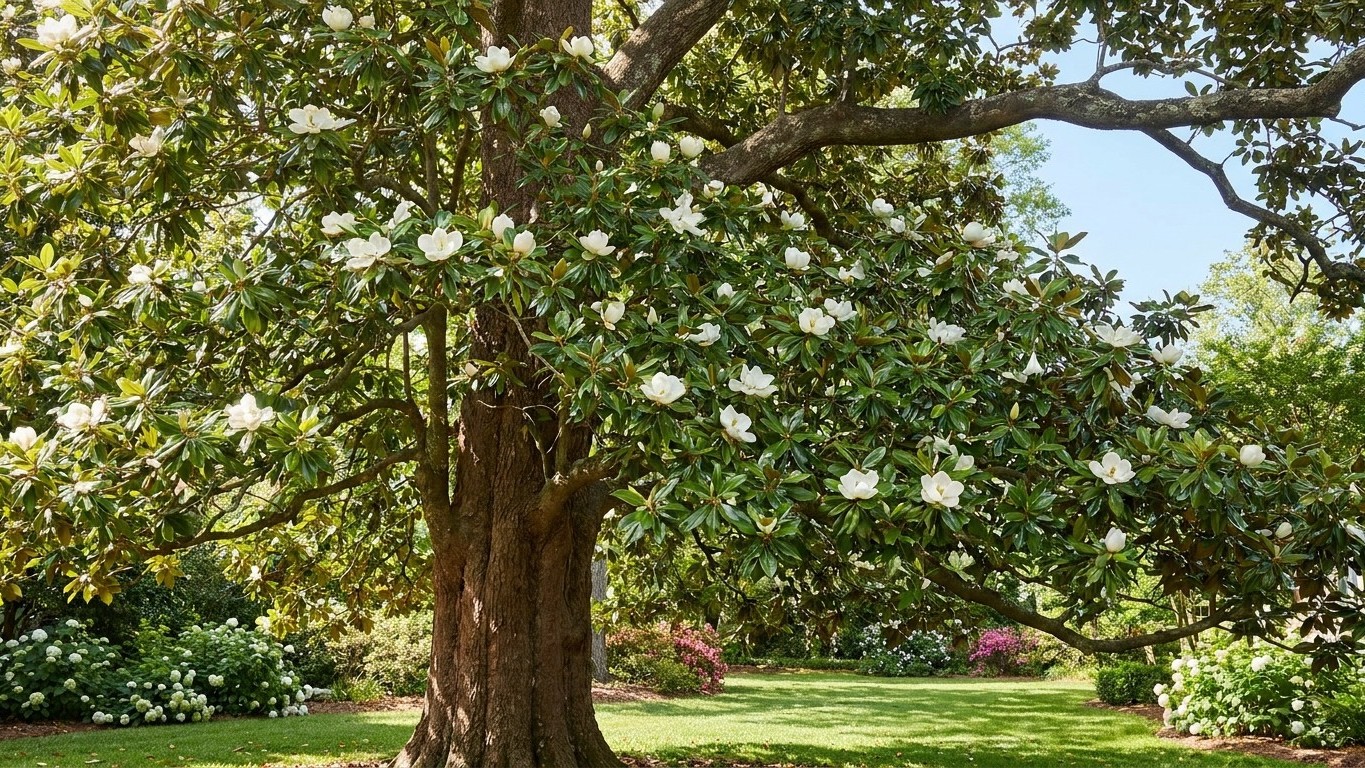

Southern Magnolia (Magnolia grandiflora) is hardy across USDA zones 6a-9b, reaches a mature spread of 24 to 60 feet, or more than 60 feet where conditions allow full growth, and grows best in full sun to partial shade on soil with good drainage. It’s also sold and labeled as Bull Bay or Large Tree Magnolia. The bigger issue for most homeowners isn’t whether it will survive a given winter. It’s whether there’s enough ground for it to grow into.
Where it will and will not survive

The USDA hardiness range for this tree is 6a-9b. That figure is a boundary, not a recommendation: it tells you where the biology stops, not where the tree is happiest. Below the bottom of that range, winter cold will kill or badly damage a Southern Magnolia more winters than not. Above the top of it, the tree can survive, but survival and comfort aren’t the same thing. A plant rated to the warm edge of its range is often stressed there by heat and humidity even while it stays alive.
Zone maps are also drawn at a scale that misses a lot of real-world variation. A property near a large body of water, on a slope, or in a low frost pocket can sit in a different practical zone than the county-level map suggests. Look up the specific rating for your state and county on this site’s hardiness zone guide before deciding whether this tree belongs on your property at all.
Southern Magnolia is also classified by its source as a Native Plant, though that label is regional: native to the southeastern United States, not native everywhere it’s sold or planted. Outside that native range, the hardiness zone match is the deciding factor, not the “native” label.
One more wrinkle: a tree that survives its first winter in a marginal zone can still be lost in a harder winter five or ten years later, since cold-hardiness limits describe averages, not guarantees for every year going forward.
The mistake that costs the most: space
The source gives the mature spread of Southern Magnolia as 24 to 60 feet, or more than 60 feet under strong growing conditions. Either figure describes a large tree, and the habit is described as conical, dense, and pyramidal, meaning it holds a full, wide crown rather than an open, airy one that lets light and structures share space beneath it.
This is the mistake that costs more than a hardiness misjudgment, because a hardiness mistake shows up fast: the tree struggles or dies within a season or two, and the loss is limited to the cost of the plant. A space mistake shows up on a completely different timeline. A young Southern Magnolia planted too close to a foundation, driveway, or septic field looks fine for years, until the crown pushes into siding or lines and roots wide enough to match a 60-foot canopy start lifting pavement. At that point the fix isn’t pruning. A tree this size, planted too close, usually has to come out.
Before digging, run through the same checks every time:
- Look up: is there any overhead utility line, eave, or roofline that a crown reaching well past 60 feet across could eventually reach?
- Look down: is there a septic field, water line, sewer line, or foundation footing within the tree’s eventual root zone?
- Measure the canopy reach: plan for a radius of roughly half the mature spread from the trunk to the widest point of the crown in any direction.
- Think about shade direction: a dense, pyramidal evergreen this size will cast a heavy, year-round shadow, so consider what’s on the shaded side decades out.
Treat “more than 60 feet” as a real possibility rather than a worst-case exaggeration.
The site it actually wants
The source describes tolerances rather than a single ideal setup. Southern Magnolia isn’t a plant that demands rich, tilled loam to succeed; it accepts a range of conditions, which is part of why it shows up so often in older neighborhoods and unamended soils.
| Condition | What the source lists as acceptable |
|---|---|
| Light | Full sun (6+ hours direct) or partial shade (2-6 hours direct) |
| Soil texture | Clay, loam/silt, or soil high in organic matter |
| Soil pH | Acid (below 6.0), neutral (6.0-8.0), or alkaline (above 8.0) |
| Drainage | Good drainage or consistently moist soil |
Read that table as a list of what the plant will tolerate, not as a formula to reproduce. Where the tolerance list narrows things down is drainage: “good drainage or moist” doesn’t include soil that sits waterlogged for days after rain.
Checking your own site without lab equipment
Drainage is easy to test directly. Dig a hole roughly a foot deep, fill it with water, let it drain once, then fill it a second time and time how long it takes to empty. Water gone within a few hours indicates fast, well-drained soil; standing water after half a day or more suggests a spot better suited to moisture-tolerant planting.
Soil pH is harder to eyeball, but a basic soil test through a county extension office will give a reliable number. Given that this species tolerates acid, neutral, and alkaline soil, a pH test mostly rules out extreme outliers rather than dictating a specific target.
When a site doesn’t match well, treat that as evidence the spot isn’t right, even if the size and hardiness both check out.
Planting it so it establishes
Getting a Southern Magnolia into the ground correctly matters more than most people expect for a tree this size, because the two most common planting errors don’t show up as failure right away. They show up as a slow decline over several years, by which point the cause is hard to trace back.
- Choose the planting season using local frost timing rather than a fixed calendar month; this site’s frost date guide for your state is a better reference than “spring” or “fall.”
- Dig the planting hole wide, generally two to three times the width of the root ball, rather than deep, so roots spread outward instead of stopping at the edge of a narrow pit.
- Locate the root flare, the point where the trunk widens into roots, before setting the tree in the hole.
- Keep that root flare level with, or very slightly above, the surrounding grade. Planting too deep is one of the most common causes of a young tree slowly failing over several years.
- Tease out any roots that are circling the root ball, since these can eventually girdle the trunk as the tree grows.
- Backfill with the same soil that came out of the hole rather than a different soil mix, so roots spread into the native ground.
- Water deeply and infrequently rather than a light daily sprinkle, so moisture reaches down to where roots need it.
- Mulch two to three inches deep in a wide ring, keeping mulch pulled back from the trunk to avoid rot.
The source lists this tree as tolerant of established drought conditions, but that tolerance applies to a mature root system, not a first-year planting. A newly planted Southern Magnolia needs regular, deep watering through at least its first growing season regardless of how drought-tolerant the species becomes later.
What it resists, and what it does not
Resistance, in a plant description, means a lower likelihood of damage, not immunity. A tree described as deer resistant still gets browsed occasionally, especially in a hard winter. A tree described as drought resistant still needs water while young.
For Southern Magnolia specifically, the source doesn’t assign a rating for deer, salt, wind, disease, wet soil, insect pests, storm damage, or urban conditions. Each of those is listed as unspecified rather than resistant or vulnerable.
| Challenge | What the source states | What that means for a reader |
|---|---|---|
| Deer | Not specified | No documented resistance rating; don’t assume it’s a deer-proof choice |
| Salt, wind, storm damage | Not specified | No basis for claiming coastal or storm hardiness beyond general observation |
| Diseases, insect pests | Not specified | No documented resistance; monitor the tree rather than assume it’s problem-free |
| Wet soil, urban conditions | Not specified | Use the drainage and site tolerances above instead of assuming a resistance rating |
Where a source is silent, the honest answer is that no claim can be made either way, not that the tree is presumably tough because it’s large and long-lived.
What the source does specify is a medium growth rate paired with high to medium maintenance. Combined with a mature spread that can exceed 60 feet, a medium grower still adds up to a lot of growth over a couple of decades. The maintenance rating reflects that size and density: a dense, evergreen canopy this large sheds leaves and seed pods year-round rather than in one tidy fall cleanup, and pruning a tree this size safely usually calls for a professional once it’s past the reach of a homeowner’s ladder. Southern Magnolia also attracts pollinators, small mammals, and songbirds, but that’s a factor separate from the maintenance question.
Common questions
Is Southern Magnolia the same as the Bull Bay or Large Tree Magnolia sold at some nurseries?
Yes. Bull Bay and Large Tree Magnolia are both common names used for the same tree, Magnolia grandiflora. None of the three names is the official one, which is why the botanical name is more reliable to check against before buying.
When does Southern Magnolia bloom?
The source lists spring and summer as the bloom season. The exact timing shifts with latitude and elevation, so a specific month isn’t a reliable guide from one property to another.
What does the fruit look like, and is it edible?
The source describes a spherical, cone-like fruiting cluster up to 3 to 5 inches long, made up of an aggregate of follicles that mature from September to October and release individual rose-red seeds on slender threads. That’s a physical description only; the source doesn’t address taste or edibility, and none should be assumed.
Does “drought resistant” mean I can skip watering a new tree?
No. Drought tolerance in the source’s data applies to an established root system, generally built up over the first year or more in the ground. A newly planted tree needs regular deep watering during that establishment period regardless of how the mature plant is described.