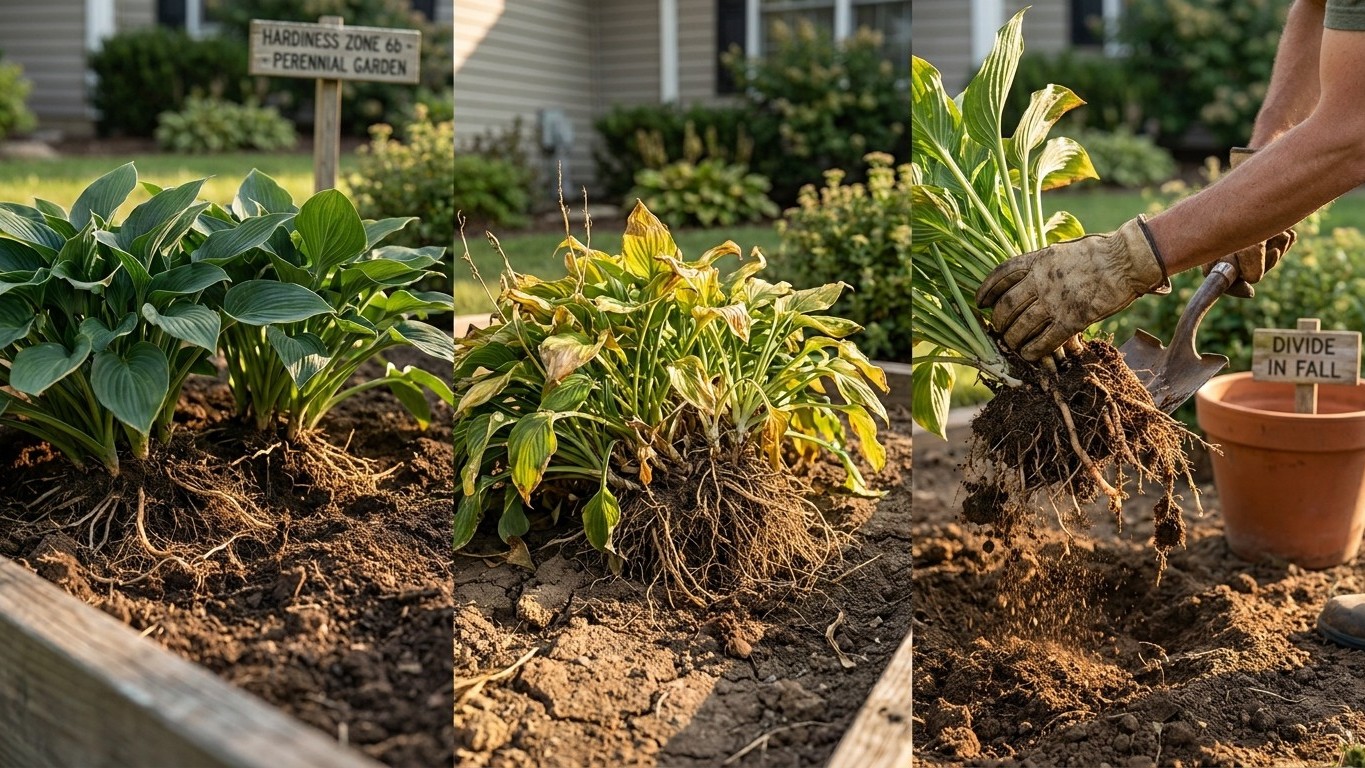

The short answer: a perennial’s fate in your yard comes down to three checks, run in order. Hardiness zone tells you What Will Not Survive a typical winter. Drainage tells you whether the roots will rot before the top growth even struggles. And a division schedule, once the clump is established, keeps it from crowding itself into decline. Skip any one of the three and the plant either dies quietly or takes over the bed.
The limit that decides everything

Hardiness is usually presented as a promise: this plant grows in zones 5 through 9. Read it the other way. The range is really a boundary telling you where the plant will not survive, not a guarantee of how well it will grow inside that boundary. A hosta rated to zone 3 will live through a brutal Minnesota winter. Whether it looks good in a hot, dry corner of a zone 8 yard is a completely separate question that hardiness data never answers.
The USDA Plant Hardiness Zone Map is built from one number: the average annual minimum winter temperature for a given location, recorded over a multi-year period. Each zone spans a 10-degree Fahrenheit band, and each zone is split again into an “a” half and a “b” half, five degrees apart. That letter is not decoration. A plant rated for 7b but not 7a can freeze out in a garden that sits in the colder half of the same zone number, especially in a low spot where cold air pools on a still night. Two addresses ten miles apart can land in different half-zones once elevation and local terrain are factored in, so it’s worth checking your specific zone through the USDA Plant Hardiness Zone Map rather than assuming it matches a neighboring town or a number remembered from years ago. Boundaries have shifted in some regions as the underlying climate data has been updated.
One more thing worth flagging before it costs anyone a plant: if a source lists a plant’s hardiness as a scattered set of zones, something like 4, 6, 8, separated by commas instead of a continuous span, that pattern usually signals a gap in the data rather than an actual planting quirk. A plant does not skip zone 5 and zone 7 while surviving in 4, 6, and 8. Treat that kind of listing as incomplete and look for a fuller range before planting on the strength of it.
None of this touches comfort. A shrub can be fully hardy for a zone and still sulk there every summer because the soil, the light, or the humidity doesn’t suit it. Hardiness answers one question: will it survive the cold. Everything else about how well it performs is a separate set of checks, starting with the one gardeners tend to skip.
And the one people discover too late
Hardiness gets checked because it feels like a pass-or-fail test. Mature size gets skimmed because the plant in its pot looks harmless, and the mistake doesn’t show up for years. A maple planted three feet from a foundation, a viburnum tucked under a power line, a perennial clump that seemed modest at planting time but swallows the path by its fifth summer: these are the expensive errors, because by the time the problem is obvious, the fix isn’t a light pruning. It’s removal, and often removal of something that took a decade or more to grow.
The reason this mistake is so common is that a young plant gives almost no visual cue about its ceiling. A five-gallon tree and a five-gallon shrub can look nearly identical at the nursery and end up 40 feet apart in mature spread. Before digging, a short set of checks catches most of the trouble:
- Look up. Note any overhead utility wires within the eventual height of the plant, not just its current height.
- Look at what’s nearby at ground level. Foundations, driveways, and walkways can be damaged by roots or by a trunk that widens over decades.
- Look down, or rather find out what’s down there. Buried utility lines, septic fields, and irrigation piping all matter to where roots are allowed to spread.
- Think in terms of the eventual canopy, not the current one. A plant’s spread at maturity, not at purchase, is what determines how close it can safely go to a structure or another plant.
- Consider which direction the shade will fall once the plant is grown, since a canopy that seemed harmless at planting can eventually shade a vegetable bed, a solar panel, or a neighbor’s yard.
No specific distance belongs in a general list like this one, because the safe distance from a foundation or a wire depends entirely on how big that particular species gets, and that number varies by a factor of ten or more between one plant and another. That’s exactly why the individual plant guides on this site each carry their own mature size, and why that figure deserves more attention than the hardiness zone does when a planting spot is tight.
Choosing, in the order that works
Most plant shopping starts backwards: something looks good at the garden center, gets carried home, and then the household spends a weekend trying to find it a spot. Flip that order and most of the expensive mistakes above disappear before they happen. The site conditions get evaluated first, and only afterward does the search for an actual plant begin.
- Light. Full sun, part shade, or full shade, tracked honestly across a full day rather than guessed from a quick glance at noon.
- Drainage. Whether water sits after a heavy rain or moves through within a few hours changes which entire categories of plants are even worth considering.
- Space. The available width and height, measured against what’s overhead and underground, not against what looks empty today.
- Zone. The hardiness check, run last among the site factors, since it eliminates candidates rather than selecting one.
- Only then, what’s available. With the first four boxes filled in, the remaining question is simply which plant, among the ones that fit, is worth growing.
The order matters because the first two items on that list, light and drainage, are close to fixed. Full sun can’t be created where a mature tree already casts shade, short of removing the tree, and a naturally wet low spot can’t be turned into well-drained soil without significant regrading or an underdrain system, neither of which is a casual weekend project. Space is even less negotiable: a six-foot bed is a six-foot bed regardless of what anyone wishes were true about it. Zone, by contrast, is fixed by geography and can only be worked around at the margins, with a warmer microclimate against a south-facing wall or added winter protection.
A plant chosen before any of this gets forced into whatever’s left, which is how a shade-loving perennial ends up scorched in full sun, or a plant that wants sharp drainage ends up rotting in clay that holds water for days. Working from the site inward, the specific guides on this site for trees, shrubs, and perennials each lay out the light, drainage, and mature size needed to make that last step, picking the actual plant, the easy part instead of the guessing game it usually turns into.
What is on this site
The individual guides on this site are organized the way the decision above actually unfolds: by category first, then by the details that separate one candidate from another once light, drainage, space, and zone have narrowed the field. The tree guides cover species chosen for the home landscape rather than for a woodlot, with attention to root behavior near structures and the eventual canopy that matters so much once a tree is in the ground for good. The shrub guides sit in the middle of the size range, useful for screening, foundation plantings, and seasonal color, and they carry the same hardiness and mature-size information as the tree pages, scaled to a shorter timeline. The perennial guides, including the individual cultivar pages, are where division schedules live in the most detail, since perennials are the category most likely to need splitting every few years to stay vigorous rather than crowding themselves out.
One honest note about where the plant data itself comes from: the underlying growing information across these guides draws on a university extension source based in North Carolina. The USDA hardiness range for any given plant is a national standard and applies the same way regardless of where the source is written. Regional growing advice from that same source, timing notes, regional pest patterns, or seasonal care windows, reflects conditions in the Southeast and should be weighed against local extension guidance for anyone gardening well outside that region. It’s also worth knowing that when that source labels something a “native plant,” it typically means native to the southeastern United States specifically, not native to North America as a whole, which matters for anyone selecting plants with a regional ecosystem in mind rather than just a hardiness match.
Common questions
What if my address falls right on the line between two hardiness zones?
Treat the colder of the two as the working number for anything marginal, especially in a low-lying yard where cold air settles. It costs nothing to plant a little more conservatively, and the loss of an expensive shrub to one hard winter costs a lot more than the caution would have.
Can poor drainage make a plant fail even inside its correct hardiness zone?
Yes, and it’s one of the most common reasons a supposedly hardy plant dies anyway. Waterlogged soil suffocates roots and encourages rot regardless of how cold-tolerant the top growth is rated to be. Hardiness and drainage are separate tests, and a plant has to pass both.
How do I know when a perennial clump actually needs dividing?
The usual signs are a dead or thin center with vigorous growth only around the outer ring, noticeably fewer or smaller flowers than in previous seasons, and a clump that has outgrown its space. Timing and exact frequency vary by species, which is why the individual perennial guides carry their own division notes.
Does “deer resistant” mean deer will leave a plant alone entirely?
No. It means deer tend to avoid that plant when other food is available, not that the plant is immune to browsing. A hungry deer in a lean winter will sample almost anything, including plants labeled resistant, so it’s a reasonable planning factor rather than a guarantee.
Guides by state
- Achillea millefolium
- Amsonia hubrichtii
- Asclepias tuberosa
- Baptisia australis
- Anacis verticillata
- Echinacea purpurea
- Heuchera americana
- Iris sibirica
- Lavandula angustifolia
- Monarda didyma
- Phlox paniculata
- Rudbeckia fulgida
- Salvia nemorosa
- Hylotelephium spectabile
- Achillea millefolium: Hardiness, Drainage and Dividing
- Amsonia hubrichtii: Hardiness, Drainage and Dividing
- Asclepias tuberosa: Hardiness, Drainage and Dividing
- Baptisia australis: Hardiness, Drainage and Dividing
- Anacis verticillata: Hardiness, Drainage and Dividing
- Echinacea purpurea: Hardiness, Drainage and Dividing
- Heuchera americana: Hardiness, Drainage and Dividing
- Iris sibirica: Hardiness, Drainage and Dividing
- Lavandula angustifolia: Hardiness, Drainage and Dividing
- Monarda didyma: Hardiness, Drainage and Dividing
- Phlox paniculata: Hardiness, Drainage and Dividing
- Rudbeckia fulgida: Hardiness, Drainage and Dividing
- Salvia nemorosa: Hardiness, Drainage and Dividing
- Hylotelephium spectabile: Hardiness, Drainage and Dividing