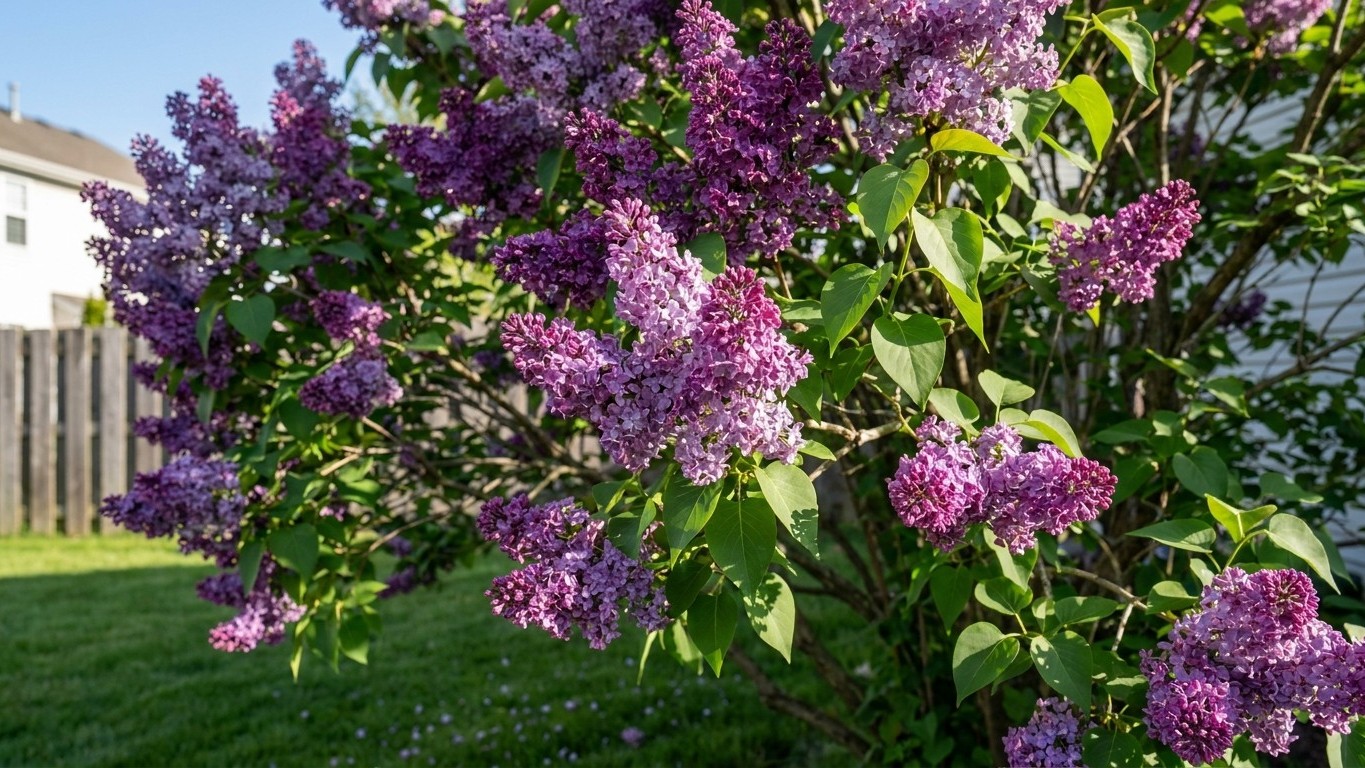

Common Lilac, English Lilac and French Lilac are the names most often used for Syringa vulgaris, a deciduous shrub hardy in USDA zones 3a-7a. North Carolina Extension lists it as Edible, Perennial, Shrub, with spring flowers that can be eaten raw or fried into fritters. It grows 6 to 12 feet wide and tall, tolerates full sun or partial shade, and needs decent drainage. When it gets pruned depends entirely on when it blooms, and that detail is worth understanding before the first cut.
Where it will and Will Not Survive
USDA hardiness zones 3a-7a is the range North Carolina Extension gives for Syringa vulgaris. A plant rated for this range should survive winter lows within it, but that says nothing about how happy it will be at either edge. A lilac at the cold floor of zone 3a is doing exactly what it evolved to do; one at the warm ceiling of zone 7a is surviving, not necessarily thriving.
Below the bottom of this range, winter temperatures drop past what the plant can take, and no amount of mulch changes that reliably. Above the top of it, the problem usually isn’t a killing frost but the absence of one: many lilacs need real winter chill to set buds, so a site that stays too warm tends to produce a shrub that lives but blooms poorly.
None of this tells you what to do with your own yard, because “above” and “below” only mean something once you know your zone. Don’t assume it from a state name or a neighbor’s garden; zones shift by county and even by elevation. This site’s hardiness zone guide breaks the country down by state so you can check the actual number for your address before planting.
North Carolina Extension is where this plant data comes from, and the USDA hardiness figure it reports is a national standard, usable anywhere. The same page also carries advice specific to North Carolina’s own regions, coastal plain, piedmont, mountains, and that regional guidance doesn’t travel. A reader elsewhere should take the zone number and leave the rest of that source’s regional detail behind.
Light, soil and where it belongs
North Carolina Extension gives a set of conditions this shrub tolerates, not a single ideal spot. Read the list as a range of acceptable ground, not a formula to match exactly.
| Condition | Tolerated by Syringa vulgaris |
|---|---|
| Light | Full sun (6+ hours direct) or partial shade (2-6 hours direct) |
| Soil texture | Clay, high organic matter, loam (silt) |
| Soil pH | Alkaline (above 8.0) or neutral (6.0-8.0) |
| Drainage | Good drainage or consistently moist |
Given the choice between the two light options, full sun tends to produce the fuller bloom this shrub is grown for; partial shade is a tolerance, not a preference, and a plant stuck in the shadier end will still be alive but leggier and less floriferous.
What it looks like from the window
The habit North Carolina Extension records, ascending, conical, erect, irregular, multi-stemmed, pyramidal, vase, describes a shrub with real structure and some unpredictability, not a tidy mound. Multiple upright stems mean it reads as a dense mass in leaf and a looser, twiggier silhouette once the deciduous foliage drops. Planted along a fence, it works as a backdrop filling the middle layer between lawn and structure. Planted where it’s seen through, expect it to screen fully only in the growing season.
Space at maturity is 6 to 12 feet, and that figure produces two different spacing decisions. For a hedge meant to knit into a continuous screen, plant closer to the low end so neighboring canopies overlap sooner. For a specimen grown alone as a focal point, give it the full 12 feet from any wall or foundation, plus enough clearance to walk around it once filled in. Planting a specimen at hedge spacing from a structure is the mistake that shows up five years later as a shrub pressed against siding.
When it flowers, and what that decides
Bloom time for Syringa vulgaris is spring, given as a season rather than a month on purpose: a spring bloom in a warmer part of its range arrives earlier than the same bloom farther north or at higher elevation.
The bloom season matters less for the display than for the calendar it sets for pruning, and this is where gardeners go wrong most often with flowering shrubs. A shrub that sets buds on the previous year’s growth needs pruning right after it finishes flowering, because pruning in late winter cuts off buds already formed and waiting. A shrub that flowers on new growth put on the same season can be pruned before growth starts, since the wood that will carry flowers hasn’t been made yet.
North Carolina Extension’s entry doesn’t state which category this plant falls into, so the honest answer is to find out by watching, not guessing. Note when the flowers fade this spring, then watch the stems over the following weeks. If pruning shortly after bloom yields a full flush again next spring, that confirms the old-wood pattern and sets your yearly window: right after flowers drop, not before. If pruning at any other time doesn’t reduce next year’s bloom, you’re dealing with a new-wood plant that can be shaped in late winter instead. One season of watching answers the question more reliably than a rule borrowed from a different shrub.
Planting and the first two years
Getting a lilac into the ground correctly matters more than anything done to it afterward. The sequence North Carolina Extension’s growing conditions data supports, combined with standard planting practice, runs in this order:
- Plant in fall or early spring, while dormant and soil is workable, rather than during summer heat.
- Dig the hole wider than deep, roughly twice the width of the root ball, so roots spread outward rather than down.
- Set the plant so the root flare sits at or just above grade, never buried.
- Tease out any circling roots before backfilling, so they don’t girdle the stem later.
- Backfill with the native soil rather than amending heavily, so roots don’t stay confined to a richer pocket.
- Water deeply right after planting to settle soil and eliminate air pockets.
- Mulch two to three inches deep out to the drip line, kept back from direct stem contact.
However drought-tolerant a mature lilac is once established, that says nothing about a plant in its first two summers. Newly planted shrubs need regular, deep watering through their first two growing seasons regardless of what the established plant can handle later, since the roots doing the establishing haven’t developed the reach tolerance depends on.
Set expectations accordingly: many woody shrubs sulk in year one, fill out more in year two, and don’t reach full bloom and form until year three. A lilac that looks stalled after its first summer usually isn’t struggling, it’s building roots that pay off later. Digging it up on the assumption something’s wrong is the more common mistake than leaving it alone.
What it resists, and what it does not
Resistance in a plant description means a tendency to be left alone, not a guarantee. A “deer resistant” label describes what deer usually do, not what a hungry deer in a bad winter won’t do.
North Carolina Extension’s resistance data lists three categories, deer, salt and rabbits, and for Syringa vulgaris all three are recorded as unspecified. That’s a meaningful gap: it means the source makes no claim either way, and neither should this article. A reader choosing this plant specifically to keep deer or rabbits out of a bed should look for a species with an actual rating rather than assuming lilac qualifies.
| Category | What the source records | What that means for you |
|---|---|---|
| Deer | Unspecified | No claim of resistance; plant near deer pressure at your own risk |
| Rabbits | Unspecified | No claim of resistance; young stems may need protection where rabbits are active |
| Salt | Unspecified | No claim of tolerance; avoid relying on it near roadside salt spray |
Growth rate is recorded as medium and maintenance as low. Together those figures describe a shrub that doesn’t demand constant attention or repeated shearing to stay in bounds. Low maintenance paired with a 6 to 12 foot mature spread means the real work happens once, at planting, in choosing a spot with enough room, rather than ongoing through the plant’s life correcting a location that was too tight from the start.
Common questions
Can you eat lilac flowers?
North Carolina Extension’s entry states that the flowers of Syringa vulgaris can be eaten raw or folded into a batter and fried to make fritters. That’s the source’s own description of use, not a broader endorsement, and it applies to the flowers specifically, not other parts of the plant.
What does the lilac seed pod look like?
The fruit is a smooth, flattened dehiscent capsule about 3/4 inch long, carried in large panicles at the branch tips. It starts green and matures to brown, splitting into two segments, with four seeds per capsule. That’s a description of appearance and timing, not a comment on taste.
Is Syringa vulgaris deer resistant?
North Carolina Extension lists deer resistance for this plant as unspecified, meaning the source makes no claim in either direction. Don’t select this shrub as a deer deterrent based on its reputation elsewhere without confirming resistance through a source that actually rates it for your conditions.
When should I prune my lilac?
The source doesn’t state whether this shrub blooms on old wood or new wood, so the safest answer is to watch one season: note when flowers fade, then observe whether pruning shortly after affects next year’s bloom. That single season of observation tells you more reliably than a general rule which pruning window fits your particular plant.