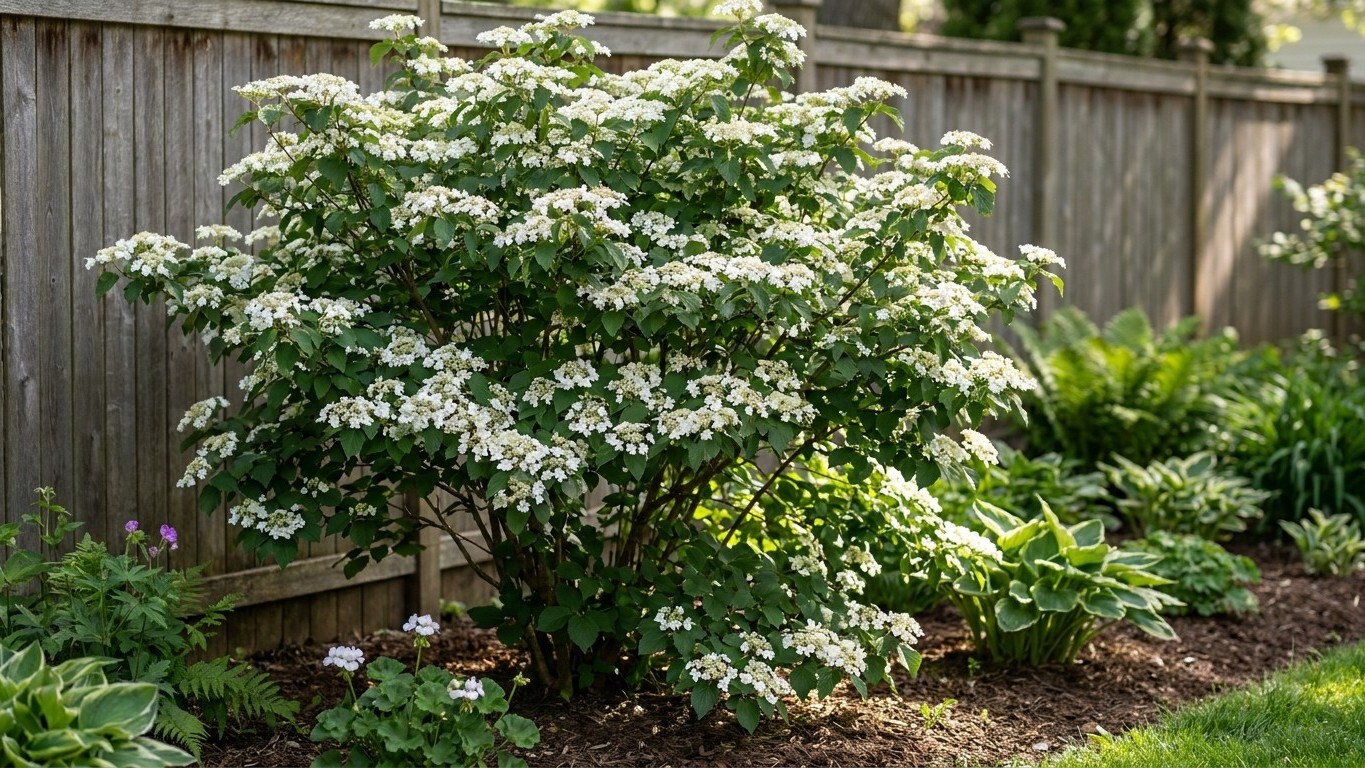

Viburnum dentatum, sold under names like Arrow-wood Viburnum, Arrowwood Viburnum, and Southern Arrowwood, survives in USDA hardiness zones 2a through 8b, one of the widest ranges you’ll find on a deciduous shrub. It tolerates full sun or partial shade, a broad mix of soil textures, and needs 6 to 12 feet of mature width. It blooms in spring, and whether you prune it before or after that bloom depends on something you’ll need to watch in your own yard, not a rule that applies everywhere.
Where it will and Will Not Survive
The USDA hardiness range for Viburnum dentatum runs from zone 2a to zone 8b. That’s a wide band, wide enough to cover most of the continental United States, but the number marks the edges past which the plant does not survive winter, not the zone where it looks its best.
Below the bottom of this range, the shrub has no track record of surviving winter cold. Above the top of it, past zone 8b, the plant runs into heat and humidity it wasn’t bred or naturally distributed to handle long-term, even though it may limp through a season or two. Neither end of the range is a place to plant with confidence.
Survival is not the same as thriving
A shrub rated hardy to zone 8b is not necessarily happy there. Hardiness ratings measure whether the plant lives through an average winter low, nothing about how vigorously it grows, how well it flowers, or how it handles the following summer. A plant sitting at the warm edge of its range can survive for years without ever settling in the way it would closer to the middle. The same logic runs the other direction at the cold edge.
None of this tells you what zone your own property sits in, and guessing is how a lot of newly planted shrubs end up dead by their second winter. Zone lines shift by county, and again with elevation and local microclimate, sometimes over a few miles. Before buying, check your own hardiness zone guide on this site rather than assuming your area matches a number you remember from years ago.
Worth noting separately: the plant data behind this profile comes from the North Carolina Extension Gardener Plant Toolbox, and that source lists Viburnum dentatum as a Native Plant, meaning native to the southeastern United States specifically, not native to the country as a whole. A wide hardiness range doesn’t make a plant native everywhere it can survive. Those are two separate questions, and the source only answers one of them.
Light, soil and where it belongs
The North Carolina Extension Gardener Plant Toolbox lists a range of conditions this shrub tolerates, not a single ideal setup. Reading it as a list of what it will accept, rather than what it needs, keeps expectations realistic.
| Condition | Tolerances listed by the source |
|---|---|
| Light | Full sun (6+ hours direct) or partial shade (2-6 hours direct) |
| Soil texture | Clay, loam (silt), sand, shallow rocky |
| Soil pH | Acid (below 6.0) or neutral (6.0-8.0) |
| Drainage | Good drainage, moist, or occasionally dry |
That spread of tolerances is unusually forgiving. Clay soil that stays soggy, sandy soil that drains fast, or a mix that’s fairly rocky and shallow all fall inside what this plant has shown it can handle. It doesn’t mean any of those soils get the best out of it, only that none of them rules the plant out on their own.
What it looks like from the window
The habit is described as arching, erect, multi-stemmed, and rounded, meaning a full-bodied shrub rather than a single trunk with a canopy. Planted along a property line, that habit works as a screen you can’t easily see through once it fills in. Planted as a lone specimen, the same form reads as a soft mass rather than a sculptural focal point, and its blue-black fruit, shown from July through September, draws in birds and other small wildlife, worth factoring in if the planting sits near a window you look out of.
Space at maturity is listed as 6 to 12 feet, and that figure implies two different spacings depending on the job. For a hedge meant to knit into a solid screen, plant on the tighter side, closer to 6 feet apart, so neighboring shrubs merge instead of leaving gaps. For a standalone specimen, give it the full 12 feet of clearance from walls, fences, and other plantings. Splitting the difference is the most common way this shrub ends up crowded a few years after planting.
When it flowers, and what that decides
Viburnum dentatum blooms in spring, given as a season rather than a calendar month, because bloom timing shifts with latitude and elevation.
The flowering season matters for more than the display of white spring blooms. It decides when the shrub should be pruned, and getting that timing backward is the most common way gardeners cut off a season’s flowers without meaning to.
The old-wood, new-wood rule
Shrubs that set flower buds on the previous year’s growth need pruning shortly after they finish blooming, before they form next year’s buds. Cut them in late winter or early spring instead, and you remove the growth that was about to flower. Shrubs that flower on the current year’s new growth work the opposite way: they can be pruned in late winter or early spring, before growth resumes, without losing a bloom.
The source used for this profile doesn’t state which category Viburnum dentatum falls into. Rather than guess, the more reliable approach is to watch it for one season. Note when flowers appear and how far along new stem growth is at that point. If blooms show up early on stems that grew the previous year, before much new growth has emerged, treat it as an old-wood bloomer and prune right after flowering ends. If flowers appear later, on stems that clearly grew out that same season, prune in late winter instead.
Planting and the first two years
Getting a Viburnum dentatum established follows the same sequence that works for most container-grown shrubs, with a few steps that matter more than they look like they should.
- Plant in fall or early spring, when soil is workable and temperatures aren’t extreme in either direction.
- Dig the hole wider than it is deep, roughly two to three times the width of the root ball, so roots have loosened soil to grow into laterally.
- Set the root flare, where the trunk widens into roots, level with or slightly above the surrounding grade. Buried too deep, it struggles for years.
- Tease out any roots circling the root ball before planting, so they don’t continue growing in a loop underground.
- Backfill with the native soil that came out of the hole, without amending it heavily, so roots don’t stay confined to a softer pocket.
- Water deeply right after planting, soaking the entire root zone rather than a light surface sprinkle.
- Mulch two to three inches deep out to the drip line, keeping mulch pulled back a few inches from the stems.
The source lists this shrub as tolerant of occasionally dry conditions once established, but that tolerance describes a plant with a developed root system, not one still settling in. The first two summers decide whether it makes it, regardless of what the label says about drought tolerance later, and that means regular deep watering through those seasons even in a species known for handling dry spells once mature.
It also helps to know what normal looks like early on. Many shrubs, this one included, spend their first year doing very little above ground while roots establish. Year two brings visible fill-in growth. Year three is usually when the shrub performs the way it’s described on a plant tag. A shrub that looks stalled in year one is not necessarily failing, and digging it up to check the roots usually does more harm than the patience would have.
What it resists, and what it does not
Resistance, wherever it’s claimed for a plant, means a tendency to shrug off a problem more often than not. It doesn’t mean immunity, and a resistant plant can still be affected under the wrong conditions.
The North Carolina Extension Gardener Plant Toolbox entry for this species doesn’t specify particular pest or disease resistances for Viburnum dentatum, so none should be assumed or listed here. What the source does confirm are its growth habits and the wildlife it draws in.
| Trait | What the source states | What it means for care |
|---|---|---|
| Growth rate | Medium | Fills in over a few seasons rather than a single year; no need to crowd plants for faster coverage. |
| Maintenance | Low | Doesn’t demand frequent feeding, spraying, or shaping to stay presentable. |
| Attracts | Butterflies, pollinators, small mammals, songbirds | Worth siting where wildlife activity near the shrub is welcome, not a problem. |
A medium growth rate paired with low maintenance points toward a shrub that needs occasional shaping rather than constant attention, once the pruning timing question from the earlier section is settled. Given the 6- to 12-foot mature spread, the main ongoing task is simply making sure the space allotted at planting still holds up once the shrub reaches its full width.
Common questions
Is Viburnum dentatum the same plant as Arrowwood Viburnum?
Yes. Arrow-wood Viburnum, Arrowwood Viburnum, and Southern Arrowwood are all common names used for the same plant, Viburnum dentatum. None is the official or primary name; the botanical name is used here because the common names don’t sort out a clear favorite.
Can Viburnum dentatum survive a zone 9 winter?
The USDA hardiness range given for this shrub tops out at zone 8b, so zone 9 falls above it. Confirm your specific zone with a hardiness zone guide before planting, since zone boundaries can shift over short distances.
How far apart should I space Viburnum dentatum for a hedge?
Given a mature spread of 6 to 12 feet, plant toward the tighter end, near 6 feet apart, if the goal is a solid, continuous hedge. Wider spacing leaves gaps between shrubs even after they mature.
When should I prune Viburnum dentatum?
That depends on whether it flowers on old wood or new wood, which the available plant data doesn’t specify for this species. Watch one bloom season: if flowers appear early on stems from the prior year, prune right after flowering; if they appear later on that season’s new growth, prune in late winter instead.