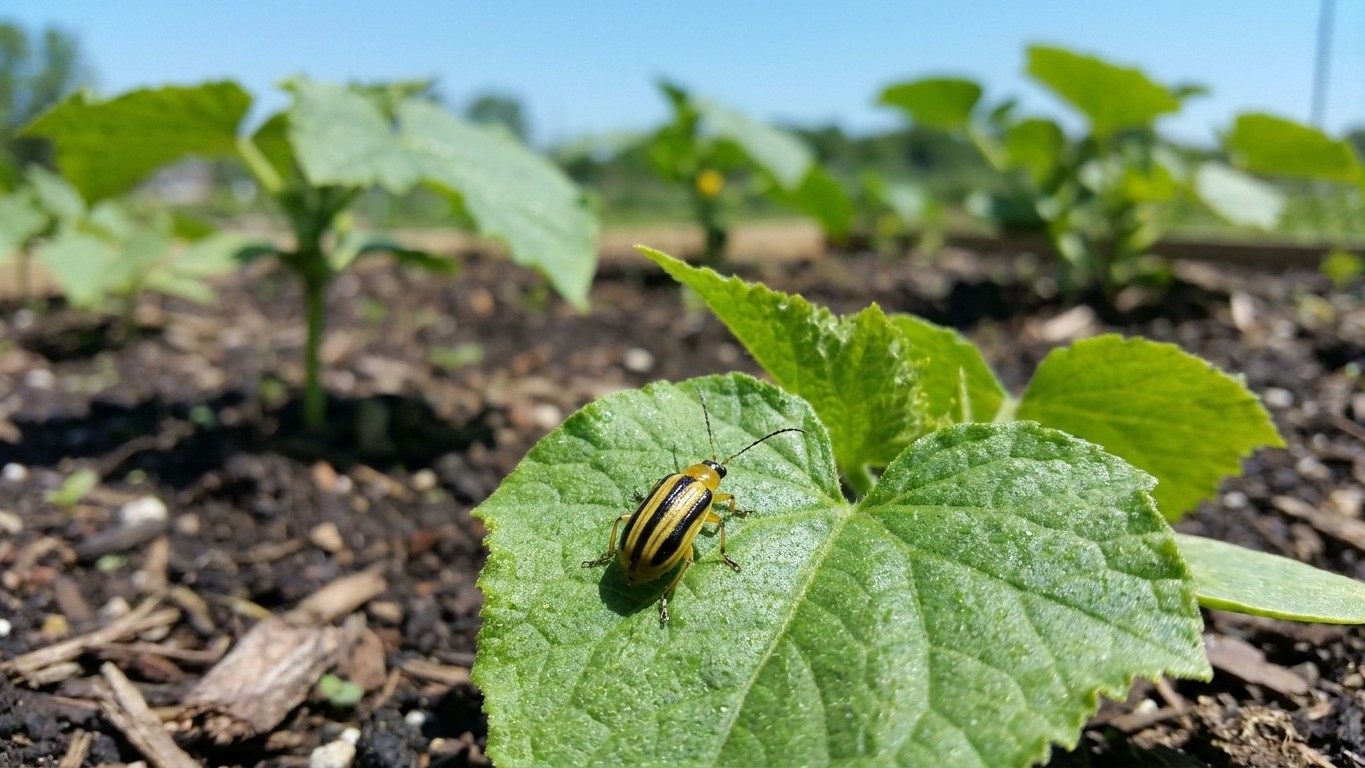

Summer squash in New Hampshire gets hit hardest by two insects: the squash vine borer, which kills whole plants from the inside, and the striped cucumber beetle, which spreads bacterial wilt as it feeds. Flea beetles, Japanese beetles, and a couple of sap-sucking bugs round out the list, but timing and scouting decide how much damage they actually do.
Which pests attack summer squash in New Hampshire

UNH Cooperative Extension documents nine insect pests for this territory, and only six of them have any business on a summer squash plant. The rest are real pests, just not of this crop, and naming them here would send a gardener chasing the wrong bug.
The ones that actually feed on summer squash are the squash vine borer, the striped cucumber beetle, flea beetles, the Japanese beetle, the brown marmorated stink bug, and the tarnished plant bug. The vine borer tunnels into stems and is the one that kills a plant outright, often overnight. The striped cucumber beetle chews leaves and blossoms but does more damage as a disease vector, since it carries the bacterium behind bacterial wilt from plant to plant. Flea beetles shred young leaves into a fine, buckshot-like pattern, mostly on seedlings. Japanese beetles skeletonize foliage, leaving the veins behind like lace. The brown marmorated stink bug and the tarnished plant bug both pierce and suck rather than chew, leaving scarred or dimpled fruit rather than missing leaf tissue.
Three pests on the UNH list don’t belong on this page. The Asiatic garden beetle is mostly a turf and ornamental problem: its grubs feed on grass roots and the adults prefer garden flowers, not cucurbit foliage. The lily leaf beetle is a specialist that feeds almost exclusively on true lilies and fritillaria; it has no documented interest in squash. The rose chafer is a fixture on roses, grapes, and peonies, but it isn’t listed as a summer squash feeder here, so it stays off this list too.
That leaves a shorter roster than a lot of gardening advice implies. UNH Cooperative Extension documents a handful of pests for this territory, not a dozen, and the squash vine borer and striped cucumber beetle are the two that actually cause the kind of damage that ends a planting.
When each one shows up, and what it does first
New Hampshire’s growing season is bookended by a last spring frost that typically falls between April 16 and April 27 and a first fall frost usually arriving between October 13 and October 26, both based on the reference weather station and running one to two weeks earlier or later depending on the actual garden. Squash pests track that frost-free window more reliably than they track a calendar month, since insect activity follows soil and air temperature, not the date on a seed packet.
Striped cucumber beetles are usually the first to show up, often within days of transplanting or of seedlings breaking through the soil. The first sign is small, ragged holes in the cotyledons and first true leaves, sometimes with the beetles themselves visible on the undersides at dawn or dusk. A few weeks later, plants that looked fine can suddenly wilt from one side, which is the bacterial wilt these beetles carry rather than a new insect.
Squash vine borer adults tend to appear a few weeks after that first flush of beetle activity, once the vines are running. The earliest sign isn’t the borer itself but a small pile of moist, sawdust-like frass sitting near the base of the stem, right where the caterpillar has bored in. By the time a gardener notices sudden wilting of an entire vine while the rest of the plant looks green, the damage inside the stem is usually already done.
Flea beetles show up earliest of all, sometimes attacking transplants within a day or two of being set out, which is why the first two to three weeks after the frost-free date are the highest-risk window for young plants. Japanese beetles arrive later in the summer, once their grub stage has matured, and they go straight for open leaf tissue in full sun. The stink bug and tarnished plant bug tend to appear as the fruit starts forming, leaving small sunken or discolored spots rather than chewed leaves.
Telling the damage apart from everything else
Not every wilted squash plant has an insect problem, and treating a water issue like a pest problem wastes a season. The single detail that separates insect damage from most look-alikes is where the damage starts: at the stem base, on the leaf surface, or on the fruit itself.
| Symptom | Likely cause | What tells them apart |
|---|---|---|
| Sudden wilting of one vine, rest of plant fine | Squash vine borer | Frass at the stem base near the soil line; slit the stem and a caterpillar is often still inside |
| Whole plant wilting, no visible stem damage | Bacterial wilt via cucumber beetle, or drought stress | Cut the stem and squeeze; a milky, stringy ooze points to wilt disease, not lack of water |
| Small round holes across many leaves | Flea beetles or Japanese beetles | Flea beetle damage looks like buckshot on young leaves; Japanese beetle skeletonizes leaves later in summer, leaving veins intact |
| Yellowing between leaf veins | Nutrient deficiency, often nitrogen or magnesium | No chewed tissue or holes present; soil test is the only way to confirm |
| Torn or bruised leaves, broken stems | Mechanical damage from wind, hail, or foot traffic | Damage pattern is irregular and matches the direction of the weather or the path a person or tool would take |
A soil moisture check is worth doing before assuming any insect is responsible. New Hampshire’s reference station averages about 10.7 inches of rain across June, July, and August, with July the driest month at 3.3 inches, and a single dry stretch during that driest month can mimic wilt symptoms on its own. None of this replaces an actual look at the plant, and a gardener who isn’t sure what they’re seeing is better off sending a photo to their local extension office than guessing from a list like this one.
What actually works here, and what is a waste of time
A short growing season rewards timing over treatment. Row cover set down at transplanting and left on until flowering begins keeps both flea beetles and cucumber beetles off the plant during the highest-risk stretch, since that first two to three weeks after the frost-free window is when seedlings take the most damage relative to their size. The cover has to come off once flowers open, though, or pollinators can’t reach the blossoms and fruit set drops.
For the squash vine borer, the timing that matters is catching the frass pile at the stem base early, before the caterpillar has tunneled far enough to cut off the plant’s water supply. Some gardeners slit the stem lengthwise at that spot and remove the borer by hand, then mound moist soil over the wound so the stem can root again above the damage. It’s a fussier fix than a spray, but on a short New England season it often saves the plant, where waiting rarely does.
What doesn’t hold up well here is relying on a single late-season treatment after wilting has already spread through the vine, since by that point the bacteria or the borer has usually done damage that isn’t reversible. Broad, untimed treatments applied without regard to when pollinators are active also tend to cost more good insects than they save in squash, and this site doesn’t recommend specific products or active ingredients anyway. What’s labeled and legal to use in New Hampshire changes, and that call belongs to the state’s extension service, not a general gardening page.
Where to check this for your own county
The starting point for anything more specific than this page is UNH Cooperative Extension, reachable at extension.unh.edu. Its county offices track pest activity as it actually happens on the ground, which matters because none of the numbers above are guarantees for one particular yard.
New Hampshire spans USDA hardiness zones 3b through 6a, and a squash bed in the Connecticut River valley isn’t working the same calendar as one near the coast or up toward the White Mountains. The frost dates cited earlier come from a single reference station, and a garden a few miles away, especially at higher elevation or in a low-lying frost pocket, can see its last spring frost run a week or two later and its first fall frost arrive a week or two earlier. That shift changes when flea beetles hit transplants and when the vine borer’s egg-laying window opens.
A county extension office can also confirm what’s actually being seen locally in a given year, since pest pressure swings from one season to the next depending on how the previous winter went. Bringing in a photo, or better yet a sample of the damaged stem or leaf, gets a more useful answer than trying to match symptoms to a general list. That’s the next step worth taking before assuming which of these six pests is behind what’s showing up on the vine.