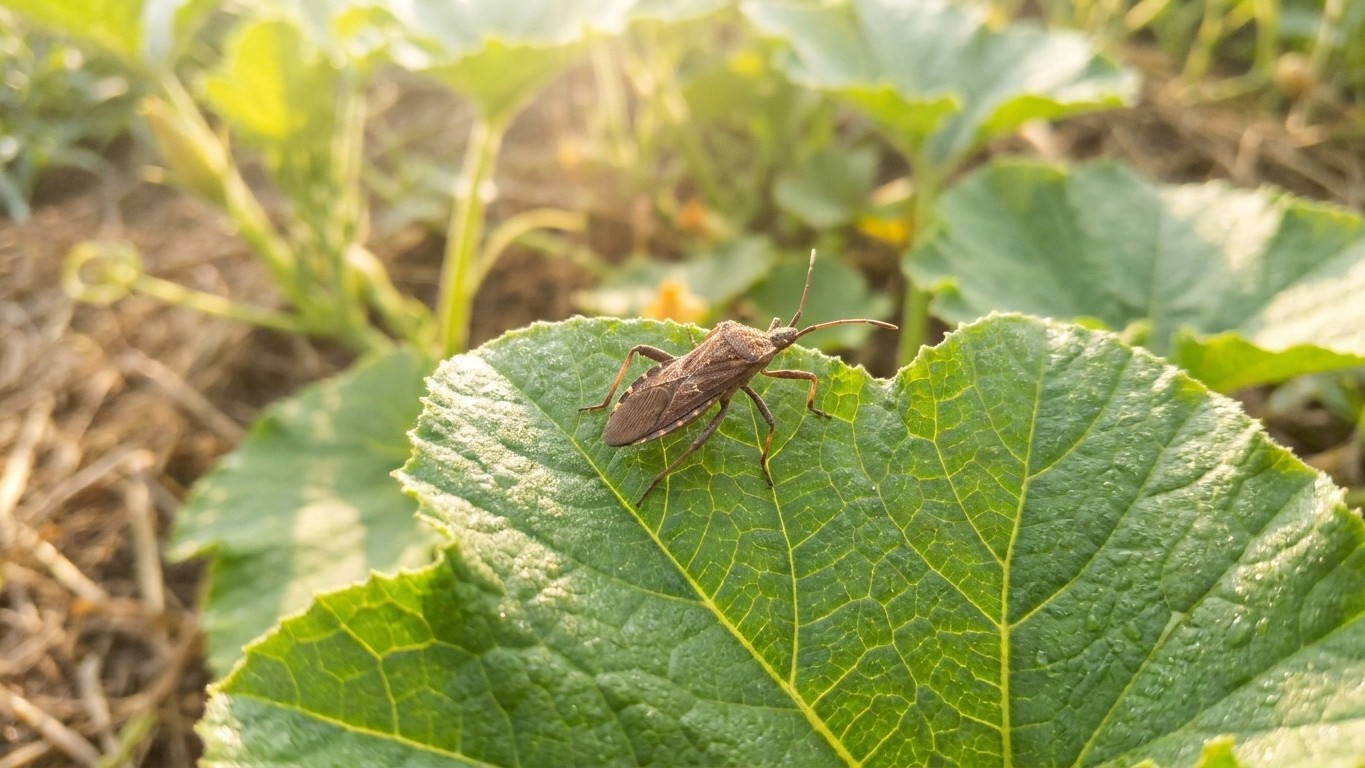

Four insects account for nearly all documented squash damage in North Carolina gardens: the striped cucumber beetle, flea beetles, Japanese beetle, and thrips (both tobacco and western flower species). The striped cucumber beetle arrives earliest and does the most damage to young plants, while Japanese beetle and thrips build through the hottest stretch of summer. Corn earworm shows up occasionally, but mostly as a minor nuisance on blossoms.
Which pests attack summer squash in North Carolina

NC State Extension documents nine insects for this territory, but only a handful of them have any business in a squash patch. The full list includes cabbage looper, corn earworm, fall webworm, flea beetles, hemlock woolly adelgid, imported cabbageworm, Japanese beetle, striped cucumber beetle, and thrips (tobacco and western flower). Naming all nine on a squash page would be dishonest, so here is the sorting.
The striped cucumber beetle is the one to watch first. It feeds on cotyledons and young leaves, and it carries bacterial wilt, a disease that can kill a plant within days once the beetle has fed on it. Flea beetles chew small round holes in seedling leaves and can stunt a plant before it ever sets a true leaf. Japanese beetle skeletonizes leaves later in the season, leaving a lace-like pattern behind, and it will also chew on flowers. Thrips, both the tobacco and western flower kinds, rasp at leaf and flower tissue and can distort new growth; they thrive in hot, dry stretches.
Corn earworm is on the documented list too, and it will occasionally feed on squash blossoms or the soft rind near a blossom end, but its primary hosts are corn and tomato. Treat it as a secondary concern here, not a headline pest.
Cabbage looper and imported cabbageworm do not attack squash. Both are caterpillars that feed almost exclusively on brassicas, cabbage, broccoli, kale, and their relatives. A squash leaf is not a host plant for either one, so a caterpillar found chewing squash foliage is something else, not one of these two.
Fall webworm and hemlock woolly adelgid are excluded for the same reason: they are documented pests of trees, not garden vegetables. Fall webworm spins silk nests on deciduous trees like pecan and persimmon. Hemlock woolly adelgid feeds exclusively on hemlock trees and has nothing to do with a raised bed or a row of squash plants. If either shows up in a search result next to squash, the source is padding its list, not describing what actually happens in a garden.
When each one shows up, and what it does first
Timing here runs off the frost calendar, not the calendar on the wall. North Carolina’s Piedmont region, where Charlotte sits as the reference point, sees its last spring frost between March 23 and April 5, and its first fall frost between October 30 and November 8. Squash typically goes into the ground after that spring frost window closes, and the pest sequence starts almost immediately.
Striped cucumber beetles are usually the first sign of trouble, often within a week or two of transplanting or seedlings emerging. The first thing a gardener notices is small, ragged holes in the cotyledons or the first true leaves, sometimes with the beetles themselves visible, black and yellow striped, clustered at the base of the plant. If the plant wilts suddenly a week or two later, without a clear water problem, bacterial wilt spread by the beetle is a strong possibility.
Flea beetles overlap with cucumber beetles early in the season, and their damage looks different: a shotgun pattern of tiny round holes across the leaf, rather than ragged chewing at the edges. Seedlings take the worst of it because they have so little leaf surface to spare.
Japanese beetle becomes noticeable later, once the region moves into its hottest stretch. The Piedmont averages 35 days a year at or above 90°F, and that heat load lines up with when Japanese beetle populations peak. The first sign is usually skeletonized leaves, where only the veins remain, along with beetles feeding openly on flowers during the warmest part of the day.
Thrips build through the same hot window, and they favor dry conditions. The first symptom is often distorted new leaves or streaked, silvery patches on foliage, rather than obvious chewing. Because they are so small, thrips damage is frequently noticed before the insect itself is spotted.
Corn earworm, when it appears at all, shows up mid to late summer and leaves small entry holes near blossoms or at the point where a young fruit meets the vine.
Telling the damage apart from everything else
Squash plants fail for plenty of reasons that have nothing to do with insects, and mixing them up leads to the wrong response. The single detail that separates most insect damage from everything else is whether the plant itself, or something feeding on it, is visible on close inspection. A magnifying lens and a few minutes at dawn or dusk, when beetles and thrips are most active, settles more questions than any photo comparison online.
| Symptom | Possible pest cause | What else it could be | What settles it |
|---|---|---|---|
| Ragged holes in young leaves | Striped cucumber beetle | Slug or snail feeding, hail damage | Beetles are visible on the plant; slug damage leaves slime trails, usually worse overnight |
| Tiny shotgun holes in leaves | Flea beetles | Early-stage fungal leaf spot | Flea beetle holes have clean edges and no discoloration ring; fungal spots often have a yellow halo |
| Skeletonized leaves, veins left intact | Japanese beetle | Rarely confused with anything else | Beetles are large, metallic green and copper, and feed in groups in daylight |
| Sudden wilting of one vine | Bacterial wilt following cucumber beetle feeding | Underwatering, root rot from waterlogged soil | Cut the stem; wilt disease produces a sticky, stringy sap when the cut ends are pulled apart |
| Distorted new growth, silvery streaks | Thrips | Herbicide drift, nutrient deficiency | Thrips damage is patchy and worse in hot, dry weeks; herbicide injury tends to affect the whole plant evenly |
None of this replaces a direct look. A local extension agent can confirm what a photo or a description cannot, especially for anything that looks like disease rather than chewing.
What actually works here, and what is a waste of time
On a short growing season, timing beats almost any product decision. Row cover placed over seedlings at transplanting, and removed once flowers open for pollination, is the single most reliable tool against cucumber beetle and flea beetle damage because it blocks the insect during the exact window when a young plant has no leaf surface to lose. Waiting until beetles are already visible means the cover is Protecting a plant that has already been fed on.
Removing flowers is not an option since squash needs bees for fruit set, so the cover has to come off before bloom, and that is exactly the point where scouting daily matters most, since the plant is unprotected right as beetles are most active.
Straw or mulch under the plants helps less with insects and more with the wilt disease they spread, by reducing soil splash and keeping humidity down around the stem base. Crop rotation, moving squash to a different bed each year, reduces the number of overwintering cucumber beetles nearby, since they spend winter in garden debris close to where they fed the year before.
What tends not to work: broad, calendar-based spraying without checking for the pest first. Thrips and flea beetles are mobile enough that a treatment applied on a fixed schedule, rather than triggered by an actual count of insects on the plant, wastes effort and money. Handpicking Japanese beetles into soapy water works on a small planting but does little on a larger one, since beetles are drawn from a wide area by scent.
Any chemical decision, including what is labeled for use on cucurbits in this state, belongs to a conversation with the local extension office, not a generic product label read at a store shelf.
Where to check this for your own county
The list above is documented at the state level by NC State Extension, and state-level documentation is a starting point, not a guarantee of what is in any one backyard. Pest pressure shifts across North Carolina: the coastal plain warms earlier in spring than the Piedmont, the mountains stay cooler later, and a beetle population thriving in one county can be barely present forty miles away.
The extension service’s county offices are where that gap gets closed. Every county in the state has one, staffed by agents who track what is actually showing up in local gardens that season, not just what is possible statewide. A call or a visit, ideally with a sample or a clear photo in hand, gets a much sharper answer than any general list can.
NC State Extension’s main site is ces.ncsu.edu, and it links out to every county center from there. For a gardener trying to figure out whether a beetle on a squash leaf is the striped cucumber beetle or something else entirely, that county office, not a search result, is the next stop.