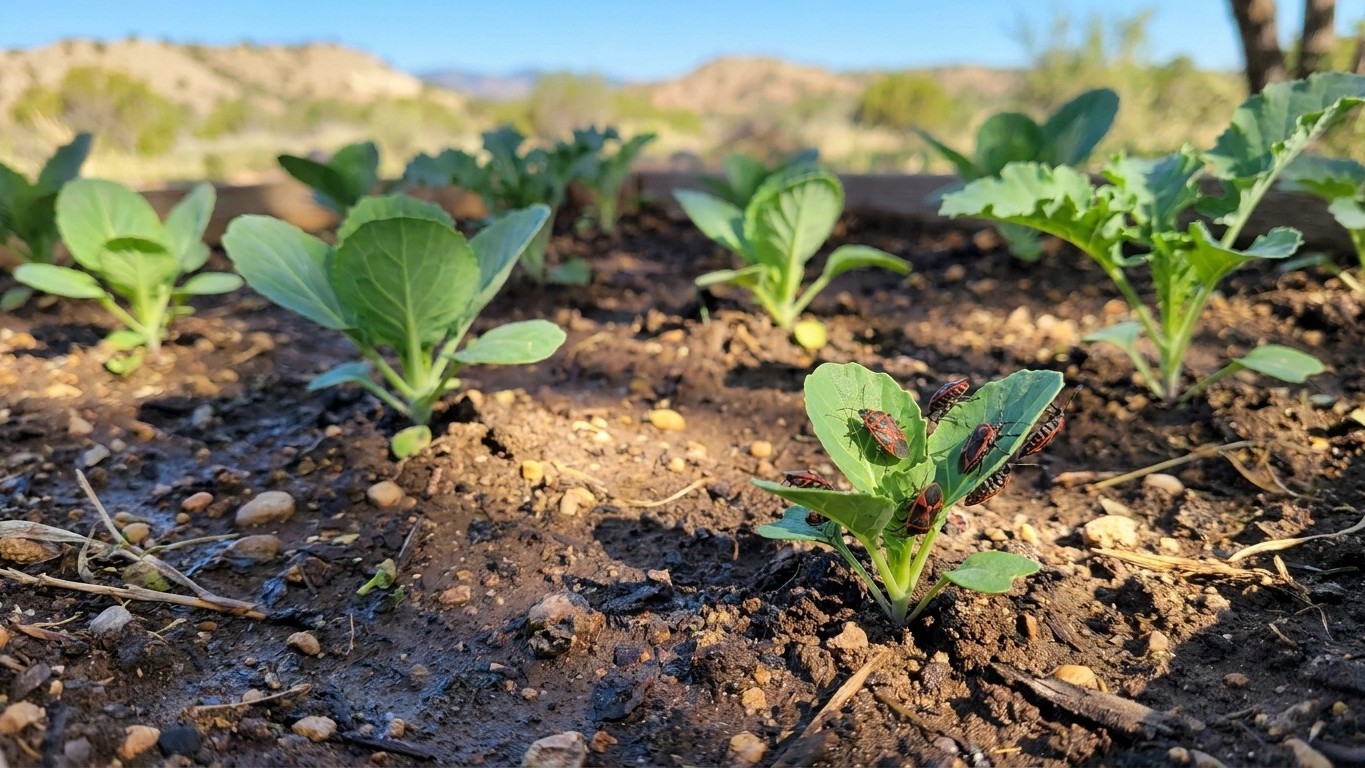

Bagrada bug shows up in New Mexico gardens once soil and air temperatures climb into the hot stretch of late spring and summer, targeting cole crops and their relatives while seedlings are still tender. New Mexico State University Extension doesn’t publish a specific date window for this species, but the pest’s own biology, combined with the state’s frost calendar, gives gardeners a workable planning tool.
The weeks to watch

New Mexico State University Extension’s guide to common garden insect pests, H-176, tracks generation counts for squash bugs, cucumber beetles, cutworms, Grasshoppers, Lygus bugs, and peachtree borer moths. Bagrada bug isn’t among them. That’s not an oversight so much as a gap in what’s been formally documented for this state: the pest is a relatively recent arrival to the Southwest, and its local timing hasn’t been pinned down the way older, more Established pests have.
What fills that gap is the general pattern seen wherever Bagrada bug has settled in the desert Southwest. It’s a heat-loving insect. Populations build as temperatures rise and slow down once the weather cools, which in practice means the risk window runs from the point brassica seedlings go into warming soil through the hottest weeks of summer.
Spring emergence
Adults become active as soon as daytime temperatures reliably push into the warm range, seeking out young crucifer plants and the weedy mustards that often host them along field edges and vacant lots before a garden crop is even in the ground.
Summer generations
Once established, Bagrada bug produces overlapping generations through the hot months, with adults, eggs, and nymphs present at the same time on the same plants. That overlap is what makes late-summer populations feel like they appeared overnight, even though the buildup has been happening for weeks.
Reading the calendar from your last frost

The one date most New Mexico gardeners actually plan around is the last spring frost, which for the reference station falls between March 31 and April 12, according to NOAA’s 1991-2020 Climate Normals. Bagrada bug doesn’t answer to that date directly. It answers to soil warmth, so a cold, slow spring pushes its arrival later, and an early warm-up brings it sooner.
The arithmetic is straightforward, but it produces a range, not a single day, because the frost date itself is a range:
- Start with your local last frost date. The reference figure is March 31 to April 12, but many suburban and rural gardens in New Mexico see frost later than that, sometimes by one to two weeks, especially at higher elevation.
- Count forward from whenever you actually Transplant. The pest typically causes visible damage within the plant’s first few weeks in the ground, while leaves are still soft and the growing point hasn’t hardened off.
That means row covers should go on at transplanting, not after the first stippling appears, and they need to stay in place through the early weeks when seedlings are most exposed. Treat the frost date as a normal to plan around, not a guarantee for your specific yard.
What it attacks, and what the damage looks like

The first sign is usually cosmetic before it’s alarming: white or pale stippling on young leaves, followed by seedlings that wilt in the heat of the day even when the soil is moist. On the worst-hit plants, the main growing point dies back entirely, and the plant responds by pushing out a cluster of stunted side shoots instead of a single strong stem, a symptom sometimes called “blind” growth. Both nymphs and adults cause this by piercing leaf and stem tissue with needle-like mouthparts and withdrawing sap, which is why the damage looks like scattered dead spots rather than chewed holes.
Because feeding happens on the outside of the plant at every life stage, rather than inside a stem or root where it would be hidden, gardeners can catch and treat an infestation at any point in the pest’s development. Crops most at risk include:
- Cabbage
- Broccoli
- Cauliflower
- Kale and other leafy brassicas
- Arugula, mustard greens, radish, and turnip
Weedy relatives of these crops, particularly mustards growing along fence lines and irrigation ditches, often carry the pest into a garden before a planted crop is even at risk, so damage on a nearby weed patch is worth noticing even if your beds look fine.
How New Mexico sits in this pest’s range

On this site, Bagrada bug is documented in one territory: New Mexico. That’s a narrow footprint compared to pests logged across a dozen or more states, and it puts New Mexico near the edge of what’s been formally tracked for this species rather than deep in its established core range. The pest’s broader U.S. range centers on the warmer parts of the Southwest and California, where it’s been established longer and where extension programs have had more seasons to document generation timing and crop losses.
A narrow documented range doesn’t mean the pest is rare in New Mexico gardens. It means the local data set is thinner, which is part of why New Mexico State University Extension’s own pest guide doesn’t yet list a specific seasonal window for it the way it does for longer-studied insects like squash bugs or cutworms. Gardeners in the state are, in effect, working with regional biology and local frost data rather than a state-specific generation count.
What actually works against it

The most effective responses are cheap, mechanical, and timed to the plant’s early weeks rather than aimed at wiping the pest out entirely.
- Adjust planting timing. Getting brassica transplants in early, before the hottest stretch of the season, or shifting a fall crop to avoid peak summer heat, means fewer weeks of overlap between tender seedlings and the pest’s most active period.
- Use row covers at transplanting. A physical barrier keeps adults from reaching foliage in the first place. It only works while it’s actually covering the plant, so it needs to go on the day seedlings are set out, not after the first stippling shows up, and it has to come off before flowering crops need pollinators.
- Hand-pick or shake plants over soapy water. On a home garden scale, this physically removes adults and nymphs before they reproduce further. It’s labor-intensive but has no waiting period and works at any point in the season.
- Rotate crops out of the same bed. Moving brassicas to a different spot each season disrupts the pest’s ability to build up in one location year after year, since overwintering adults tend to emerge close to where they fed the previous season.
- Clear weedy mustards and garden debris. Removing the weedy hosts that let the pest breed before your crop is even planted cuts down the population pressure hitting your beds later in the season.
Some gardeners also try reflective mulch as a deterrent, on the theory that the shifting light confuses the insect’s ability to find host plants. Field trials on that approach have been inconclusive, so it’s worth treating as a possible add-on rather than a primary defense. Because Bagrada bug feeds externally at every stage of its life, none of these measures become useless the way they would against a pest that bores into a stem or root; the challenge is timing and coverage, not access.
Common questions
Does Bagrada bug only attack brassicas?
Its strongest preference is for cole crops and their weedy relatives, but heavy populations can spill over onto other nearby plants when preferred hosts run short, particularly during the peak of summer buildup.
Can I treat Bagrada bug once I see wilting?
Yes. Because feeding happens on the plant’s surface rather than inside the stem, hand-picking and covers still work after damage appears, though a wilted or “blind” growing point on a young seedling usually won’t recover on its own.
Is Bagrada bug the same as a stink bug?
It’s in the same broad family as stink bugs and shares the shield-shaped body, but Bagrada bug is smaller, marked with orange and white patterning, and specifically drawn to crucifer crops rather than the wider host range typical of common stink bugs.