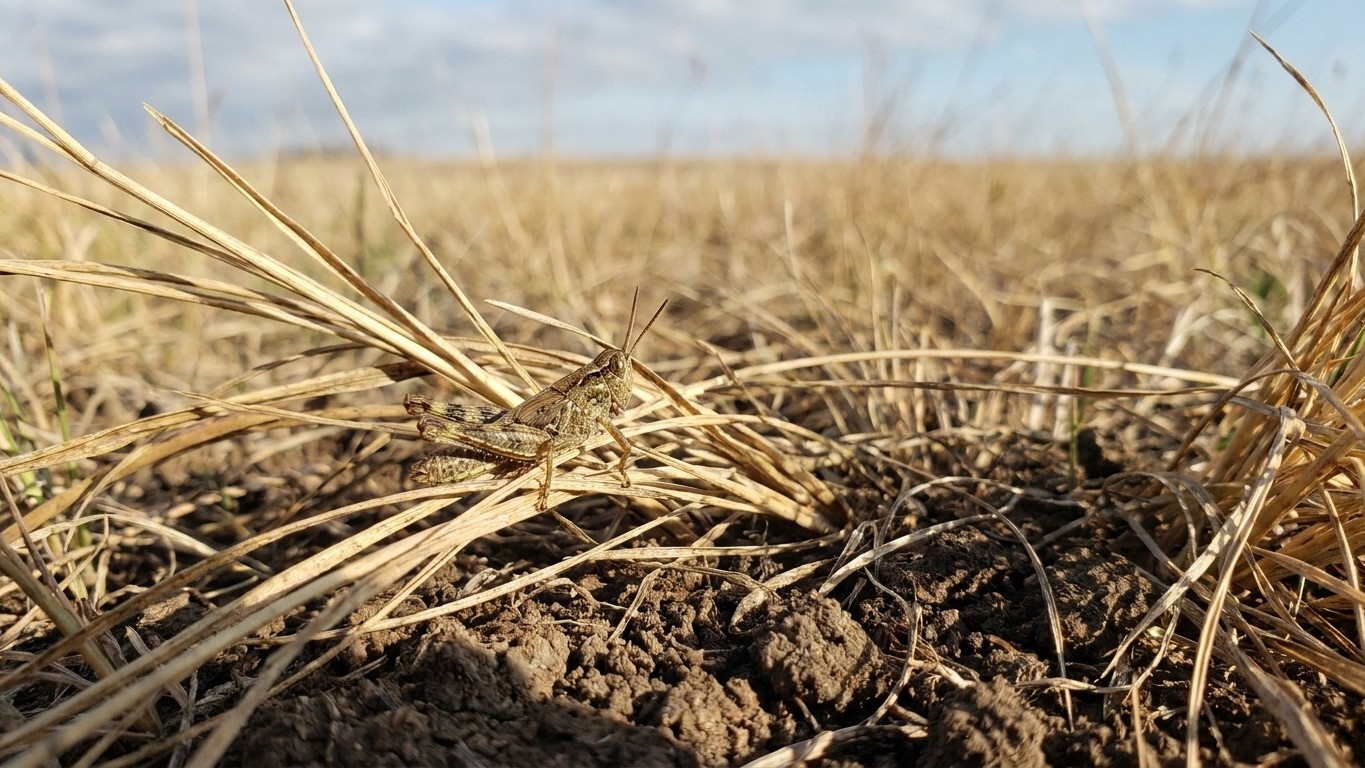

Grasshoppers show up across Kansas from late spring through late summer, with numbers building steadily as the season warms. There’s no single arrival date because they overwinter as eggs in the soil, not as adults, so the timing shifts with how fast the ground warms each year. What stops them is mostly about disrupting that egg-to-nymph cycle before it gets going.
The weeks to watch

Grasshoppers belong to the group of Kansas garden pests that overwinter as eggs rather than as adults, according to K-State Research and Extension’s pocket guide to common pest problems. That single fact explains the whole seasonal rhythm: nothing is flying around in early spring, but eggs laid the previous fall are sitting in undisturbed soil, roadside ditches, and field edges, waiting for warmth.
K-State’s guidance groups grasshoppers with stink bugs, twospotted spider mite, tomato hornworm, imported cabbageworm, corn earworm, and squash vine borer as later-season pests, distinct from early risers like the striped cucumber beetle or squash bug that come out of winter as adults. The extension materials don’t publish a specific hatch-to-adult window for grasshoppers the way they do for bagworms, whose egg hatch is pinned to late April through early May. For grasshoppers, the general pattern is what gardeners have to work with: eggs hatch as soil temperatures climb in spring, and the pest problem builds through summer into a peak that runs into late summer.
Nymphs in late spring
Young grasshoppers, called nymphs, emerge wingless and stay close to where they hatched, feeding on tender young growth. This is the stage when damage is easiest to prevent, because the insects haven’t yet gained the mobility to hop or fly into a garden from a neighboring field.
Adults through summer into late summer
By midsummer, nymphs have molted into winged adults capable of moving long distances. This is when populations that built up in unmown ditches, pastures, or fallow ground start showing up in vegetable gardens, and pressure typically holds through late summer before egg-laying for the next generation begins.
Reading the calendar from your last frost

Grasshopper eggs respond to soil temperature, not to a printed calendar date, so a gardener’s best planning tool is the last spring frost for their own area, not a fixed grasshopper start date. NOAA’s 1991-2020 climate normals put the last spring freeze for the reference weather station at April 4 to April 18, a range rather than a single day, and it’s worth treating that range as a normal rather than a promise. Suburban and rural gardens away from that station often see frost linger one to two weeks later, and more at higher elevation, so a county check is worth the five minutes it takes.
- Start from your own last frost date, using the April 4 to April 18 range as a baseline and adjusting later if your garden sits outside town or at higher elevation.
- Expect early grasshopper feeding on transplants roughly a few weeks after that date, once topsoil has had time to warm enough for eggs to hatch, with pressure increasing as the season moves toward its late-summer peak.
That arithmetic is why row covers matter more at transplant time than any other single week. A cover installed right after the last frost, while nymphs are still small and wingless nearby, blocks feeding before it starts. Pulling that cover too early, chasing an average date instead of watching the actual weather, hands the pest exactly the opening it needs.
What it attacks, and what the damage looks like

A gardener usually notices ragged, chewed leaf edges or entire leaves reduced to a skeleton of veins well before they spot the insect responsible. Grasshoppers feed on leaf tissue in a chewing pattern that’s coarser and less orderly than caterpillar damage, often working from the leaf margin inward, and on heavily infested plants they’ll strip foliage down to bare stems. Both nymphs and adults do this feeding, which matters because it means the damage doesn’t stop once the insect matures. There’s no single vulnerable life stage to target with timing alone; nymphs are just easier to control because they’re smaller, more concentrated, and can’t fly away.
Kansas gardens see grasshopper damage across a wide range of crops, since these insects aren’t picky feeders the way some specialist pests are. Vegetables commonly affected include:
- Sweet corn leaves and silks
- Beans and other legumes
- Leafy greens such as lettuce and chard
- Squash and other cucurbit foliage
- Tomato and pepper leaves, particularly on young plants
Ornamental plantings near unmown grass or pasture edges often take the heaviest hits first, since that’s where the eggs were laid the previous fall and where nymphs concentrate before dispersing.
How Kansas sits in this pest’s range
Grasshoppers aren’t a pest unique to one region of the state or one part of the country. K-State’s own extension guidance places them among the standard later-season insects gardeners across Kansas deal with every year, alongside stink bugs and spider mites, rather than treating them as a localized or unusual problem. That widespread presence means the real difference between one Kansas county and another isn’t whether grasshoppers show up, but when and how heavily, driven by local soil temperature, rainfall, and how much unmown grassland sits nearby to host egg-laying adults the previous fall.
Western Kansas, with more open rangeland and pasture bordering cropland, tends to feel grasshopper pressure differently than densely built suburban yards in the eastern part of the state, simply because there’s more egg-laying habitat within flying distance. That’s a matter of local land use, not a documented severity ranking, and the published extension guidance doesn’t break out county-by-county numbers or trend data for this pest. What it does confirm is the shared biology: eggs overwinter in the ground everywhere in the state, and warm-up timing is the variable that shifts from one spring to the next.
What actually works against it

Control works best when it targets the egg and early nymph stages, before grasshoppers gain wings and the ability to move in from neighboring land. Once adults are established and flying, the options narrow considerably, so the order below runs from the cheapest and earliest interventions to the ones that only help at the margins later on.
- Fall tillage of garden borders and field edges. Disturbing soil where females have laid eggs exposes them to weather and predators, reducing the number that survive to hatch the following spring. This works only where tillage is practical and only before winter sets in.
- Mowing tall grass and clearing weedy borders. Nymphs concentrate in unmown vegetation right after hatching; keeping those areas short removes the food source that lets small populations build before they disperse into the garden.
- Row covers installed at transplanting. A physical barrier keeps wingless nymphs off young plants during the vulnerable weeks right after the last frost. Covers lose their usefulness once plants need pollinator access or once adults are flying and can simply land past the cover’s edges.
- Hand-picking on small plantings. Grasshoppers are large and visible, making this a realistic option for raised beds or container gardens, though it becomes impractical once populations climb into the dozens per plant.
- Crop rotation and diversified plantings. Since grasshoppers aren’t picky feeders, rotation offers less protection than it does against specialist pests, but breaking up large blocks of preferred plants like beans and leafy greens can reduce concentrated feeding.
Home remedies like diatomaceous earth barriers or garlic sprays show up often in gardening forums; the honest answer is that controlled trials on their effectiveness against grasshoppers specifically are limited, and extension sources don’t confirm a mechanism strong enough to rely on alone. Treat them as a possible supplement to the measures above, not a replacement.
Common questions
Do grasshoppers damage Kansas gardens every year, or only in bad years?
They’re a recurring part of the later-season pest lineup K-State tracks every year, though population size varies with weather and nearby habitat, so pressure is more of a constant low hum than an occasional outbreak.
Can row covers stay on all summer to block grasshoppers?
They work best in the weeks right after transplanting when nymphs are still small and wingless nearby; most fruiting vegetables need covers removed for pollination before summer, which is also when adult grasshoppers become mobile enough to bypass a cover’s edges anyway.
Does tilling in fall actually reduce next year’s grasshoppers?
Disturbing egg-laying sites exposes eggs to cold and predators, which extension guidance lists as a genuine cultural control, though it only helps for eggs laid in areas that actually get tilled, not for eggs in neighboring pasture or ditches outside a gardener’s control.