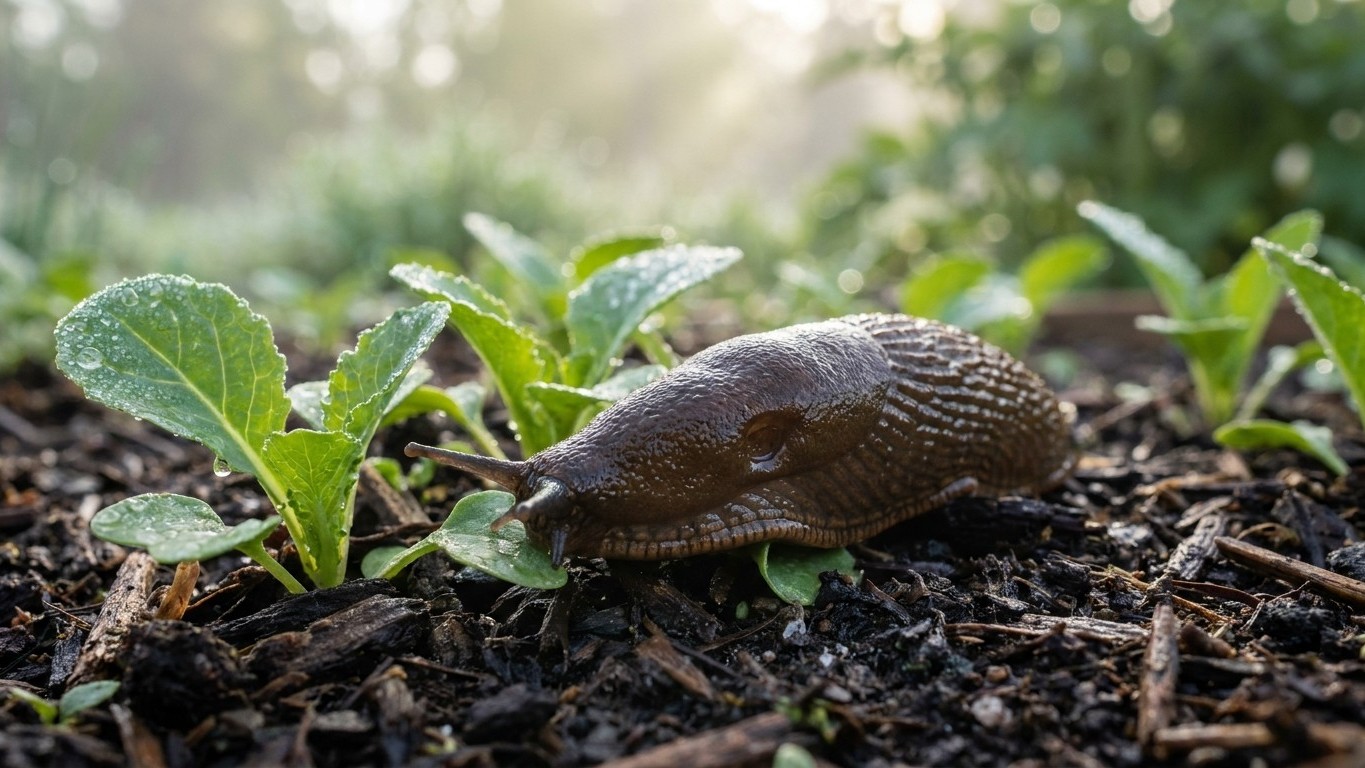

Garden slugs in Wyoming become active once spring soil holds steady moisture and nighttime temperatures stop dropping below freezing, usually as the ground firms up in the weeks following the last frost. They feed at night or on cloudy, damp days, slow down sharply once summer heat dries out the topsoil, and often return for a second push once fall rains arrive. Copper barriers, hand-picking, and morning inspections remain the most practical home defenses across the state.
The weeks to watch

Garden slugs start moving once nighttime lows stay reliably above freezing and the topsoil holds consistent moisture, a shift that typically follows the last hard freeze by several weeks rather than days. University of Wyoming Extension does not publish a specific emergence window for garden slug, so the timing below follows the general biological pattern documented for slugs in cool, high-elevation climates: a spring surge, a summer lull during the driest stretch, and a smaller fall rebound.
Spring emergence
Slugs overwinter as eggs or partly grown juveniles tucked under mulch, leaf litter, or boards. As soon as soil dampness returns in spring, those eggs hatch and juveniles start feeding on tender seedlings. In a state where mountain valleys and high plains warm at different rates, this emergence can arrive noticeably earlier in a low, sheltered garden than in one at elevation, even a short drive apart.
Fall second wave
Activity typically drops off during the hottest, driest weeks of summer, when slugs retreat into damp hiding spots rather than disappear entirely. Once nights cool and rain or irrigation picks back up in late summer and early fall, a second wave of feeding often shows up on late-season greens, brassicas, and anything still tender in the ground.
Reading the calendar from your last frost

The one date most Wyoming gardeners already track is the last spring frost, which for this area falls between May 7 and May 18, according to NOAA’s 1991-2020 climate normals for this station (NOAA NCEI). Slugs do not answer to a fixed calendar date, though. They answer to soil moisture and temperature, so a cold, wet spring pushes their activity later, while an early, damp spring can bring feeding pressure sooner than that frost window suggests.
- Start from the local last-frost range, May 7 to May 18, not a single day within it.
- Add roughly two to three weeks after transplanting before slug damage typically becomes visible on tender seedlings, since young plants need a little time in the ground before slugs find them.
That arithmetic gives another range, not a fixed date, which matters when deciding when a row cover needs to go on and when it can safely come off. Given roughly 130 frost-free days at 6,000 feet, and the real possibility of frost in any month at higher elevations, most gardeners here keep protective covers handy well past the calculated window rather than pulling them at the first warm stretch.
What it attacks, and what the damage looks like

Most gardeners notice the damage before they ever spot the slug itself. Leaves show irregular holes with smooth edges, often concentrated near the leaf center rather than along the margin the way caterpillar feeding tends to look. Seedlings can disappear almost overnight, reduced to a stub at soil level. A silvery, dried trail of mucus across leaves, stems, or the soil surface is the giveaway that separates slug damage from other chewing pests. Because slugs feed mainly at night, the damage is often the only evidence a gardener finds until they check the garden after dark with a flashlight.
The feeding stage is also the only stage that matters for timing a response: juveniles and adults both cause damage directly with their feeding, unlike pests that do their real harm as unseen larvae inside a stem. That means visible damage on a plant is a reliable signal that active slugs are still present nearby, not evidence of a problem that already ended.
Crops commonly attacked in home gardens include:
- Lettuce and other tender leafy greens
- Young seedlings of nearly any vegetable, before they toughen up
- Strawberries, especially fruit resting on damp soil
- Hostas and other soft-leaved ornamentals
- Brassicas such as cabbage and kale
How Wyoming sits in this pest’s range

On this site, garden slug is currently documented for one territory, Wyoming, so there is not yet a cross-state comparison to draw from for timing or pressure. That single entry does not mean the pest is rare or unusually severe here; it means the documentation is limited to this state so far, and any claim about how Wyoming compares to neighboring states would go beyond what the available data supports.
What can be said with confidence is that Wyoming’s mix of high elevation, short frost-free stretches, and dry summer air puts it toward the cooler, drier end of conditions where garden slugs typically thrive. Slugs need sustained moisture to move and feed, so gardens with heavier irrigation, dense mulch, or shaded, damp microclimates will see more pressure than exposed, wind-dried plots, even within the same town. That variation between individual gardens is likely to matter more than any broad statewide trend, given how few territories are documented so far.
What actually works against it

The cheapest, most effective measures come first, and each one loses effectiveness once conditions or timing shift against it.
- Water in the morning, not the evening. Slugs need surface moisture to move, so damp soil overnight gives them ideal conditions. Morning watering lets the surface dry out by dusk.
- Clear mulch, boards, and debris from directly around vulnerable seedlings. These spots serve as daytime hiding places; removing them forces slugs to travel farther and exposes them to drying and predators.
- Hand-pick at night with a flashlight. This is the most direct control while slugs are actively feeding on the surface, and it stops working only once damage has already been done to a plant beyond recovery.
- Use copper tape or copper mesh barriers around beds or containers. Many gardeners rely on copper as a physical barrier slugs are reluctant to cross; controlled trials on its effectiveness remain inconclusive, so treat it as one layer of defense rather than a guaranteed fix.
- Rotate crops and avoid planting the same tender seedlings in a known slug hot spot two seasons running. This reduces the odds that overwintering eggs in that exact spot hatch directly into a fresh food source.
- Time transplanting for drier stretches when possible. Since slugs need moisture to hunt, seedlings set out during a dry spell get a head start before the next damp period brings pressure back.
None of these measures help once a plant has already been reduced to a stub; at that point, the choice is simply replanting once pressure eases rather than trying to save the original seedling.
Common questions
Do garden slugs survive Wyoming winters?
Most survive as eggs or as partly grown juveniles tucked under mulch, boards, or leaf litter rather than as active adults. Once soil moisture and warmth return in spring, those overwintering eggs hatch and feeding resumes.
Are garden slugs worse at higher elevations?
There is no data on this site comparing pressure across elevations within Wyoming. What is known is that slugs depend on sustained moisture, so a damp, shaded garden at any elevation will typically see more activity than a dry, exposed one nearby.
Can garden slugs damage plants in a single night?
Yes. Young seedlings can be reduced to a bare stub overnight, since slugs feed under cover of darkness and a small plant offers little resistance. This is why nighttime hand-picking is one of the more effective direct responses once damage is spotted.