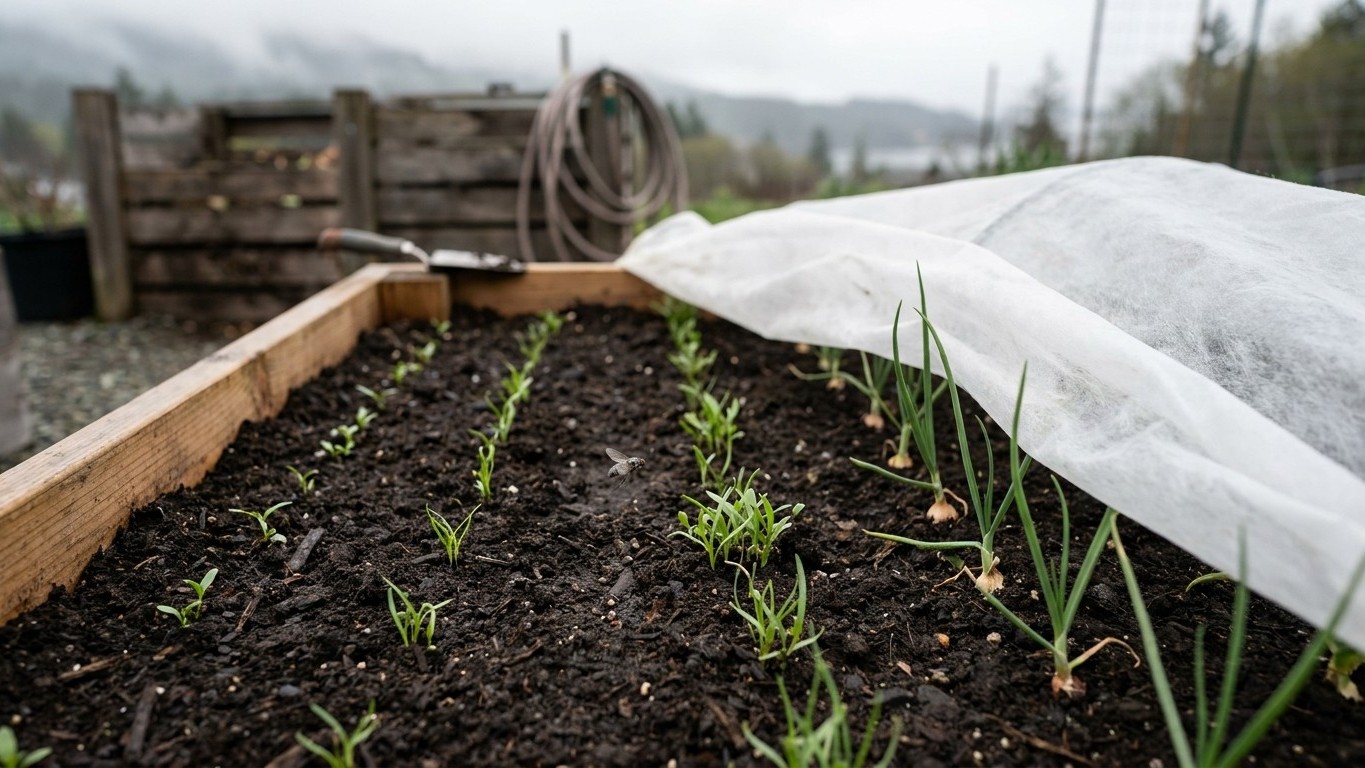

Onion maggot shows up in Washington gardens in spring, right after transplants or sets go into the ground, and again in a second wave during summer. There’s no official state-by-state flight calendar for it, so gardeners work from the general life cycle instead. The single best defense is a physical barrier, a floating row cover sealed down at planting time, before the first flies ever find the bed.
The weeks to watch

The first generation of onion maggot flies becomes active as soon as soil temperatures climb into the 40s and 50s Fahrenheit in spring, which in most of Washington lines up with the window when onion sets, transplants, or seed go into the ground. The local extension service does not publish a specific onion-maggot flight window for Washington, so what follows leans on the general pattern documented for this pest across its range rather than a state-specific date.
First generation (spring)
This is the flight that does the most damage, because it targets tender young seedlings and transplants that have almost no root mass to spare. Flies lay eggs at the base of the plant, right where the stem meets the soil, within days of the plants going in.
Second generation (early to mid-summer)
A second flight follows roughly a month or so later, once the first generation’s larvae have pupated and emerged as adults. Established onions with thicker necks tolerate this wave better than transplants did, but bulbs still forming can be tunneled.
Third generation (late summer into fall)
In regions with a long enough growing season, a third generation appears before frost. Whether this happens in a given Washington garden depends heavily on how warm the summer ran and how late onions stayed in the ground, which is exactly the kind of local variation a general pattern can’t pin down to a date.
Reading the calendar from your last frost

Western Washington’s last spring frost falls between February 27 and March 18, based on 30-70% freeze probability data from the NOAA station in the Seattle area. That’s a mild date compared to most of the country, but it doesn’t mean onions belong in the ground the day frost risk drops. Cold, wet soil and short daylight hold spring crops back well past that freeze date, and eastern Washington’s high desert climate runs on a completely different, shorter calendar that this normal doesn’t cover at all.
- Start from the last-frost window for your area (February 27 to March 18 in western Washington, based on the cited NOAA normal), and remember it’s a probability band, not a promise.
- Onion maggot damage on transplants typically becomes visible within two to three weeks of planting, once larvae have hatched and begun feeding at the base of the stem. Count forward from your actual transplant date, not from the frost date itself.
That arithmetic tells a gardener roughly when to have row covers already in place, which is before transplanting, not after the first wilted seedling turns up.
What it attacks, and what the damage looks like

The first sign is usually a seedling or young transplant that wilts and yellows for no obvious reason, often collapsing at the base while the roots look intact from above. Pull the plant and the real evidence shows up underground: soft, discolored tissue at the stem base, sometimes with visible tunneling, and small white larvae inside the bulb or stem itself. On older plants, the damage looks more like a bulb riddled with brown, slimy channels rather than a dead seedling.
The maggot stage, not the adult fly, does all the feeding damage. That matters for treatment, because by the time larvae are visibly tunneling inside a bulb, nothing applied to the plant’s surface reaches them. Any intervention that works has to happen before eggs hatch or before larvae burrow in.
Crops at risk include:
- Onions (bulb and green)
- Leeks
- Garlic
- Shallots
- Chives
How Washington sits in this pest’s range

Onion maggot is a widespread pest across the temperate onion-growing regions of North America, and its presence in Washington isn’t in question. What differs from one growing region to another is timing, not whether the insect shows up at all. A grower in a cooler coastal valley deals with a later, more compressed spring flight than a grower in a warmer inland valley, even within the same state.
That’s exactly why western and eastern Washington can’t be treated as one climate for planning purposes. The mild, maritime frost dates around Seattle bear no resemblance to the shorter, more extreme season east of the Cascades, and a spring flight calculated from Seattle’s soil-warming pattern would be off by weeks if applied to a high-desert garden near Yakima or Spokane. Gardeners in each region are better served checking soil temperature directly at their own site than borrowing a date from the other side of the mountains.
What actually works against it

- Rotate onion-family crops out of the same bed for at least a year. Onion maggot pupae overwinter in soil near where the previous crop grew, so planting onions, leeks, or garlic in a different spot breaks the connection between last year’s population and this year’s transplants.
- Avoid planting into cold, wet soil earlier than necessary. Slow-growing transplants sitting in chilly ground stay vulnerable longer, giving the first generation a wider window to find them. Waiting for soil to warm a bit, even past the last frost date, often means sturdier seedlings by the time flies are active.
- Install floating row covers at transplanting and seal the edges to the soil. This is a physical barrier that stops egg-laying flies from reaching the base of the plant at all. It works only if it goes on before the first flight arrives and stays sealed; a cover added after flies have already laid eggs does nothing for those eggs already in the soil.
- Remove and destroy cull onions, thinnings, and crop debris promptly rather than leaving them in the row. Rotting onion tissue attracts egg-laying females and gives newly hatched larvae an easy first meal before they move to healthy plants.
- Pull and discard any plant showing wilting or base rot as soon as it’s spotted. Once larvae are established inside the stem or bulb, no surface treatment reaches them, and removing the infested plant is mainly about limiting how many larvae survive to become the next generation’s flies, not about saving that particular plant.
Common questions
Does a row cover still help once onions are already up and growing?
It helps less. The cover’s job is to keep egg-laying flies away from the base of the stem before eggs are laid. Once plants are established and the covers are already off, a cover mainly protects against a later flight rather than undoing exposure that’s already happened.
Can the same bed grow onions again next year if maggots showed up this season?
Skipping onion-family crops in that bed for at least one growing season is the standard recommendation, since pupae overwinter in the soil near where the infested crop grew. Moving onions to a different part of the garden interrupts that cycle far more reliably than treating the same spot again.
Is onion maggot the same insect as cabbage maggot?
No. They’re closely related root maggot flies with similar biology and similar management approaches, but they target different host plants, onion maggot on the allium family and cabbage maggot on cole crops, and a row cover effective against one won’t necessarily need adjusting for the other since both respond to the same barrier strategy.