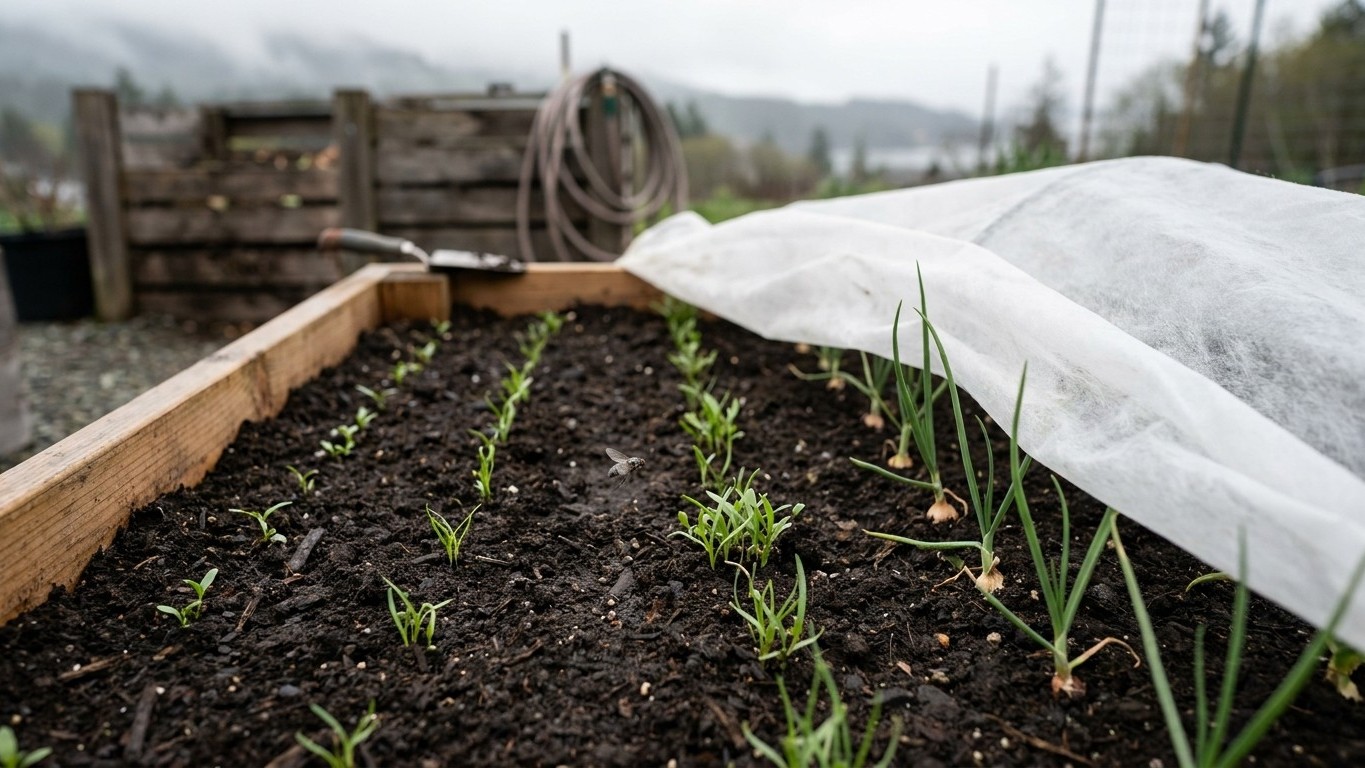

Onion maggot damage in Wisconsin tracks soil warming each spring, not a fixed date on the calendar. The state’s home garden pest season runs from April through September, and for this species the risk is front-loaded: seedlings and fresh transplants take the worst hits in the first weeks after the ground thaws, while later generations tend to matter more for large plantings than backyard rows.
The weeks to watch

UW-Madison Division of Extension’s home vegetable garden guide (A2088) doesn’t publish a species-specific flight window for onion maggot the way it does for a few other pests. That same guide notes most corn pests don’t build up until mid-August, and that squash vine borer damage typically shows as wilting vines in late July. Onion maggot isn’t covered with a date of its own, so the honest answer is that Wisconsin’s extension literature gives a general home-garden pest season (April through September) rather than a maggot-specific calendar.
What fills that gap is the general biological pattern known for this insect across cool-climate growing regions: it overwinters as pupae in the soil and produces multiple generations in a season, with the first the most destructive to home gardens.
First generation
Adult flies emerge as soil warms in spring and lay eggs at the base of young onion, garlic, and leek plants. This generation causes the most visible losses because seedlings and freshly set transplants have little root mass to spare.
Later generations
Subsequent generations develop through summer. In home gardens, plants that survive the first wave and grow past the seedling stage are far less vulnerable, since a maturing bulb tolerates some root feeding that would kill a seedling outright.
Reading the calendar from your last frost

Southern Wisconsin’s average last spring frost falls between April 16 and April 29, based on NOAA’s 1991-2020 climate normals for the region. That range, not a single date, is what a gardener actually has to plan around, since onion maggot activity follows soil temperature rather than the calendar itself. A cold, wet spring pushes the risk window later; an early warm-up pulls it forward.
- Start from your local last-frost range (April 16 to April 29 for southern Wisconsin, earlier inland to the north where freezes also arrive sooner in fall).
- Expect the vulnerable window to open around that same stretch and extend through the first few weeks after transplanting, while seedlings are small and soil is still cool and moist, conditions the adult flies favor for egg-laying.
That means row covers over onion sets or transplants should go on at planting time, right around the frost range, and stay in place until plants are past the seedling stage and starting to bulb. Pulling covers too early, while soil is still cool, leaves the most fragile stage exposed.
What it attacks, and what the damage looks like

The giveaway is usually a wilting or yellowing seedling long before anyone spots an insect. Leaves flag over, growth stalls, and the plant can be pulled from the soil with almost no resistance because the roots are gone. Slicing open the bulb or root of an affected plant typically reveals tunneling and soft, rotting tissue, sometimes with small white larvae still inside. It’s the larval stage, the maggot itself, that does the feeding damage; the adult fly only lays eggs at the plant base and doesn’t chew on the plant.
That distinction matters for treatment, because anything aimed at the adult fly stops working the moment eggs have already hatched and larvae have tunneled in. Crops affected include:
- Onions (bulb and green types)
- Shallots
- Garlic
- Leeks
Seedlings and young transplants are hit hardest; established, larger bulbs generally shrug off light feeding.
How Wisconsin sits in this pest’s range

Onion maggot is a widespread cool-climate pest across the northern tier of the country, and Wisconsin’s local extension literature doesn’t publish a rank or severity score for the state within that broader range. Where a pest is this widespread, the meaningful difference between states usually isn’t presence, it’s timing: cooler, shorter seasons in the northern half of Wisconsin push the spring emergence and each generation’s activity later than in the state’s southern counties, while the underlying biology stays the same everywhere the insect is found.
Lake Michigan’s moderating effect on nearby counties adds another local wrinkle. Lakeshore areas see delayed first fall freezes, stretching the growing season on that side of the state, while inland southern Wisconsin typically freezes by early October and the north often much earlier. That doesn’t change how the pest behaves, but it does shift how long a garden stays exposed to later-season generations before frost effectively ends the season.
What actually works against it

- Rotate alliums out of last year’s bed. Onion maggot pupae overwinter in soil where the previous crop grew, so planting onions, garlic, or leeks somewhere new each year removes the built-in head start those pupae would otherwise have.
- Avoid the earliest possible planting date. Setting transplants slightly later, once soil has warmed a bit past the coldest range, can mean the seedling’s root system is a little more established by the time adult flies are most active.
- Use floating row covers at transplant time. A physical barrier over the bed keeps egg-laying adults off the plants entirely. It works only while it’s sealed at the edges and only before eggs are laid; once larvae are already tunneling inside a root, a cover on top does nothing.
- Clear old onion and garlic debris and cull bulbs after harvest. Leftover plant material and discarded bulbs give overwintering pupae a place to sit through winter, so removing them reduces next year’s starting population.
- Rogue out wilting seedlings promptly. Pulling and destroying an infested plant as soon as it wilts can keep maggots from finishing development and moving on to neighboring plants.
- Wood ash or diatomaceous earth around the stem base. Many home gardeners use these as a dry barrier at planting, but field trials on their actual effectiveness against onion maggot are inconclusive, so treat them as a low-cost add-on rather than a primary defense.
Common questions
Does onion maggot affect garlic and leeks too, or just onions?
Yes. Garlic, leeks, and shallots share the same vulnerability as onions, since the larvae feed on the same type of bulb and root tissue across all of these alliums.
Can a wilting plant be saved once maggots are already inside?
Rarely. Once larvae have tunneled into the root or bulb, the damage is largely done; the more useful move at that point is removing and destroying the plant to protect its neighbors, rather than trying to treat the one that’s already wilting.
Does rotating onions to a new bed each year fully solve the problem on its own?
It reduces the risk significantly by removing overwintering pupae from the immediate area, but it isn’t a complete fix by itself, since adult flies can still move in from other parts of a yard or from neighboring properties where alliums were grown the year before.