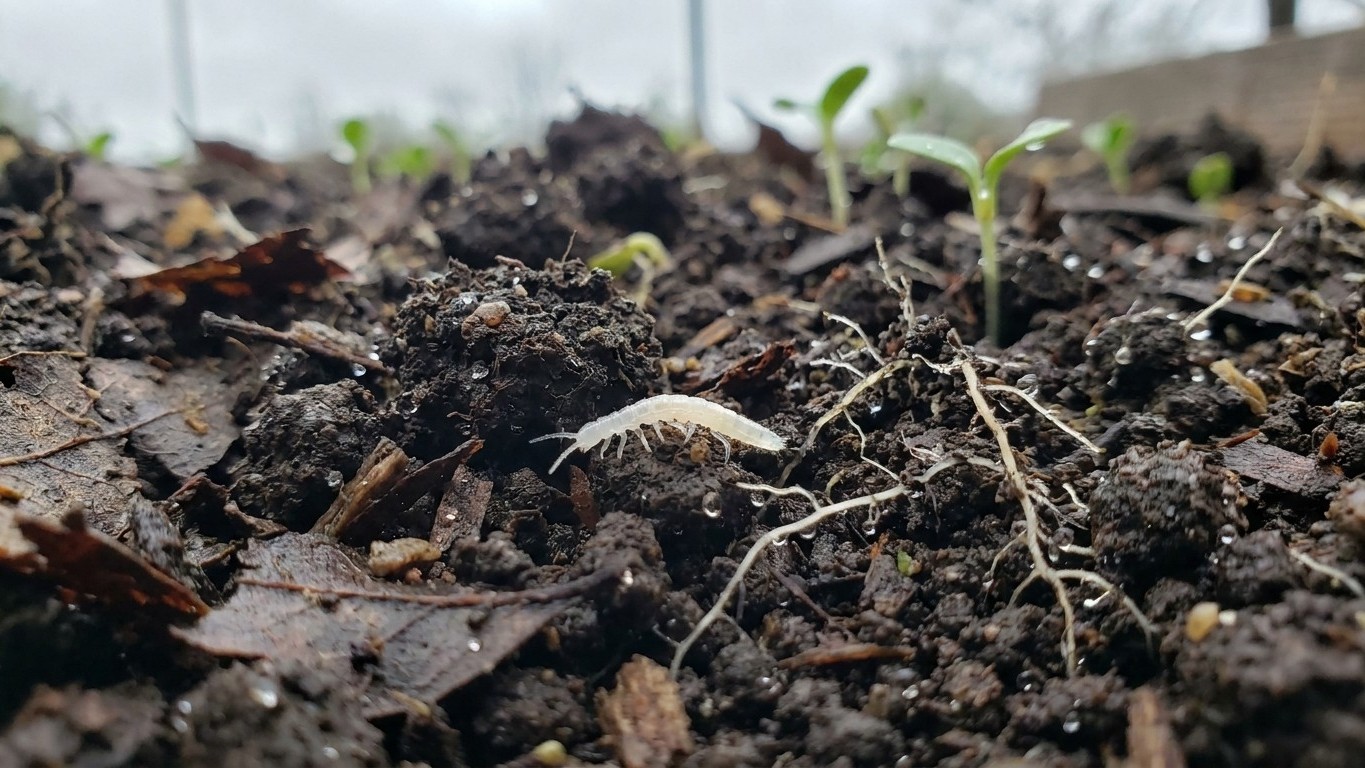

Garden symphylans don’t get their own entry on Oregon State University Extension’s spring pest calendar, and that gap tells you something. The general pattern for this soil-dwelling arthropod holds instead: activity tracks moist, cool soil, so it peaks in spring and again in fall, and eases off once summer bakes the topsoil dry. Stopping it means changing what happens underground, not spraying what happens above it.
The weeks to watch

Oregon State University Extension’s published pest guidance for the season, the same document that names slug and aphid windows, does not list a specific date range for symphylans. That’s the honest answer. What fills the gap is the general biology of the pest: symphylans are soil moisture and temperature specialists, and they move up and down through the soil profile as conditions change, rather than emerging on a fixed calendar date the way a flying insect might.
Spring surge
As soil warms from winter cold but before it dries out, symphylans move into the upper few inches where plant roots are growing. This is when seedlings and transplants take the worst hit, because the pest and the tender root system occupy the same shallow layer at the same time. Growers in the Willamette Valley, where soils tend to stay cool and moist longest, report this as the riskier stretch of the year.
Fall return
A second rise in activity tends to follow the first fall rains, once summer’s dry crust breaks and moisture returns to the surface layers. It’s a quieter window for home gardens since most summer crops are already through their vulnerable seedling stage by then, but fall plantings of greens and cole crops can still take damage.
Reading the calendar from your last frost

Oregon’s last spring frost falls somewhere between March 6 and March 21, depending on the year, according to NOAA climate normals for the region. That range is a planning tool, not a guarantee, and it’s the one date most Willamette Valley gardeners actually build a schedule around. Symphylans don’t read that calendar either. They respond to soil temperature and moisture, so a cold, wet March pushes their surface activity later, while an early warm-up brings it forward.
- Start from the local last-frost window (March 6 to March 21) and count forward to your actual transplant date, since that’s the moment tender roots enter the soil layer symphylans occupy.
- Count forward from transplanting: gardeners in the valley often notice the first stunted or collapsing seedlings within two to three weeks, once the young root system has had time to show stress but before it’s established enough to outgrow the damage.
That two-step math means row covers or delayed planting have to be in place before, not after, that window opens. Once symptoms show, the feeding has usually been going on under the soil line for a while already.
What it attacks, and what the damage looks like

The symptom shows up before the culprit does. A patch of seedlings looks stunted, pale, or wilted even though the soil is moist and nothing above ground explains it. Stands come up spotty, with gaps where seeds simply failed to establish. Pull an affected plant and the roots often look chewed or pitted, sometimes reduced to stubs, rather than showing the smooth taper of a healthy root system. The feeding happens below ground on root hairs and fine roots, which is why the plant shows nutrient-deficiency symptoms, yellowing and stunting, long before anyone thinks to look at the roots themselves.
All the active life stages feed the same way, chewing on roots and root hairs, so there’s no single stage a gardener can wait out. The immature stages are usually far more numerous in the soil than adults, which is part of why populations can build quietly for a season before damage becomes obvious.
Crops most commonly affected in home and market gardens include:
- Lettuce and other leafy greens
- Spinach
- Beans
- Sweet corn
- Potatoes
- Asparagus
- Strawberries
- Cole crops such as broccoli and cabbage
How Oregon sits in this pest’s range

This site currently documents symphylans in one territory, Oregon, which reflects where published local guidance exists rather than any claim about how far the pest actually ranges. Garden symphylans are a known soil pest across much of the temperate United States, and Oregon’s presence here has more to do with the Willamette Valley’s reputation among growers, cool, moist, organic-matter-rich soils that happen to suit the pest well, than with any unique vulnerability the state has compared to others.
Oregon State University Extension is the named local source for the general soil-pest guidance referenced here, and its material doesn’t rank Oregon’s symphylan pressure against other states or describe a trend over time. What it does confirm is the mechanism: soils high in organic matter, common in valley vegetable ground that’s been amended for years, tend to hold more of the moisture and food source symphylans need. That’s a soil-type story more than a state-ranking one.
What actually works against it

- Let tilled soil dry and warm before planting. Symphylans retreat from dry, warm surface soil, so a short delay between tillage and planting can reduce how many are active in the root zone right when seedlings go in.
- Rotate out of susceptible crops. Moving a bed to small grains or forage grasses for a season reduces the food source symphylans prefer, since they favor tender roots over grass roots.
- Keep clean cultivation between plantings. Symphylans travel through soil channels and cracks; regular tillage disrupts those pathways and the debris that shelters them.
- Go easy on fresh organic matter right before planting. Heavy incorporation of undecomposed compost or manure just ahead of a susceptible crop tends to draw symphylans upward toward the food and moisture it provides.
- Use transplants instead of direct seeding where damage has been a problem. A transplant with an established root ball gets past the most vulnerable seedling stage faster than a seed germinating in place.
- Flood the field if the setup allows it. Prolonged waterlogging can reduce symphylan numbers, since they don’t tolerate saturated soil for long, though this only fits larger plots with irrigation control, not a typical backyard bed.
None of these measures reach a symphylan already feeding deep on an established root system below the point a hoe or cover can touch. Once populations are entrenched in a bed’s soil structure, the realistic goal shifts from control to gradual reduction over a rotation or two, not a single-season fix.
Common questions
Do row covers stop symphylans? Row covers work against flying and crawling insects moving in from above ground, but symphylans travel through the soil itself, so a cover over the bed does nothing to block them from reaching roots.
Can I tell symphylan damage apart from root rot? Root rot tends to produce mushy, discolored roots and often smells sour; symphylan feeding leaves roots chewed, pitted, or stubbed, with the plant otherwise structurally intact but nutrient-starved.
Are symphylans worse in raised beds with lots of compost? Beds built up with rich, well-decomposed organic matter and kept consistently moist do tend to match the conditions symphylans favor, which is part of why long-term vegetable beds sometimes see more pressure than newer ground.