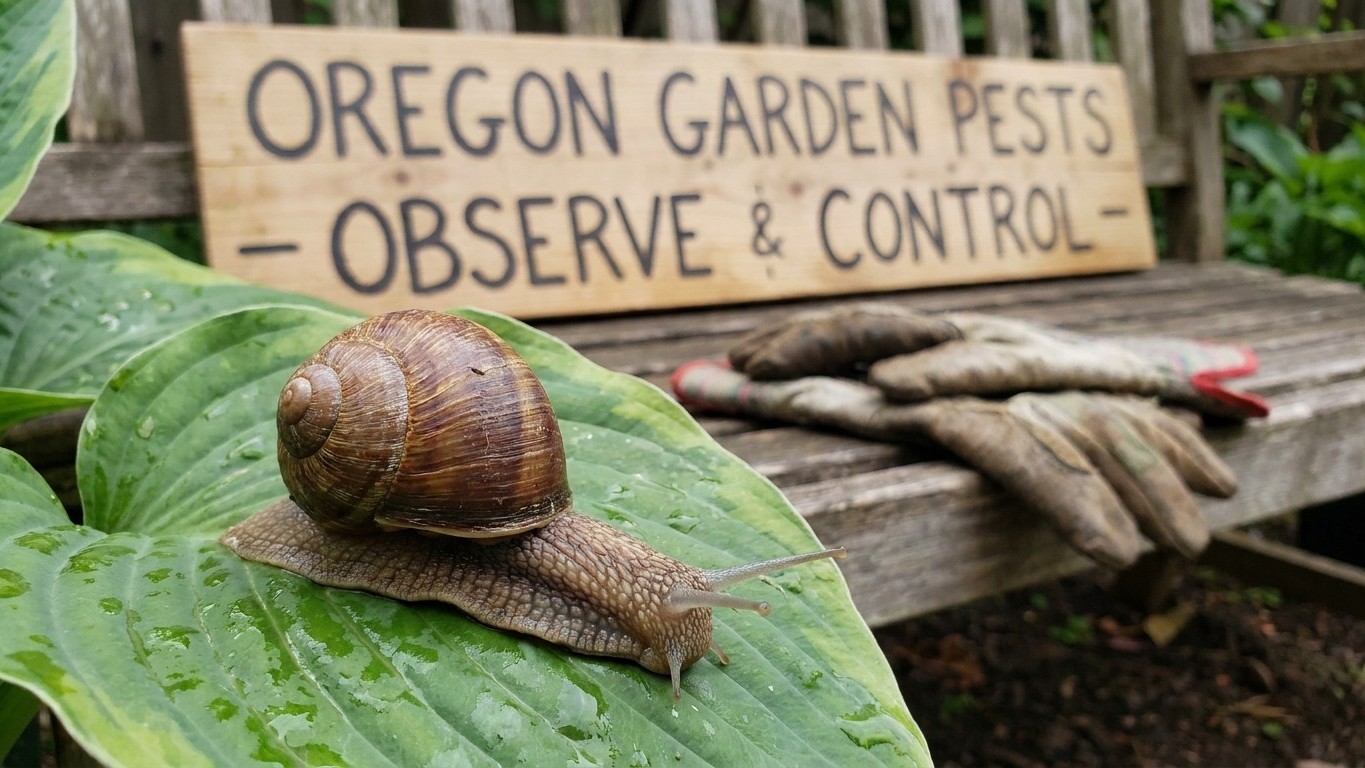

Oregon State University Extension names ten pests as the ones worth knowing on sight in home gardens here: slugs, the brown garden snail, Cucumber beetles in Oregon, Aphids in Oregon, Imported cabbageworm in Oregon, Cabbage maggot in Oregon, Carrot rust fly in Oregon, symphylans, European earwig in Oregon, and the Brown marmorated stink bug in Oregon. Slugs cause the most damage of the group. They feed at night once temperatures climb above 50°F in moist soil, and near Portland they lay eggs as the fall rains begin, typically the end of September into early October, per OSU Extension. Go out with a flashlight after dark and check under boards, pots, and leaf litter near seedlings before you reach for any product.
What Oregon gardens actually deal with

Slugs in Oregon are the biggest problem in an Oregon garden, and the fix starts with catching them before they’ve eaten a whole seedling in one night. Once nights stay above 50°F and the soil’s damp, they come out to feed in the dark and lay eggs as fall rains arrive, usually late September into early October near Portland. Tonight, take a flashlight out after dark and check under boards, pots, and leaf litter near your seedlings — that fifteen minutes tells you more than any product on a shelf will.
Slugs

The gray field slug is the one OSU Extension names specifically, a soft gray-brown animal with no visible shell, usually one to two inches long when active. It leaves ragged holes in leaves and a silvery slime trail that dries by morning. Seedlings and transplants take the worst of it because a slug can eat a whole cotyledon in one night.
Brown garden snail

Similar chewing damage to slugs, but the animal carries a brown shell with darker spiral bands, about an inch across. It retreats into the shell when disturbed, which makes it easier to hand pick in daylight than a slug.
Cabbage maggot

The adult looks like an ordinary small gray fly and does no direct damage. The larva, a tiny white maggot living in the soil around brassica roots, is the one doing the eating. Above ground you see wilting or stunted broccoli, cabbage, and radish plants long before you see the insect, because the damage is happening underground.
Carrot rust fly

The adult is a small, shiny greenish-black fly with an orange-yellow head and legs, easy to miss in the garden. Its larva, a pale yellow-white maggot, tunnels through carrot and parsnip roots, leaving rust-colored channels that only show up when you pull the crop.
Cucumber beetles

Small, about a quarter inch, yellow-green with black spots or stripes running down the back. They chew holes in cucumber, squash, and melon leaves and flowers, and their feeding can spread bacterial wilt between plants.
Imported cabbageworm

The adult is a white butterfly with a black spot or two on each forewing, harmless and often mistaken for a beneficial insect. Its larva is a velvety green caterpillar, close to an inch at full size, that chews large, ragged holes through brassica leaves and can skeletonize a young plant fast.
Symphylans
A soil-dwelling arthropod, white, fast-moving, centipede-like, about a quarter inch long with long antennae. It feeds on root hairs and fine roots, and the visible symptom is a seedling that stalls out for no obvious reason. You have to dig to find it.
European earwig
Dark reddish-brown, flattened, shiny, about three-quarters of an inch, with a pair of curved pincers at the tail end that look alarming but aren’t dangerous to people. It feeds at night on seedlings, soft fruit, and flower petals, leaving irregular holes similar to slug damage but without the slime trail.
Aphids
Tiny, soft, pear-shaped insects in green, black, or gray, clustered on new growth and the undersides of leaves. OSU Extension identifies July and August as the months they cause the most trouble in home gardens. They leave sticky honeydew behind, which often grows a black sooty mold.
Brown marmorated stink bug
Shield-shaped, mottled brown, about five-eighths of an inch, with distinctive light and dark banding on the antennae. OSU Extension notes reports of this pest peak in fall. It feeds on fruit, causing discolored, dimpled patches known as cat-facing.
Telling damage apart

Before you treat anything, figure out whether you’re looking at an insect, a disease, or a watering problem. Each one leaves a different signature, and treating the wrong cause wastes time and, if you reach for a spray, money.
Chewing versus sucking damage
Ragged holes with irregular edges, especially on seedlings and low leaves, point to chewing pests: slugs, snails, earwigs, cucumber beetles, or cabbageworm caterpillars. A slime trail narrows it to slugs or snails. No slime but similar holes, especially near dusk, suggests earwigs. Stippling, tiny pale dots scattered across a leaf, along with curled new growth and a sticky film, is the signature of aphids sucking sap rather than chewing tissue. Tunnels revealed only when you pull a carrot or a cabbage plant mean a root maggot or rust fly larva has been at work underground the whole time, invisible until harvest.
When it’s not a pest at all
A plant that wilts hard at midday but looks fine again by evening is usually stressed for water, not under insect attack. Check soil moisture before you check for bugs. Yellowing that spreads evenly across a whole plant, rather than showing up as spots or stippling on specific leaves, more often traces back to overwatering or a nutrient gap than to any pest. Fungal disease tends to show as spots with a defined border, or a powdery or fuzzy coating, and it shows up without any accompanying slime, chew marks, or insects. Turn the leaf over and look at the underside before deciding what you’re dealing with: that’s where aphids cluster and where the first sign of most leaf diseases appears.
When each one shows up
Pest activity in Oregon gardens tracks moisture and temperature more closely than the calendar. The same species can show up two or three weeks apart from one part of the state to another, so watch the plant stage and the weather rather than a fixed date.
Early season, cool and wet
Slugs are active whenever nights stay above 50°F and the soil is moist, which in practice means most of spring near Portland, according to OSU Extension. This is also when seedlings are at their most vulnerable, since a slug or an earwig can take out a whole cotyledon in one feeding. Symphylans do their damage to roots underground during this same cool, wet stretch, showing up as seedlings that stall without an obvious cause. Cabbage maggot and carrot rust fly larvae are working underground on the same schedule, tied to when brassicas and carrots are young and their roots are small enough to be overwhelmed.
Midsummer, warm and dry
Cucumber beetles and imported cabbageworm build up as their host crops mature through late spring and summer. Aphids become the main problem here: OSU Extension flags July and August as their peak months in home gardens, when populations explode on tender new growth faster than natural predators can keep pace.
Fall, as the rains return
Slug pressure rises again as soon as the fall rains start, and near Portland that means egg-laying begins around the end of September into early October, per OSU Extension, which makes this the second of the two big control windows for slugs each year. Reports of the brown marmorated stink bug also peak in fall, according to OSU Extension, as it looks for overwintering spots and continues feeding on ripening fruit before cold weather sets in.
What actually works
Prevention beats intervention for almost everything on this list, because most of these pests are easier to keep out than to remove once established.
Before you see damage
- Rotate brassicas and carrots to a different bed each year to interrupt cabbage maggot and carrot rust fly life cycles tied to the soil.
- Time transplants to skip the most vulnerable seedling stage during the wettest weeks, when slug and earwig pressure is highest.
- Use physical barriers: copper tape or diatomaceous earth rings around vulnerable beds for slugs and snails, floating row cover pinned tight at the edges against cabbageworm butterflies and cucumber beetles.
- Leave some habitat for ground beetles and birds, both of which eat slugs and caterpillars, rather than clearing every leaf and stone from garden edges.
Once you see damage
Hand picking at night with a flashlight works for slugs, snails, and earwigs, and it’s the most direct way to bring a bad population down fast without any product at all. Iron phosphate slug bait is the option OSU Extension discusses for slugs that keep coming back despite barriers, and it’s considerably less risky around pets than older metaldehyde baits. For aphids, a strong water spray knocks a light infestation off the plant, and insecticidal soap handles the rest without wiping out the lady beetles and lacewings that would otherwise keep numbers down on their own.
Beer traps for slugs do very little in a real garden bed, since they draw slugs from a only a small radius and need refilling constantly to stay effective. Broad-spectrum insecticides are worth skipping for aphids specifically, since they kill the predators that would have handled the population for free.
Gardeners in the Puget Sound area deal with a similar slug-heavy climate, and the same night-inspection habit applies, as covered in our guide to Washington garden pests.
What control costs
None of these approaches cost the same in money or in time, and the cheapest option for a home garden is rarely the one that gets marketed hardest.
Comparing the four approaches
| Method | Money cost | Time cost | Repeat frequency |
|---|---|---|---|
| Hand picking | Lowest, essentially free | A few minutes per bed, most effective at night | Every few nights during peak pressure |
| Barriers and row cover | Moderate upfront, reusable for years | Low once installed | Check seals after wind or watering, otherwise minimal |
| Biological controls (predators, natural enemies) | Low, mostly the cost of not spraying | Low, requires patience for populations to build | Ongoing, no repeat action needed once established |
| Sprays (soap, iron phosphate bait) | Moderate, recurring purchase | Moderate, application plus reapplication | Every one to two weeks or after rain |
Hand picking is the cheapest control by a wide margin for a home-scale garden, since it costs nothing but a flashlight and some evening time. Barriers cost more up front but pay that back over several seasons because the same copper tape or row cover gets reused year after year. Sprays, even the relatively low-risk ones like insecticidal soap or iron phosphate bait, are the option you keep buying, since both need reapplication through the season rather than a one-time purchase.
Local help
Oregon State University Extension tracks outbreak reports across the state and can identify a specimen you’re not sure about, through your county office. Their published guidance, including EM 9155 on slug control and EC 871 on vegetable gardening, covers pests beyond the ten listed here. Start at the Oregon State University Extension site, or browse our other Oregon guides for planting and frost timing that affects when these pests find your plants most vulnerable.
Common questions
Why do I only see slug damage but never the slug itself?
Slugs feed at night and retreat to damp, shaded spots like under boards, pots, or mulch during the day. Go out after dark with a flashlight, an hour or two after sunset, and you’ll usually find them on the plants they’ve been damaging.
Are the pincers on an earwig dangerous?
No. The pincers can pinch if you handle the insect roughly, but they aren’t venomous and don’t pose a real risk to people or pets. The damage they do is to seedlings and soft fruit, not to anyone handling the garden.
Will planting marigolds keep pests out of my vegetable beds?
There’s no reliable evidence that marigolds repel the pests on this list at a meaningful scale in a home garden. Physical barriers, timing, and hand removal do far more, and marigolds are better thought of as a flower you like than a pest control strategy.
Do I need to treat for symphylans if I’ve never seen one?
Only if you have stunted seedlings you can’t otherwise explain. Symphylans live underground and rarely surface, so the usual sign is a plant that fails to establish despite good soil and water, not a visible insect. Dig a few inches down near the root zone to check before assuming it’s something else.