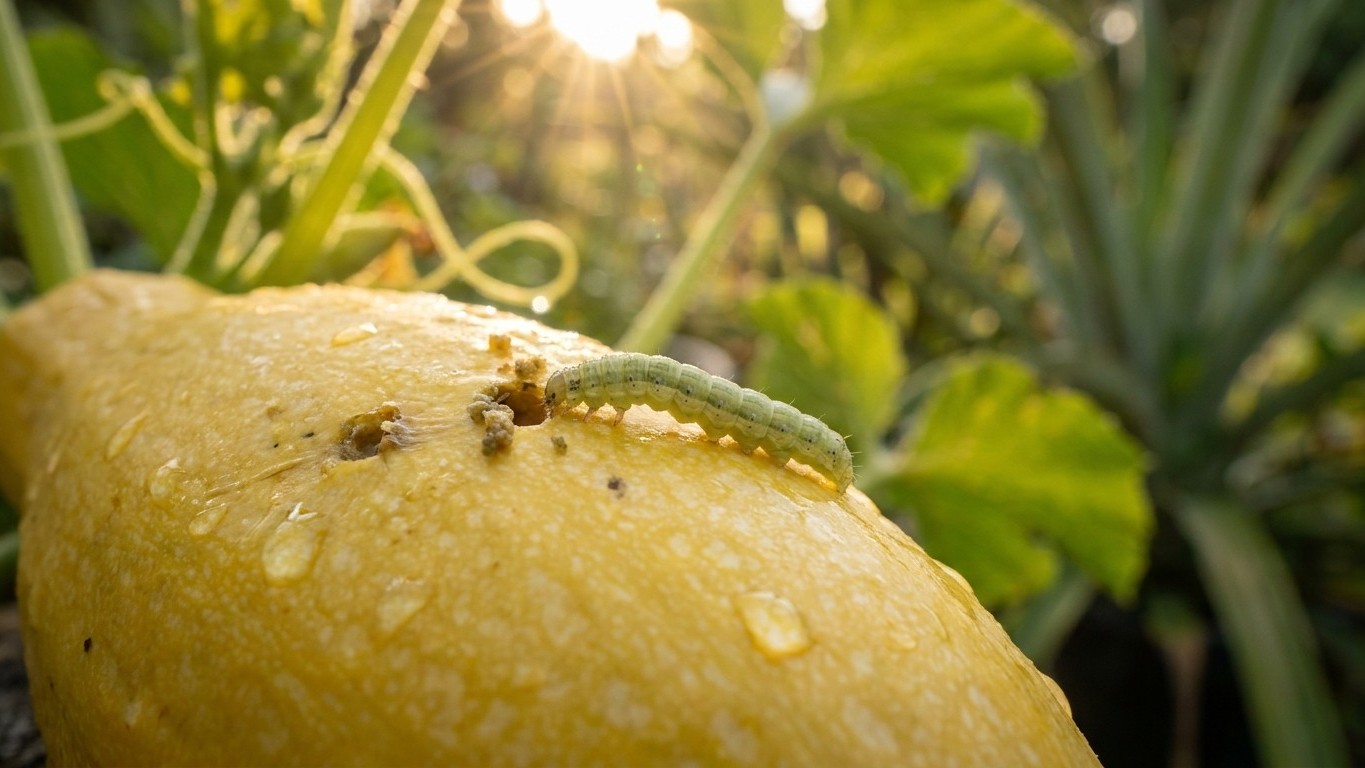

Pickleworm doesn’t survive a hard Texas freeze, so its yearly return depends on migration from warmer ground, not a fixed date on the calendar. In most of the state, the damage shows up on squash, cucumber, and melon vines by mid-to-late summer, once moths have flown in and the plants are flowering. Row covers before bloom, frequent hand-picking of damaged buds, and cleanup after harvest are what actually slow it down.
The weeks to watch

Texas A&M AgriLife’s regional pest advisories don’t publish a fixed flight-week window for pickleworm the way they do for a handful of other cucurbit pests, so the timing here follows the insect’s known biology rather than a local calendar entry. Pickleworm (Diaphania nitidalis) can’t survive a freeze in any life stage. It overwinters only in the mildest, frost-free corners of the country, and for Texas that means the far southern tip near the Rio Grande Valley. Everywhere else, the population each year is a reinvasion, not a holdover.
Early-season arrival in South Texas
In the Rio Grande Valley and similar frost-free pockets, moths can be active almost as soon as cucurbits are in the ground, since there’s a resident population riding out mild winters nearby. Gardens there should treat pickleworm as a season-long risk rather than a late-summer surprise.
Peak pressure in mid-to-late summer
Further north and inland, across most of the state, moths take weeks to migrate up from those southern source populations and to build numbers large enough to notice. That pushes the heaviest pressure into July, August, and September, right as cucurbit vines are blooming heavily and producing the fruit and buds the larvae prefer. A cool, late spring across the state can slow that northward push; a warm one can speed it up. There’s no single day to circle, only a stretch that shifts with the season.
Reading the calendar from your last frost

Pickleworm itself doesn’t answer to a frost date the way, say, a cold-sensitive plant does. It answers to how warm the ground and air are further south, which determines how fast moths can move and multiply. But a Texas gardener’s planting decisions do run off frost, and that’s the practical hook worth using.
For the Houston area, NOAA’s 30-year normals put the last spring freeze anywhere from February 4 to March 1, based on data from the IAH weather station. That’s a Gulf Coast number. Texas spans four separate USDA zones, so the Panhandle freezes months later into spring and months earlier into fall, and Hill Country and North Texas fall somewhere in between. Even within Houston, the airport at Hobby tends to run about two weeks milder than IAH. Treat any frost date here as a normal to plan around, not a promise for a given year.
The arithmetic a gardener can actually use looks like this:
- Start from your local last-frost window (Feb. 4 to March 1 for the Houston/IAH area, adjusted for your own zone if you’re elsewhere in the state).
- Add the weeks it typically takes cucurbit vines to reach flowering after transplant, generally somewhere in the six-to-eight-week range depending on variety and weather. That flowering point, not a specific day, is when row covers need to come off for pollinators and when pickleworm risk on buds and fruit really begins.
What it attacks, and what the damage looks like

Most gardeners notice pickleworm through a wilting vine tip or a fruit that looks fine from the outside but has a small, ragged hole plugged with greenish-brown, sawdust-like frass. Buds and blossoms may brown and drop before opening. Cut into an affected stem or fruit and you’ll usually find a pale green to coppery caterpillar, sometimes over half an inch long, tunneling through the tissue. That caterpillar, the larval stage, is the one doing all the damage; the adult moth only lays the eggs that produce it.
Pickleworm sticks to cucurbits, though it doesn’t treat them all equally. It attacks:
- Summer squash and zucchini
- Winter squash and pumpkin
- Cantaloupe and other muskmelons
- Cucumber, which it generally prefers less than squash and melon
- Ornamental and edible gourds
Because the larva does the boring, it’s protected inside the plant tissue for most of its damaging life. That single fact decides which controls still have a chance and which are already too late once you see the frass.
How Texas sits in this pest’s range
Pickleworm’s range runs across the warm, humid Southeast and Gulf Coast, and Texas sits at one edge of it in an unusual way: rather than being a place the pest merely reaches, the far southern part of the state is one of the few spots where it can actually overwinter and reseed the population that later spreads north and east each summer. That makes the southern tip functionally different from the rest of Texas, not just earlier on the same clock.
North and inland from there, the story is about timing, not presence. Every part of the state that gets warm summers can host pickleworm once moths arrive, but a Panhandle garden and a Rio Grande Valley garden are not working from the same season. The Panhandle’s later, harder freezes and shorter warm season mean pickleworm shows up later relative to planting and has fewer generations to build up before frost shuts it down again. The Gulf Coast and South Texas, milder and longer in their warm stretch, can see two or more overlapping generations in a single growing season.
What actually works against it

Once pickleworm larvae are tunneled into a stem or fruit, nothing sprayed on the surface reaches them. Everything below is ranked from the least effort and cost to the most, and each one stops being useful at a specific point in the insect’s life cycle.
- Plant timing. Setting out cucurbits early enough that fruit set happens before the main summer flight arrives reduces the number of moths present when blossoms open. It costs nothing but planning, and it only works before moths are already in the area.
- Scouting and hand-picking. Checking blossoms and young fruit every few days and removing anything with frass or a pinhole lets a gardener pull eggs and newly hatched larvae before they bore in. This works only in that narrow window right after hatching; a caterpillar already inside the fruit is out of reach.
- Row covers before bloom. A physical barrier keeps egg-laying moths off the plant entirely. It has to come off once flowers open so pollinators can reach them, and that removal is exactly the moment risk begins, so covers only buy time, not permanent protection.
- Biological sprays targeting young larvae. Products based on the bacterium Bacillus thuringiensis work by disrupting a caterpillar’s gut after it eats treated leaf or bud tissue, but only while the larva is still feeding on the outside. Once it has tunneled in, it stops ingesting treated surfaces and the spray no longer reaches it.
- Crop rotation and staggered plantings. Spacing out cucurbit plantings and rotating where they’re grown limits how much local buildup happens season to season. It does little against the moths migrating in from outside the garden, which is most of the pressure in Texas.
- Clearing vines and debris after harvest. Removing spent cucurbit plants denies any remaining larvae or pupae a place to finish developing locally, cutting down next season’s local carryover even though it won’t stop reinvasion from warmer regions further south.
Common questions
Does pickleworm survive winter in Texas?
Only in the mildest, frost-free parts of the state, generally the far southern tip near the Rio Grande Valley. Everywhere else, the population each year arrives through migration rather than surviving locally through winter.
What does pickleworm damage look like on squash?
Look for a wilting vine tip, a small hole in a fruit or stem plugged with greenish-brown frass, or blossoms that brown and drop before opening. Cutting into the damaged spot usually reveals a pale green to coppery caterpillar tunneling through the tissue.
Can pickleworm be treated once it’s inside the fruit?
No. Once the larva has bored into a stem or fruit, it’s protected from anything applied to the surface. Controls only work before that point, which is why scouting for eggs and young larvae on blossoms matters more than treating fruit that already shows damage.