
Corn earworm moths reach Washington gardens every summer, riding warm air north from milder regions before laying eggs once corn silks appear. In the cool, marine climate west of the Cascades, expect a single late-summer wave, weeks behind the warmer corn belts. East of the mountains, irrigated corn country sees earlier, heavier pressure. Nothing eliminates the moths outright, but timing, tight husks, and cleared-out stalks are what actually cut the damage.
The weeks to watch

Washington State University Extension does not publish a fixed flight-date calendar for corn earworm the way it sometimes does for other named pests, so timing has to be read from the insect’s own biology rather than a local table. Corn earworm pupae mostly don’t survive Washington’s cold winters, which means the moths that show up each season are largely new arrivals, flying in from warmer interior or southern areas on favorable warm air rather than emerging locally in spring. Eggs go on fresh corn silk almost as soon as it appears, larvae hatch within a few days, and feeding continues for two to four weeks before pupation.
Single generation west of the Cascades
Cool, cloudy summers on the west side don’t accumulate much heat, so most gardens here see just one damaging wave, timed to whenever local corn starts silking, typically sometime in July or August depending on when it was planted.
Extended flights in irrigated eastern Washington
Warmer, drier summers in the Yakima and Columbia Basin corn-growing areas let moths arrive sooner and stay active longer. Some years bring a partial second flight before fall cooling shuts activity down, which is part of why commercial sweet corn growers on that side of the state monitor more closely than home gardeners on the coast typically need to.
Reading the calendar from your last frost

The last spring frost is the one date most western Washington gardeners actually plan around, but corn earworm doesn’t answer to it directly. NOAA’s 1991-2020 climate normals put the last 32°F freeze at the Seattle station (USW00024233) between February 27 and March 18, a probability window, not a guarantee, and some springs run colder or warmer than that band entirely.
What matters more for this pest is soil warmth well after that frost date has passed. Corn seed germinates poorly in soil under roughly the mid-50s°F, so many western Washington gardeners wait into May or even early June to direct-seed, long after the frost window has closed. From planting, sweet corn varieties commonly take somewhere around 60 to 90 days to reach silk depending on variety, and it’s the silk stage, not the seedling stage, that draws egg-laying moths.
- Start from your local last-frost window (Feb 27 to March 18 for the Seattle-area station).
- Add the weeks soil needs to warm before planting, then the weeks the variety needs to reach silk. That later date, not the frost date, is when earworm activity actually starts.
What it attacks, and what the damage looks like

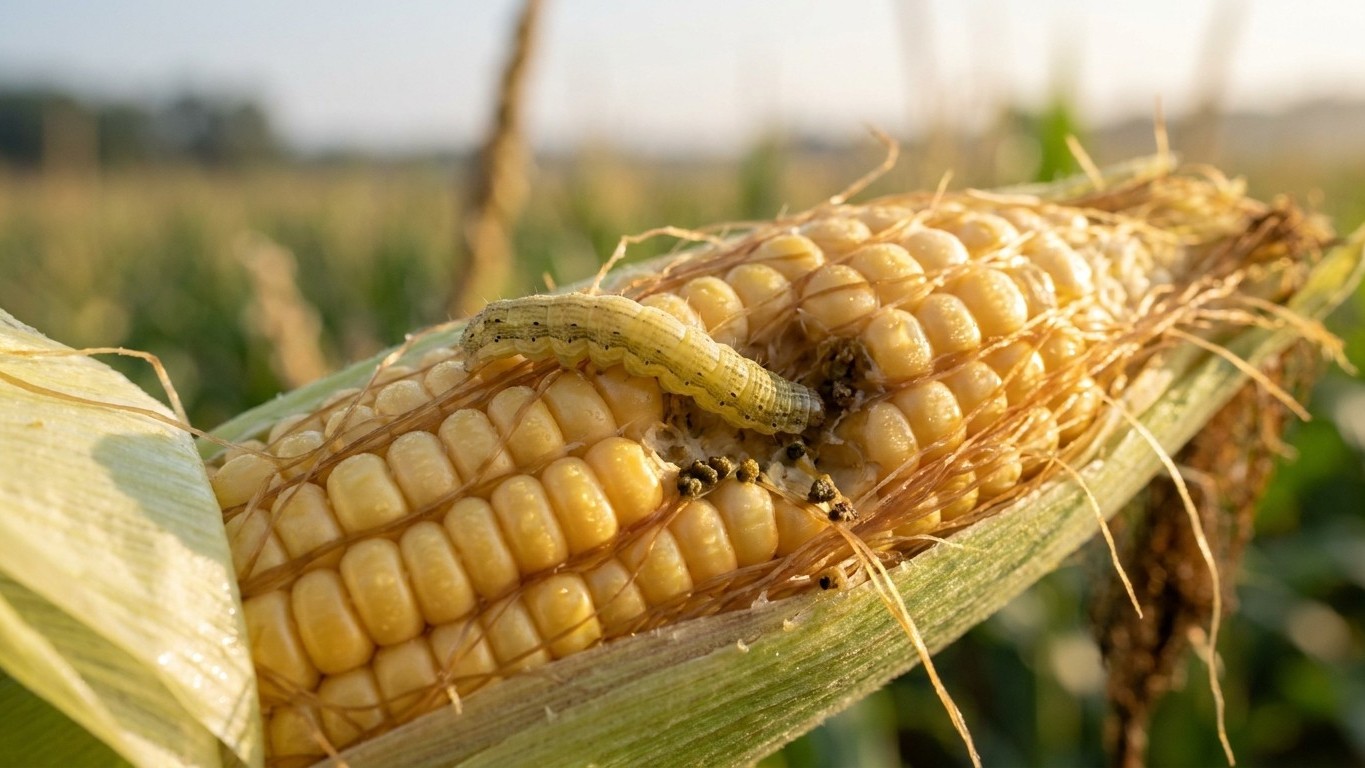
The first sign is usually at the tip of the ear: a cluster of chewed, discolored kernels sitting under a plug of coarse, sawdust-like frass, sometimes with a shed larval skin caught in the silk. On tomatoes, the same insect (there it’s often called the tomato fruitworm) tunnels in near the stem end, leaving a small entry hole and a hollowed-out interior inside fruit that looks fine from the outside. Peppers and beans show similar entry holes with frass packed just inside.
The larvae, the caterpillar stage, do all the feeding damage. Adult moths themselves don’t harm plants; they feed on nectar and lay eggs. Eggs are tiny, pale, and easy to miss, so most gardeners only notice a problem once larvae are already inside the ear or fruit, which matters for what can still be done about it.
- Sweet corn ears
- Tomato fruit
- Snap and lima beans
- Peppers
- Okra pods, less commonly grown in Washington gardens
How Washington sits in this pest’s range

Corn earworm is one of the most broadly distributed caterpillar pests in North America, turning up in nearly every state that grows corn or tomatoes commercially. Its presence in Washington isn’t really in question; what shifts by region is timing and how many generations show up in a season, not whether the insect arrives at all.
Washington’s position is shaped mostly by winter cold. In much of the South, corn earworm pupae overwinter successfully in the soil, so local populations build up generation after generation through a long growing season. In Washington, cold winters mean most overwintering pupae don’t make it, so each year’s population depends largely on moths blown in from warmer areas rather than a resident population carrying over. That puts the state closer to the cooler edge of the pest’s active range, arriving later in the season and typically producing just one damaging generation west of the Cascades, compared with several further south.
What actually works against it

Home control here is mostly cultural, and the order matters: cheap, easy measures first, more labor-intensive ones once damage shows up.
- Choose early-maturing or tight-husk corn varieties. Tighter husks physically slow young larvae from reaching the kernels, and earlier varieties can finish silking before peak moth flight in some years.
- Time planting to push silking either earlier or later than the expected peak flight window for your area, so fewer moths are actively laying eggs when silk is fresh.
- Cover young corn with row cover until silks start to emerge, then remove it, since pollination needs open access to wind and insects at that stage.
- Check silks regularly and hand-pick visible eggs or newly hatched larvae before they burrow past the first inch or two of the ear tip.
- Some gardeners apply a small amount of plain vegetable or mineral oil directly into the silk channel shortly after pollination, aiming to physically block the entry path for hatching larvae; results in university trials on this method have been inconsistent, so treat it as a possible extra step, not a guaranteed fix.
- After harvest, pull and destroy old cornstalks and fallen fruit rather than leaving them in the garden, since this removes overwintering pupae and cuts down what’s available for the following year.
Once larvae have tunneled several inches into an ear or deep into a tomato, none of these measures reach them anymore. At that point the practical move is harvesting early and trimming the damaged tip, not treating the plant.
Common questions
Does corn earworm survive Washington winters?
Mostly not. Cold soil temperatures kill most overwintering pupae, which is why each season’s population depends heavily on moths migrating in from warmer regions rather than a local population building up year over year.
Can corn earworm damage tomatoes as well as corn?
Yes. The same species is often called the tomato fruitworm when it attacks tomatoes, tunneling in near the stem end and leaving fruit hollowed out inside while looking intact from the outside.
Is there a corn variety that resists corn earworm completely?
No variety is immune, but tight-husk varieties make it physically harder for young larvae to reach the kernels, which is why husk tightness is one of the few plant-based traits gardeners can select for ahead of planting.