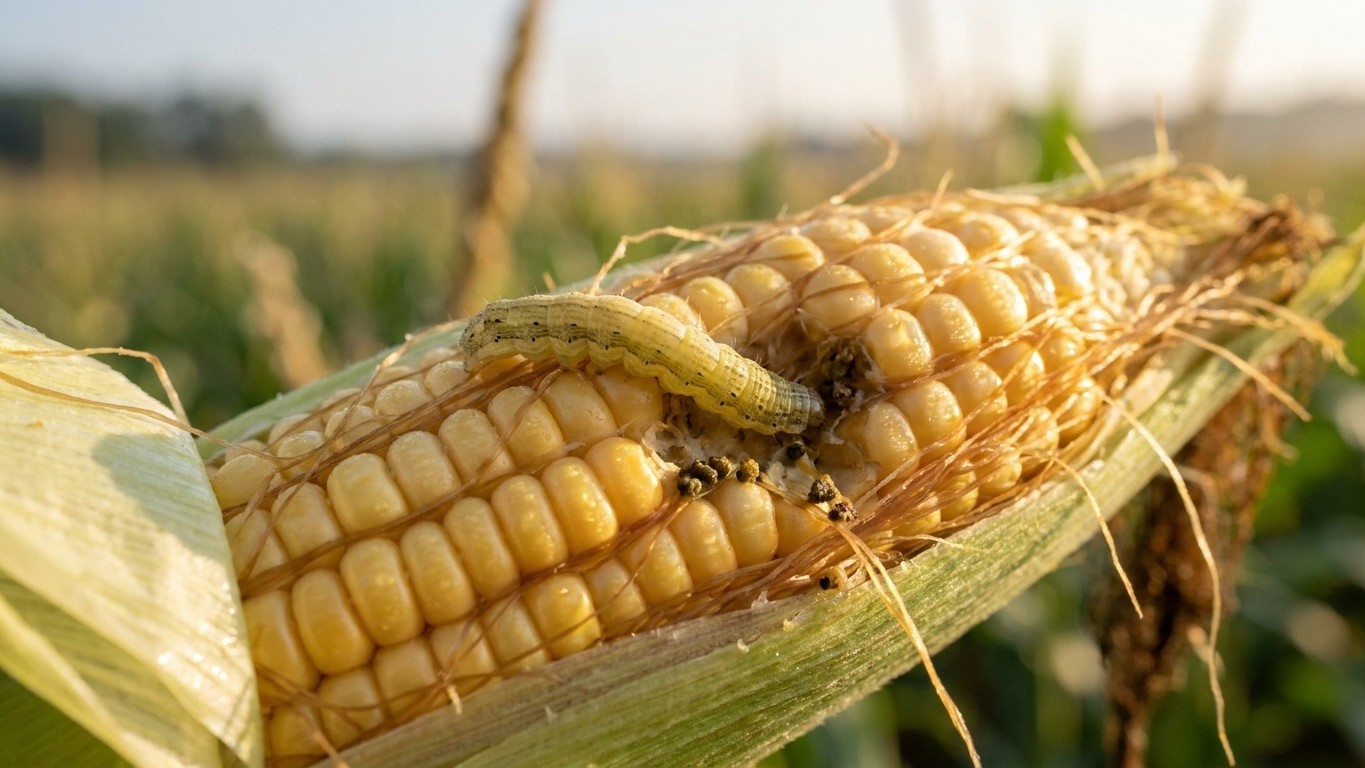

Corn earworm moths reach British Columbia’s growing regions from mid-summer through early fall, arriving as migrants rather than local survivors of winter. They target sweet corn silk first, then move to tomatoes and peppers. The best defense is timing plantings around peak moth activity, covering silks before egg-laying begins, and checking ears by hand once damage starts.
The weeks to watch

Corn earworm activity in British Columbia builds through July and peaks in August, tapering off as corn crops finish silking in early fall. British Columbia’s agricultural extension services do not publish a specific flight-date window for corn earworm the way they do for some resident pests, so the timing here follows the general biological pattern rather than a locally measured schedule.
Why there’s no fixed local date
Corn earworm can’t survive a Pacific Northwest winter as a pupa in the soil the way it does in warmer states further south. Each year’s population arrives fresh, carried north on weather systems and prevailing winds from regions where the insect overwinters successfully. That means the “start date” for BC moves with the weather patterns of a given spring and summer, not with a calendar entry. A warm, early summer with southerly wind flow can push the first arrivals earlier; a cool, wet stretch can delay them by weeks.
One generation, not several
Further south, corn earworm can complete two or three generations in a single growing season, each one worse than the last. British Columbia’s shorter, cooler season generally limits the pest to a single practical generation that matters for home gardens, timed to arrive as corn reaches silk. That’s good news for anyone managing the pest here: there’s one main window to defend, not a rolling series of them.
Reading the calendar from your last frost

Corn earworm itself doesn’t respond to frost dates, since it isn’t overwintering in the ground waiting for soil to warm. But the frost date still matters, because it sets when corn goes in the ground, and corn’s silk stage is exactly when the pest does its damage. For the Vancouver area, Environment and Climate Change Canada’s 1981-2010 climate normals put the mean last spring frost at March 18, recorded at the Vancouver Int’l A station. That’s a midpoint, not a guarantee: in roughly half of all years, frost arrives after that date. Treat it as a normal to plan around, not a safe deadline, and expect northern or higher-elevation districts in the province to run weeks behind this coastal figure.
- Start from the mean last frost date for your local weather station (March 18 for the Vancouver area), remembering that actual frost can land later in half of all years.
- Add the number of weeks your specific corn variety needs to reach silking, found on the seed packet’s days-to-maturity listing, then plan your row cover or silk-check schedule around that window rather than a fixed date on the wall calendar.
That arithmetic gives a range, not a single day. Anyone counting backward from a frost normal to predict an exact silking date is doing the same thing the frost normal itself warns against: turning a statistical midpoint into a false certainty.
What it attacks, and what the damage looks like

Most gardeners notice corn earworm damage before they ever see the insect itself. On corn, the first sign is usually chewed, discolored silk at the tip of the ear, sometimes with a small pile of dark frass sitting at the entry point. Peel back the husk and there’s a tunnel running down through the kernels, often with the caterpillar still inside near the tip. On tomatoes and peppers, the damage shows up as a clean, round entry hole near the stem end of the fruit, with the interior hollowed out and full of waste. Beans and lettuce can show scattered leaf feeding, though corn and tomatoes take the brunt of it.
- Sweet corn
- Tomatoes
- Peppers
- Green beans
- Lettuce (occasional leaf feeding)
The larval stage does all the damage. Adult moths lay single eggs on fresh silk or young leaves, and it’s the caterpillar that hatches days later that bores inward. That timing matters for control: once a larva has tunneled into an ear or a fruit, it’s protected from almost everything a home gardener can do. Any treatment has to happen at the egg or newly-hatched stage, before the caterpillar disappears inside the plant.
How British Columbia sits in this pest’s range

Corn earworm is one of the most widely distributed crop pests in North America, present across nearly every U.S. state and into southern Canada during the growing season. That wide distribution means the difference between one region and another is mostly a matter of timing and severity, not whether the insect shows up at all. British Columbia sits near the cooler, northern edge of that range. The province doesn’t support a resident, overwintering population the way warmer growing regions do, which keeps pressure lower here than in places where the moth breeds through several generations each year. Instead, BC gets a seasonal wave of migrants whose numbers depend on how favorable the wind and weather patterns were further south earlier in the summer. That’s a meaningful difference for gardeners: a bad corn earworm year in a warmer state doesn’t automatically translate into a bad year here, since the population has to travel and survive the trip north first.
What actually works against it

- Time your planting. Corn that silks early in the season, before migrant moth numbers build through July and August, tends to escape the worst of the egg-laying window simply because fewer adults are around yet. This costs nothing beyond choosing an earlier-maturing variety or an earlier planting date.
- Use row covers. A physical barrier over young corn keeps adult moths from reaching the plant to lay eggs at all. The cover has to come off once silks emerge and pollination needs to happen, which is also the exact moment the plant becomes vulnerable, so timing the removal matters as much as using the cover in the first place.
- Check silks and hand-pick. Inspecting silk tips every few days for fresh frass or a visible caterpillar, then removing what’s found by hand, catches the pest before it tunnels deep enough to reach the kernels.
- Rotate crops. This measure helps far less against corn earworm specifically than it does against soil-overwintering pests, since BC’s migrant moths arrive fresh each year rather than emerging from last season’s soil. It’s still worth doing for general garden health, just don’t expect it to break this particular pest’s cycle.
- Clear plant debris after harvest. In BC’s climate this mostly denies shelter to other insects and diseases rather than corn earworm pupae, since the cold winters here limit local overwintering survival for this species. Still a reasonable end-of-season habit, just not a targeted control for this pest.
None of these measures do anything once a caterpillar has already bored into an ear or a fruit. At that point, the only realistic step is harvesting and removing the infested portion, since the larva is physically out of reach inside the plant tissue.
Common questions
Does corn earworm survive winter in British Columbia?
Generally not. The province’s winters are too cold for the pupal stage to survive in the soil, so each year’s population arrives as migrants from warmer regions rather than emerging locally.
Can corn earworm damage tomatoes as badly as corn?
Yes. The caterpillar bores into the fruit near the stem end on tomatoes and peppers, hollowing out the interior in a way that’s just as destructive as the tunneling it does in a corn ear.
Are pheromone traps worth setting up in a home garden?
They can help track when adult moths are actively present in your area, which tells you when to have row covers in place or to start checking silks closely, rather than guessing at a fixed date.