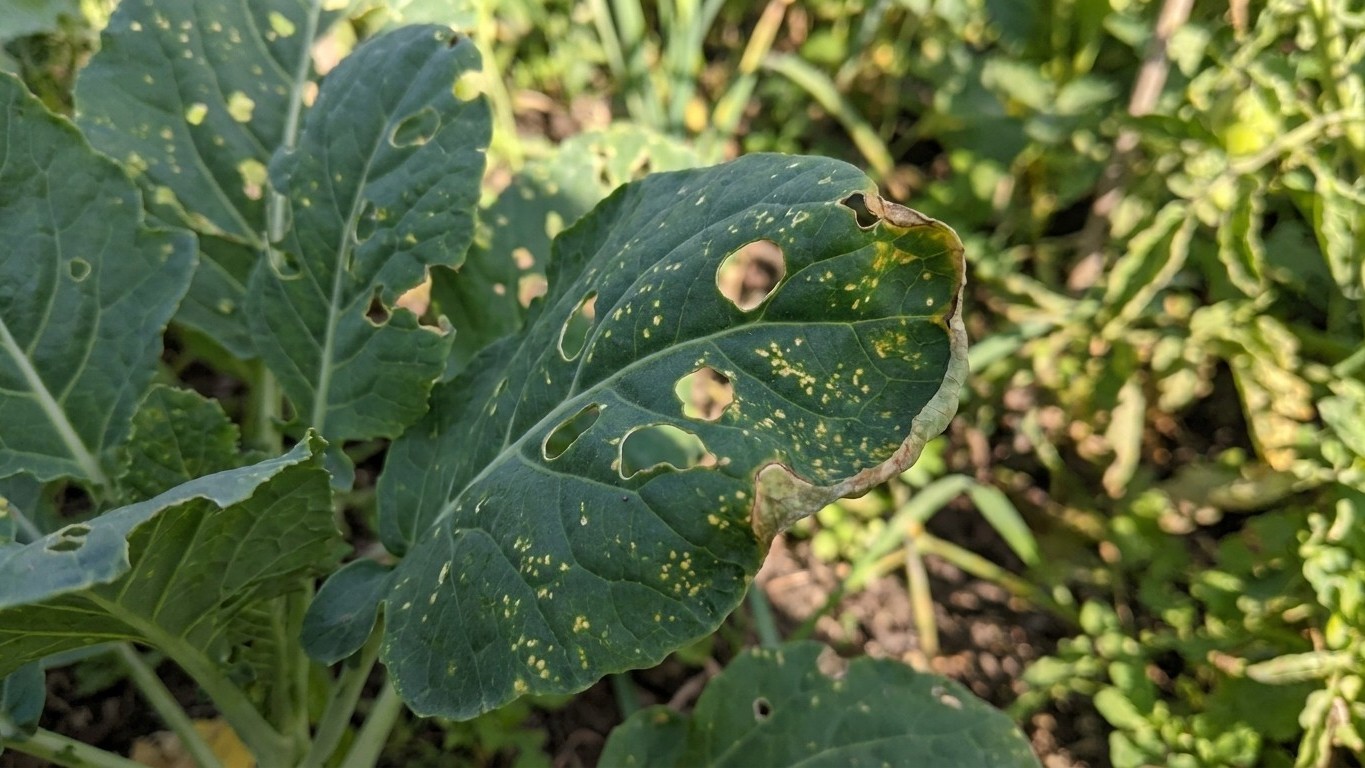

In South Dakota gardens, summer squash faces seven documented threats worth watching: squash bugs, squash vine borers, cucumber beetles, flea beetles, grasshoppers, wireworms, and blister beetles. Each one shows up on a different schedule, does a different kind of damage, and needs a different response. Knowing which is which, and when, saves a plant that a wrong guess would lose.
Which pests attack Summer Squash in South Dakota
SDSU Extension documents twelve insect pests for South Dakota vegetable gardens: Asparagus beetles, Blister beetles, Cabbage looper, Colorado potato beetle, Cucumber beetles, Diamondback moth caterpillar, Flea beetles, Grasshoppers, Imported cabbageworm, Squash bug, Squash vine borer, and Wireworms. Not all twelve belong on a page about summer squash, and pretending otherwise wastes a gardener’s time.
Five of the twelve have no business here. Asparagus beetles feed exclusively on asparagus spears and ferns, a different plant family entirely. Cabbage looper, Diamondback moth caterpillar, and Imported cabbageworm all target brassicas, cabbage, broccoli, kale, and their relatives, not cucurbits. Colorado potato beetle sticks to the nightshade family: potatoes, eggplant, and tomatoes. A gardener who spots one of these five on squash leaves is likely looking at something else entirely, or the insect wandered onto the plant without settling in to feed.
That leaves seven pests that actually feed on Summer Squash in this state. Squash bug and squash vine borer are the two that cause the most plant loss, because both can kill a mature vine outright rather than just scarring leaves. Cucumber beetles matter for a second reason beyond direct feeding: they spread bacterial wilt, a disease that can finish off a plant the beetles themselves only nicked. Flea beetles and grasshoppers are generalist feeders, less likely to kill an established plant but capable of shredding young seedlings fast enough to end the season before it starts. Wireworms live in the soil and attack at germination, striking before a gardener even sees a seedling emerge. Blister beetles round out the list, showing up in groups later in the season to strip foliage.
Seven pests is not a short list, but it is also not the whole insect world. A summer squash plant in a South Dakota garden is not equally at risk from all seven at once. Some are early-season problems, some are mid-summer, and one lives underground before the plant ever breaks the surface. The timing is what turns a documented pest list into something a gardener can actually use.
When each one shows up, and what it does first
South Dakota’s frost-free window runs from roughly April 29 to May 9 for the last spring freeze, to September 24 through October 4 for the first fall freeze, based on the 1991-2020 climate normals at the reference station. Squash goes in the ground after that spring date, and everything below is timed off transplanting, not off a calendar month, because that date itself shifts by a week or two depending on where in the state a garden sits.
The earliest arrivals
Wireworms are already in the soil before a seed goes in. Their damage shows up as a thin or spotty stand: seeds that never sprout, or seedlings that wilt and die within days of emerging, because the larvae have chewed into the stem or root below the soil line. There is no above-ground warning before that happens.
Flea beetles and cucumber beetles arrive next, often within the first week or two after transplanting or emergence. Flea beetles leave a telltale pattern: small, round shot-holes scattered across young leaves, as if someone had used a hole punch. Cucumber beetles, striped or spotted, feed on cotyledons and the first true leaves, and the first sign is often ragged leaf edges alongside the beetles themselves, easy to spot if a gardener looks closely at the underside of leaves in early morning.
Mid-season and later problems
Squash bugs and squash vine borer moths typically become active once vines start to run, several weeks after transplant. Squash bug damage starts as small yellow or bronze speckling on leaves that spreads until whole leaves wilt and turn brown, almost like a sudden drought stress. Squash vine borer gives almost no warning at all: the first sign is often a single healthy-looking vine collapsing overnight, with a small pile of moist, sawdust-like frass sitting at the base where the larva has bored in.
Grasshoppers build their numbers through the hottest stretch of summer, when the state averages nearly 14 days a year at 90°F or above, and their feeding often peaks alongside that heat, chewing ragged notches from the outer edge of leaves inward. Blister beetles tend to show up latest of the seven, often in loose groups, stripping leaves down to the veins over just a few days.
Telling the damage apart from everything else
Not every damaged squash leaf means an insect. The single most useful habit is turning a leaf over before assuming anything, because several insect pests, and their eggs, live almost exclusively on the underside.
| Symptom | Likely insect cause | Non-insect look-alike | What settles it |
|---|---|---|---|
| Sudden wilting of one vine, plant otherwise green | Squash vine borer | Bacterial wilt, uneven watering | Frass at the base of the stem points to borer; no frass, check watering history first |
| Yellow speckling spreading across leaves | Squash bug feeding | Nutrient deficiency, drought stress | Check leaf undersides for bronze bug clusters or clay-colored egg masses |
| Small round holes in young leaves | Flea beetles | Hail damage, mechanical injury | Insect holes cluster on new growth; hail marks scatter across all leaf ages evenly |
| Ragged notches from the leaf edge | Grasshoppers or blister beetles | Wind or foot traffic damage | Live insects usually still present at feeding sites during the day |
| Poor or spotty seedling stand | Wireworms | Cold or wet soil, poor seed quality | Dig at a failed spot; wireworm larvae are firm, wire-like, and shiny yellow-brown |
A gardener working through this list on their own plant should treat the table as a starting point, not a diagnosis. When a symptom does not clearly match one column or the other, the reliable next step is a local extension office rather than a guess.
What actually works here, and what is a waste of time
On a growing season this short, timing decides more than any single treatment does. Row covers placed over young plants right after the last spring frost, and removed once flowers open for pollination, block the earliest wave of flea beetles and cucumber beetles before they ever land on a leaf. That single window matters more than anything applied after the fact, because both pests do most of their damage to seedlings still small enough to be set back permanently.
For squash bug, checking leaf undersides every few days through the vining stage and crushing the bronze egg clusters before they hatch is far more effective than waiting until adults are established, since adult squash bugs are notoriously hard to control once numbers build. Squash vine borer responds best to catching the moth’s egg-laying window, wrapping the base of young vines or watching closely for the first sign of frass so a gardener can slit the stem and remove the larva before the vine collapses entirely.
Wireworms are a soil problem, and no leaf-level fix touches them; crop rotation and working ground that has not recently come out of sod cuts their numbers over time, but nothing solves them in a single season. Grasshoppers and blister beetles, both mobile and prone to moving in from field edges, are largely a nuisance to manage rather than eliminate; broad, repeated treatment across a whole garden tends to knock out the pollinators a squash plant depends on right along with the pests, which usually costs more yield than it saves. None of this replaces a product recommendation, because what is labeled and legal to use varies by state and changes over time; that question belongs with the local extension service, not a general gardening article.
Where to check this for your own county
SDSU Extension is the service that documents these pests for South Dakota, and its full site sits at extension.sdstate.edu. That is the right first stop for anything beyond identification, from current pest pressure reports to what is legal to use against a specific insect this season.
A state-level list tells a gardener what has been documented across South Dakota as a whole. It does not say what is actually present in one particular yard. Pest pressure inside a single state can swing sharply from one county to the next, shaped by soil type, nearby crop fields, how close a garden sits to sod or pasture, and even how mild or harsh the previous winter was. A county with heavy row-crop agriculture nearby often sees far more grasshopper and wireworm pressure than a garden tucked into a suburban lot.
That is exactly why county extension offices exist alongside the statewide service: they track what is showing up locally, season to season, in a way a general list never can.
For a gardener trying to identify something already happening on a squash plant this week, the most useful next move is a local county extension office, with a photo of the damage and, if possible, the insect itself. That local read, tied to a specific yard and this year’s weather, will beat any general list every time.