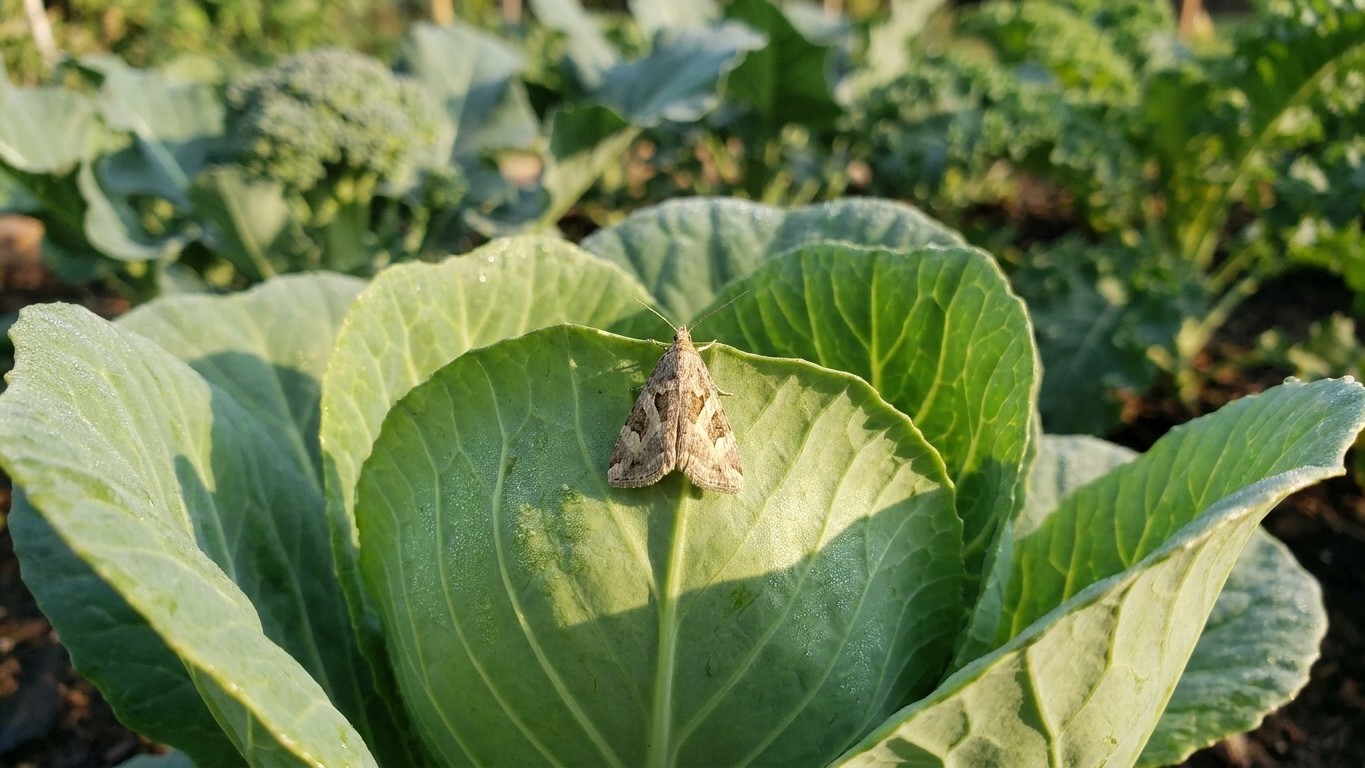

Diamondback moth shows up in Virginia every growing season, typically riding warm southerly winds into the state by mid-spring and building through summer on any cole crop left unprotected. Row covers put on before the first moths arrive stop it cold; once larvae are feeding inside a cabbage head, spraying the surface does almost nothing.
The weeks to watch
Virginia Cooperative Extension does not publish a specific first-appearance date for diamondback moth the way it does for a handful of better-tracked pests. What growers work from instead is the insect’s basic biology: it survives cold winters poorly, so populations here largely depend on adults blown north on storm systems and warm fronts from the Gulf Coast and points south. That means the “weeks to watch” shift a little every year depending on how the spring pattern sets up, but the general shape of the season stays consistent.
Spring arrival
Moths typically become active as soon as brassica Transplants and volunteer weeds like wild mustard start growing, often before a gardener has even set out their own seedlings. In a mild, early spring they can be laying eggs on the first cole crops in the ground; in a cold, wet spring their arrival lags behind.
Summer generations
Once established, diamondback moth doesn’t wait for a single “season.” Warm weather lets one generation follow another in quick succession, so a planting that looked clean in June can carry visible feeding damage by July with no obvious gap in between. This overlapping pattern is why the pest is often worse on late-summer fall brassica plantings than on the spring crop.
Fall tapering
Populations decline as nights cool, but in Virginia’s milder coastal counties, moths can keep feeding on fall and winter brassicas well after inland gardens have had their first hard freeze.
Reading the calendar from your last frost
The one date most Virginia gardeners actually plan around is the last spring frost. For coastal Virginia Beach, NOAA’s 1991-2020 climate normals put the last spring 32°F freeze between March 20 and April 3. That’s the mild end of the state. Gardens in the Blue Ridge and southwest Virginia run weeks later in spring, so a planting schedule built on the Virginia Beach numbers will put transplants out too early further inland.
Diamondback moth doesn’t answer to a printed calendar date. It answers to how warm the soil and air have gotten, so an early, warm spring pulls its arrival forward and a cold, slow one delays it, regardless of what the frost-date normal says. Extension guidance on cool-season brassicas generally points to the first two to four weeks after transplanting as the window when early feeding marks tend to show up, once seedlings are established and moths have had time to find them and lay eggs.
- Start from your local last-frost range (March 20 to April 3 near the coast; later in the Blue Ridge and southwest).
- Add roughly two to four weeks after transplanting for when the first feeding damage is likely to appear, and use that as the point to have row covers already in place, not the point to start looking for them.
What it attacks, and what the damage looks like
Most gardeners notice the damage long before they ever spot the insect. Leaves develop small, translucent “windowpane” patches where young larvae have chewed through only the lower leaf surface, leaving the upper layer intact like a thin film. As larvae grow, those patches turn into ragged holes and full-on skeletonizing, concentrated on the undersides of outer leaves and especially on the tender growing point of young seedlings, where feeding can stunt or kill a transplant outright.
The damage is done entirely by the larval stage: small, pale green caterpillars, tapered at both ends, that wriggle violently and often drop off the leaf on a silk thread when disturbed. That’s a useful field test since few other cabbage pests behave quite that way. Because larvae do the feeding, any control aimed at eggs or adults only works before that stage starts.
Crops at risk include:
- Cabbage
- Broccoli
- Cauliflower
- Kale and collards
- Brussels sprouts
- Mustard greens and turnip greens
- Arugula
How Virginia sits in this pest’s range
Diamondback moth is one of the most widely distributed insect pests of brassica crops in North America, found in nearly every state where cole crops are grown. Widespread doesn’t mean uniform, though. The real difference from one part of the country, or one part of Virginia, to another is timing rather than presence: everyone growing cabbage or kale deals with this insect eventually, but when it arrives and how many generations it manages before frost depends heavily on local temperature.
Within Virginia, that plays out along the same coastal-to-mountain gradient that shapes the frost data. The coastal plain and Tidewater region, milder and with a longer frost-free stretch, generally supports earlier arrival and more overlapping generations in a season. The Blue Ridge and far southwest, with a shorter growing season and cooler nights, tend to see the pest arrive later and produce fewer generations before cold weather knocks populations back. None of this makes Virginia unusually bad or unusually mild for diamondback moth compared with neighboring states; it simply means a gardener’s own local frost pattern, more than the state line, decides how much pressure to expect.
What actually works against it
Cheap, low-effort measures come first, and they matter more than anything sprayed on after the fact.
- Rotate where brassicas go each year. Diamondback moth pupae and related crucifer pests build up in soil and old plant debris, so moving cole crops to a different bed reduces the local carryover population feeding your next planting.
- Time the planting to dodge peak pressure. Getting a spring crop in and maturing before populations build, or delaying a fall planting until the worst summer generations have passed, avoids the pest rather than fighting it.
- Install floating row covers before moths arrive. A lightweight cover laid over the bed at transplanting physically blocks adult moths from reaching the leaves to lay eggs. It stops working the moment eggs are already on the plant or covers go on too late; it does nothing once larvae are established.
- Hand-pick larvae on small plantings. Checking the undersides of leaves every few days and removing caterpillars by hand is realistic for a backyard bed, less so for a large planting.
- Clear and destroy plant debris after harvest. Removing old brassica stalks and leaves eliminates a spot where pupae can overwinter or bridge between plantings.
- Encourage natural predators. Parasitic wasps attack diamondback moth larvae and can hold populations down over a season, particularly where broad-spectrum treatments haven’t wiped them out.
Pheromone traps are commonly sold to home gardeners for monitoring diamondback moth activity. They’re useful for telling you moths are active nearby; trials on using them alone to meaningfully reduce garden damage don’t show a clear benefit, so they’re better read as an early warning than a control method. Once larvae have tunneled into a cabbage head or the crown of a seedling, none of the above measures reach them anymore, the affected leaves or plants generally need to be removed and destroyed rather than treated.
Common questions
Does diamondback moth overwinter in Virginia? It survives cold winters poorly across most of the state, so much of each season’s population arrives on wind currents from warmer regions rather than emerging locally, though mild coastal winters can allow some local survival.
Is the Blue Ridge less affected than the coast? Generally yes, in the sense that the shorter, cooler growing season there means later arrival and fewer generations before frost, not that the pest skips the region entirely.
How is diamondback moth damage different from cabbage looper damage? Diamondback larvae are much smaller, thinner, and taper at both ends, and their early feeding leaves thin translucent windowpane patches rather than the larger, ragged holes typical of looper caterpillars.