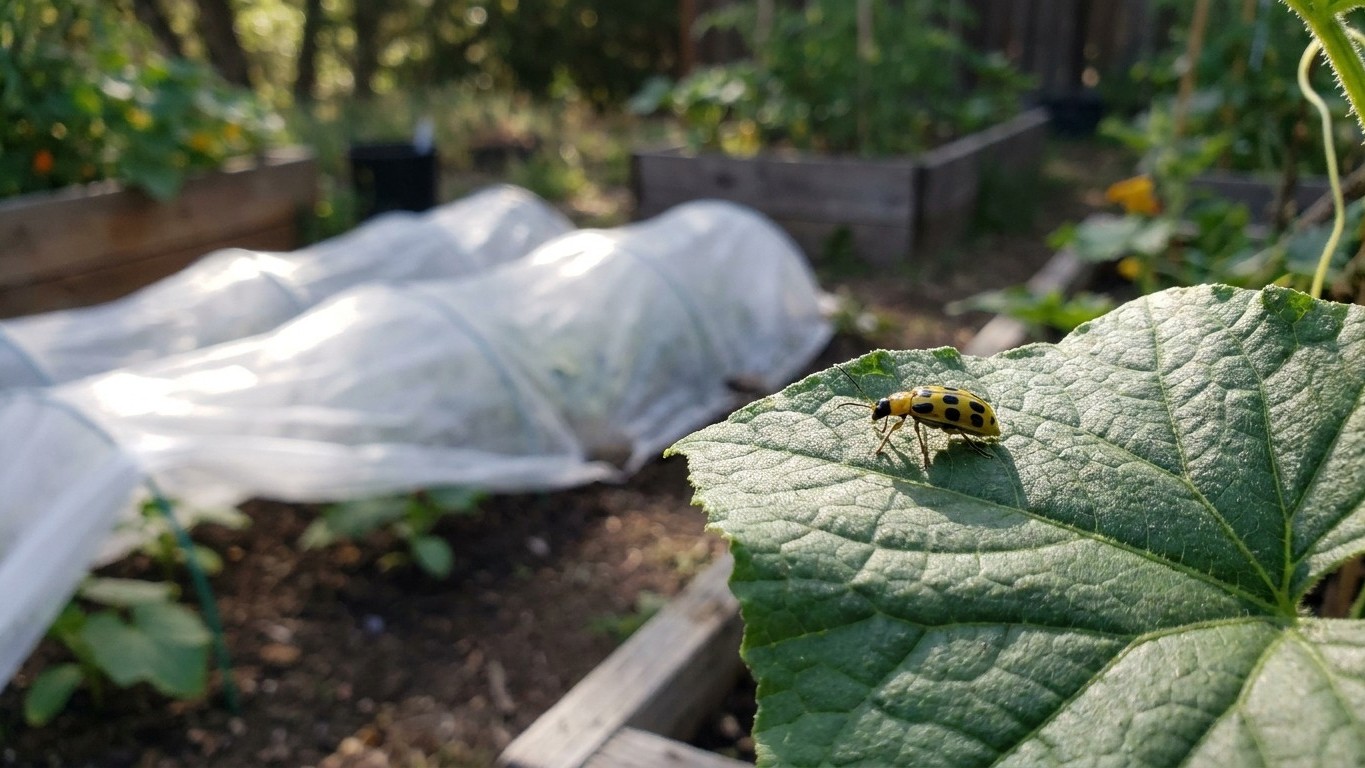

Cucumber beetles show up in Texas gardens as soon as cucurbit seedlings poke through the soil, which on the Gulf Coast can mean late winter and farther inland can mean well into spring. Both the striped and spotted species overwinter as adults in garden debris, waking once the ground warms. Stopping them comes down to timing, physical barriers, and garden sanitation, because once larvae bore into roots and stems, most controls stop working.
The weeks to watch

Cucumber beetles begin turning up in Texas gardens as soon as the first true leaves of cucumbers, squash, and melons unfold, which along the coast can happen in February and farther north or west can wait until April. Texas AgriLife Extension does not publish a fixed flight-date window for cucumber beetles the way some agencies do for a handful of other insects, so the useful guide here is the general life-cycle pattern rather than a calendar entry.
Spring emergence
Both the striped beetle (Acalymma vittatum) and the spotted beetle (Diabrotica undecimpunctata howardi) spend winter as adults tucked into leaf litter and garden debris. They stir once soil and air temperatures warm consistently in spring, then move directly into the nearest cucurbit patch, feeding on tender seedlings and later on flowers as vines mature.
Later generations
Because Texas summers run long and warm, the spotted cucumber beetle in particular tends to produce more than one generation across a single growing season, with overlapping broods keeping adults active from spring transplanting through late summer harvest. That’s different from colder states where a single generation dominates and beetle pressure tapers off by midsummer. In Texas gardens, a grower who cleared beetles off spring squash can still find a fresh wave on fall plantings of the same crop.
Reading the calendar from your last frost

Cucumber beetles don’t check a calendar. They respond to soil warmth, which is why the same insect can arrive weeks apart in two gardens just a few counties from each other. The one date most Texas gardeners actually plan around is the last spring frost, and for the Houston area (station IAH), NOAA’s 30-year climate normals put that window between February 4 and March 1. That’s a normal drawn from three decades of freeze probabilities, not a promise for any single year.
- Start with your local last-frost window. For Houston-area gardeners, that’s February 4 to March 1; other parts of the state run earlier or later depending on zone.
- Add the time it takes cucurbit transplants to establish. Seedlings set out once frost risk passes are typically at their most vulnerable to beetle feeding in the first week or two after transplanting, while overwintered adults are already active nearby and looking for the first green growth they can find.
An early, mild spring pulls beetle activity forward along with the plants; a late cold snap pushes both back. Row covers should go on at transplanting, while the seedlings are most exposed, and come off once flowers open and pollinators need access.
What it attacks, and what the damage looks like

Most gardeners notice the damage before they ever spot the insect. A vine that looked fine yesterday and is wilted flat today, on a warm afternoon with no water stress to explain it, is one of the clearest signs, since cucumber beetles carry the bacterium that causes bacterial wilt in cucurbits. Leaves riddled with small, ragged holes, almost lace-like, point to adult feeding. Fruit with shallow scars or pitted rind, and seedlings clipped off right at the soil line, round out the usual complaints.
The crops most often hit include:
- Cucumbers
- Summer and winter squash
- Pumpkins
- Cantaloupe and watermelon
- Young corn and beans, mainly from the spotted cucumber beetle’s larval stage, sometimes called the southern corn rootworm
Adults do the visible above-ground damage, chewing leaves, flowers, and fruit skin. Larvae work underground, tunneling into roots and the base of stems, which is the stage that decides whether a treatment still has a chance. Once larvae have moved into the root zone, spraying the leaves does nothing for them.
How Texas sits in this pest’s range

Cucumber beetles are found across nearly the entire country, and Texas is no exception. Where a range is this wide, the difference between one state and the next usually isn’t whether the insect shows up at all, it’s when. That holds inside Texas itself even more than it does state to state, because Texas spans four separate USDA hardiness zones. A Panhandle garden can still be under frost risk while a Gulf Coast garden two hundred miles south already has beetles on its first squash blossoms.
That spread inside one state’s borders is worth sitting with for a second, since it means a planting calendar built for Houston has little to say to a gardener in Amarillo or Lubbock. Even within the Houston area, the two main airport weather stations don’t agree with each other: Hobby runs about two weeks milder than IAH, which is the station behind the February 4 to March 1 window cited above. A gardener working from a statewide guide risks planting either too early for a lingering freeze or too late to get ahead of the first wave of beetles.
What actually works against it

The cheapest and most effective moves come first, and the list gets less reliable the further down it runs.
- Time the planting. Holding off on direct-seeding cucurbits until the coldest risk has passed lets seedlings grow past the fragile stage faster, before the first wave of overwintered adults finds them.
- Rotate the bed. Overwintering adults emerge right where last year’s cucurbit vines grew. Moving this year’s cucumbers, squash, and melons to a different part of the yard forces beetles to search harder to find them.
- Cover the seedlings. A floating row cover keeps adults off tender transplants entirely. It has to come off once flowers open, since covers also block the bees and other pollinators the plants need to set fruit.
- Hand-pick in the cool of morning. Beetles move slowly in cooler temperatures, making early morning the easiest time to knock them into a container of soapy water.
- Clear the debris. Pulling and discarding old cucurbit vines at the end of the season removes the shelter adults use to overwinter, which cuts down the population that reappears the following spring.
- Reflective mulch is a common add-on. Some gardeners lay down light-colored or foil mulch around young plants, on the idea that reflected light disorients beetles hunting for host plants. Results in trials on this practice have been inconsistent, so treat it as a possible extra layer, not a replacement for the steps above.
None of these reach a beetle once its larva has already tunneled into a root or stem base. At that point the plant showing sudden wilt is usually beyond saving, and pulling it out promptly is mainly about keeping bacterial wilt from spreading to the vines next to it.
Common questions
Do cucumber beetles bite people or pets?
No. They feed only on plant tissue, mainly cucurbit leaves, flowers, and fruit, and pose no direct risk to humans or animals.
Can one cucumber beetle really kill a whole plant?
Not the beetle itself, usually. The real damage comes from the bacterial wilt pathogen the beetle carries on its body and introduces while feeding; once a vine wilts from that infection, it typically doesn’t recover.
Are striped and spotted cucumber beetles both a problem in Texas?
Yes, both are found in the state and both feed on the same range of cucurbit crops, though the spotted cucumber beetle is the one more likely to produce multiple overlapping generations across a Texas growing season.