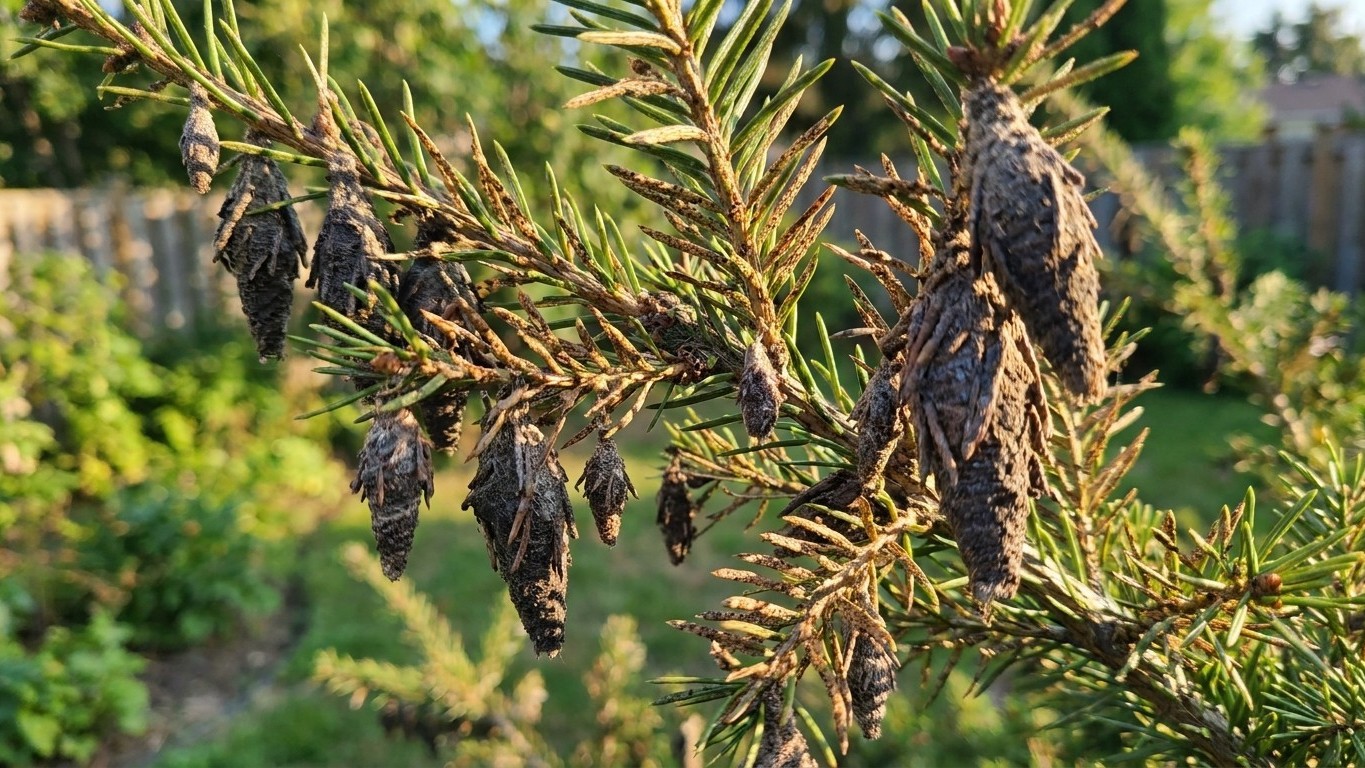

Bagworms show up in Illinois every year without exception, and the state’s humid summers give them plenty of time to do damage. Eggs hatch in late May to early June, larvae feed heavily through July and August, and by September the bags are big enough to spot from across the yard. The window that actually matters for control is narrow: once larvae pass about half an inch, sprays lose their punch and hand removal becomes the only reliable fix.
The Bagworm Timeline Across Illinois

Illinois stretches from USDA hardiness zone 5a near the Wisconsin border down to zone 7a in the southern tip near Cairo. That range matters because it shifts hatch dates by a couple of weeks depending on where you live. In the Chicago suburbs and northern counties, eggs typically hatch in the first two weeks of June. Farther south, around Carbondale or Marion, hatching can start in late May.
Each overwintering bag holds hundreds of eggs, sometimes over 1,000 in a single female’s bag. Those eggs survive Illinois winters just fine because they’re tucked inside a silk-and-plant-material casing that acts like insulation. Cold snaps below zero don’t kill them the way they might a soft-bodied insect exposed on bark.
Once the larvae emerge, they’re barely visible, about the size of a pinhead, and they immediately start building their own protective bag from silk and bits of the host plant. That’s why early-season bagworm damage looks like light stippling rather than obvious defoliation. By July, the bags have grown to an inch or more, and feeding accelerates. Late-instar larvae in August can strip entire branches on arborvitae and juniper in a matter of weeks.
Males finish feeding first, seal themselves in their bags to pupate, then emerge as small black moths in late August or September to find a mate. Females never leave their bags at all. They mate, lay eggs inside the bag they’ve occupied all season, and die there, leaving next year’s generation sealed up and ready to overwinter on the same branch.
Why Illinois Landscapes Are Particularly Vulnerable
Bagworms have a strong preference for evergreens, and Illinois yards are full of their favorites: arborvitae, eastern red cedar, blue spruce, and various junipers used as privacy screens and foundation plantings. Because these plants don’t drop their needles seasonally, damage compounds year after year if the pest goes unaddressed. A cedar hedge that loses 30 percent of its foliage in one summer often can’t recover that growth the following spring, since evergreens don’t push out replacement foliage as aggressively as deciduous trees do.
Deciduous trees aren’t immune either. Maples, honeylocust, and sycamore in Illinois neighborhoods sometimes carry bagworm populations, though the damage is less visually alarming since the tree simply grows new leaves the following year.
How to Identify Bagworms Before They Take Over
The telltale sign is the bag itself: a spindle-shaped case, one to two inches long at maturity, covered in small pieces of twig and foliage that make it look almost like a tiny pinecone hanging from a branch. Because the camouflage is so effective, homeowners frequently mistake bags for actual plant debris and miss an infestation until damage is already significant.
A few practical checks help confirm what you’re looking at:
- Gently squeeze a suspected bag. If it feels firm or you can see movement, it’s active or holds eggs.
- Look for silk strands anchoring the bag tightly to the branch, unlike loose debris that would fall off easily.
- Check the underside of branches first. Bagworms often start feeding in less visible spots before moving outward.
- Scan for brown, thinning patches on evergreens in mid to late summer. That patchy look, rather than uniform browning, often points to bagworm feeding.
Old bags from previous seasons stay attached to branches for a long time, sometimes years, even after the insect inside is gone. That makes counting bags an imperfect way to gauge current infestation size unless you know which ones are new. A fresh bag from the current season generally looks lighter in color and less weathered than one that’s been through a winter.
What Actually Stops Bagworms in Illinois
Timing drives everything when it comes to control. The University of Illinois Extension recommends treating young larvae while they’re still small, ideally in June before bags reach half an inch. At that stage, biological insecticides containing Bacillus thuringiensis var. kurstaki (Bt) work well because young caterpillars ingest treated foliage readily and the bacterium disrupts their digestive system within days.
By mid to late July, larvae have hardened and grown larger, and Bt becomes noticeably less effective. At that point, conventional insecticides labeled for bagworm control, applied thoroughly to reach larvae inside their bags, tend to work better. Complete coverage matters more than product choice at this stage, since a bag that’s only partially wetted with insecticide often shelters enough surviving larvae to keep the population going.
Hand-picking remains one of the most dependable methods, particularly for smaller trees and shrubs where every bag is reachable. Removing bags between November and March, before eggs hatch, physically eliminates next year’s generation before it starts. Dropping the collected bags into a bucket of soapy water for a day or two before disposal ensures the eggs won’t survive if the bag ends up in a compost pile.
Natural predators help too, though not enough to rely on alone. Birds, particularly chickadees and other insect-eating species common in Illinois backyards, will pick at bagworm bags in winter when other food sources are scarce. Certain parasitic wasps also target bagworm larvae, but populations of these wasps rarely build up fast enough to prevent noticeable damage in a heavily infested planting.
Spray Timing Mistakes to Avoid
The most common misstep homeowners make is spraying too late, often in August when bags are already large and the caterpillars inside have stopped feeding as heavily in preparation for pupation. At that point, chemical control offers limited return, and the more effective move is simply to hand-remove what you can reach and mark the calendar for next June.
Spraying during a heat wave or drought stress also reduces effectiveness, since stressed plants can react poorly to certain insecticide formulations, and hot, dry conditions cause spray droplets to evaporate before larvae have a chance to ingest treated foliage.
Preventing Reinfestation Year After Year
Because female bagworms can’t fly and rarely travel far from where they pupated, an infestation tends to stay concentrated on the same trees or the same row of shrubs unless something moves the bags around, like wind, birds, or landscaping equipment. That localized behavior is actually good news for homeowners: treating the specific plants that have shown bagworm activity in past summers, rather than spraying an entire yard, usually addresses the real problem.
Inspecting new plants before bringing them onto the property matters more than most people realize. Bagworm bags can hitch a ride on nursery stock, particularly evergreens purchased in late summer or fall when bags are already formed and easy to miss among the foliage. A quick visual check of any new arborvitae or juniper before planting takes a few minutes and can prevent introducing the pest to an otherwise clean landscape.
Keeping evergreens reasonably healthy through proper watering during Illinois’s occasional summer dry spells also helps trees recover from light feeding without long-term dieback. A stressed, drought-weakened juniper that loses foliage to bagworms has a much harder time bouncing back than one that entered the season well-watered and vigorous.
Scouting in early June, right around the time local schools let out for summer, gives Illinois homeowners the best shot at catching bagworms while they’re still small enough for Bt to work and before visible damage sets in. Marking that date on a calendar each spring turns bagworm control from a late-summer scramble into a routine, manageable task.