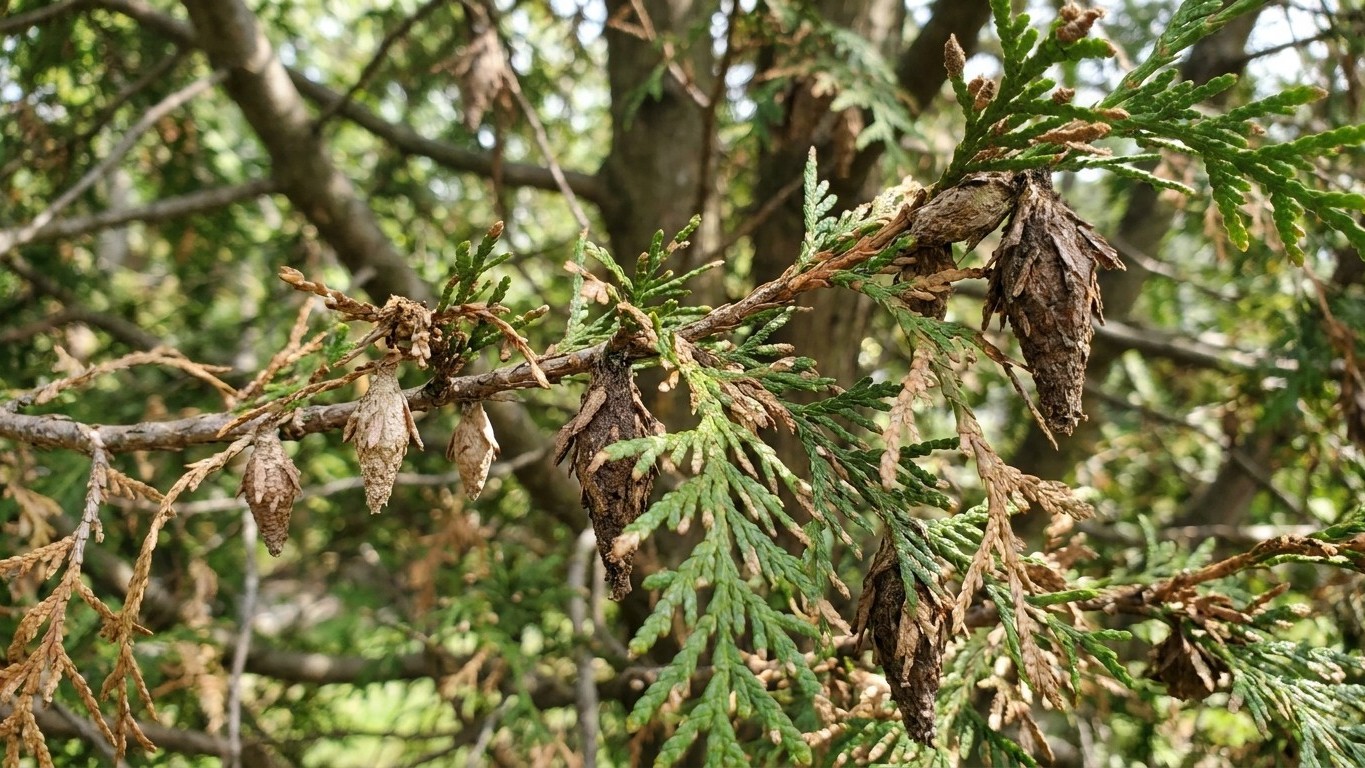

Bagworms start hatching in Kansas somewhere between late May and mid-June, and the window to stop them with anything other than scissors and a trash bag closes fast once the larvae build their protective cases. If you’ve got junipers, arborvitae, or eastern redcedar on your property, the next six weeks after hatch decide whether you lose a few branches or lose the whole tree.
When Bagworms Actually Show Up in Kansas

Bagworm eggs overwinter inside last year’s bags, glued tight to twigs and branches. Nothing happens until soil and air temperatures climb enough to trigger hatch, which entomologists track using growing degree days rather than the calendar. In practice, that means eastern Kansas cities like Kansas City, Topeka, and Wichita usually see the first larvae emerge a week or two ahead of western towns like Garden City or Dodge City, where spring warms up more slowly.
Most years, hatch runs from the last week of May through mid-June statewide. A cool, wet spring can push that date back into late June. A hot, dry one moves it earlier. This matters because the newly hatched larvae are barely an eighth of an inch long, soft-bodied, and vulnerable, they’re exposed and easy to kill for only a short stretch before they spin the silk bags that make them nearly bulletproof against most sprays.
What Bagworms Actually Damage
Kansas has an unusual amount of bagworm habitat baked into its landscape. Eastern redcedar, a native juniper that has spread aggressively across pastures and windbreaks statewide, is one of the insect’s favorite hosts. So are the arborvitae hedges planted around thousands of farmsteads for wind protection. Ornamental junipers in suburban yards round out the short list of “preferred” targets.
But bagworms aren’t picky when populations get heavy. They’ll feed on more than 100 species of trees and shrubs, including maple, honeylocust, sycamore, and black locust. The difference is survival odds. A maple or sycamore that gets stripped of leaves in August will usually push out new growth the following spring. An evergreen like juniper or arborvitae doesn’t have that luxury. Conifers don’t regenerate foliage the same way broadleaf trees do, so a heavy bagworm year can leave brown, dead branches that never come back, and a severe enough infestation can kill the whole tree in a single season, especially one already stressed by drought.
That drought connection matters more in Kansas than in wetter states. A juniper hedge that’s already struggling through a dry summer has fewer reserves to recover from defoliation. In practice, that means the same bagworm population can be a cosmetic nuisance on a well-watered tree and a death sentence on a stressed one thirty feet away.
How to Spot an Infestation Before It Spreads
The bags themselves change shape and size as the season progresses, which throws off a lot of homeowners doing a quick inspection. In June, look for tiny, spindle-shaped cases covered in bits of foliage, easy to mistake for a piece of debris caught on a branch. By August and September, those same bags have grown to an inch and a half or two inches long and start to resemble small, dangling pine cones woven from silk and twigs.
Old bags from the previous year are the giveaway to watch for before hatch even starts. They stay attached to branches through winter, gray and weathered, often mistaken for old seed pods. A juniper or arborvitae with dozens of these hanging on it going into spring is a tree that’s about to have a bad summer unless someone intervenes.
Signs the Damage Is Already Underway
Thinning foliage on the interior branches, brown patches that don’t match a normal seasonal color shift, and visible webbing near feeding sites all point to an active population. On evergreens especially, damage tends to show up from the top and outer branches inward, since that’s where larvae feed first before spreading.
What Actually Stops Bagworms in Kansas
Timing decides everything here. Bacillus thuringiensis (Bt), the biological insecticide most often recommended for bagworms, only works on small larvae actively feeding on foliage. Once a caterpillar has built enough of its bag to retreat inside, the spray can’t reach it and the treatment fails. That gives homeowners roughly a two to four week window after hatch, generally mid-June through early July across most of Kansas, to apply Bt or spinosad while it can still do its job.
Miss that window and the options narrow. Contact insecticides such as pyrethroids or carbaryl can still knock back larger larvae, but they’re less selective and more likely to harm beneficial insects like bees and predatory wasps that help keep other pest populations in check. Spraying in August, when bags are near full size, tends to produce disappointing results no matter what product gets used.
The single most reliable method, and the one that costs nothing but time, is hand removal during the dormant season. Picking bags off branches between November and February, before eggs hatch, physically eliminates the next generation before it starts. A single bag can hold anywhere from a few hundred to over a thousand eggs, so removing even a modest number of bags from a hedge can prevent a serious outbreak the following summer. Bags need to go into the trash or get burned, not the compost pile, since the eggs inside can survive composting and hatch right back into the yard.
For homeowners managing a windbreak of dozens or hundreds of trees, hand-picking every bag isn’t realistic. In those cases, scouting a sample of trees in late winter to gauge population size helps decide whether a coordinated spray program is worth the cost come June.
Regional Differences Across Kansas
Central and eastern Kansas, where eastern redcedar has spread the most aggressively into former grassland, tend to see the heaviest and most consistent bagworm pressure. The sheer volume of juniper habitat gives populations more places to build up year over year. Western Kansas has less native redcedar density, but farmstead windbreaks planted decades ago, often rows of arborvitae or juniper meant to block wind and snow, can take serious hits since they’re isolated stands with nowhere else for the insect to disperse.
Urban and suburban plantings add another wrinkle. Ornamental junipers used in landscaping around homes in Wichita, Overland Park, and other cities create small, concentrated pockets of host material, and heat retained by pavement and buildings can nudge local hatch dates slightly earlier than in surrounding rural areas.
A Practical Timeline for Kansas Yards
Late winter, roughly February through early March, is the best time to walk juniper, arborvitae, and cedar plantings and strip off any remaining bags before hatch. Early May is the point to start watching for the first signs of hatch, particularly in warmer eastern counties. Mid-June through early July is the narrow treatment window if a Bt or spinosad application makes sense based on population size. By late summer, the focus shifts from treatment to damage assessment, deciding which branches or trees need pruning, extra watering, or replacement going into next year.
One detail that surprises a lot of Kansas homeowners: a tree that looks fine in July can still be carrying a population that does real damage by September, since bagworms keep feeding and growing right up until they seal themselves in for winter. A midsummer check that comes back clean isn’t a guarantee the season is over.