
Illinois Extension names eight pests as the ones driving most home garden damage in the state: Japanese beetle, squash vine borer, squash bug, Colorado potato beetle, bagworm, brown marmorated stink bug, jumping worms, and spotted lanternfly. Pressure runs heaviest from late June through August, though it starts in late May and tapers off through September. Start checking potato, squash, and evergreen plantings weekly by mid-May, since most of the damage from this list happens in a window you can still catch early.
What Illinois gardens actually deal with

Eight bugs cause most of the plant damage in Illinois yards this summer, and you’re probably already hosting one of them. Japanese beetle populations skeletonize leaves, squash bug populations and squash vine borer populations wilt whole plants from the base, Colorado potato beetles strip foliage down to stems, bagworms hollow out evergreens from the inside, brown marmorated stink bug populations dimple your tomatoes, jumping worms wreck your soil, and spotted lanternfly sightings in Illinois are the new one to watch for. Walk your potatoes, squash, and evergreens once this week and see what’s actually there before deciding what to do about it.
Colorado potato beetle

Look for the striped adult on potato foliage first, then the reddish larvae doing the real eating. Both stages of the Colorado potato beetle populations strip leaves down to the stems, and heavy feeding can defoliate a potato patch fast enough to cut yield. Hand-picking adults and crushing egg clusters early breaks the cycle before larvae hatch in numbers.
Bagworm

The Bagworm in Illinois is easy to spot by its bag, hanging off arborvitae, juniper, and spruce like a small pinecone. Larvae inside feed on needles all summer, and by the time browning shows up, the damage is already done. Pruning and destroying bags before eggs hatch is the only timing that matters here.
Squash bug

Adults and the gray nymph clusters feed on squash and pumpkin leaves, injecting a toxin that causes wilting well beyond where they’re actually feeding. Bronze egg clusters on the underside of leaves are the earliest sign, easier to catch than the bugs themselves.
Squash vine borer

The wasp-mimic moth lays eggs at the base of squash and zucchini stems. The larva bores in and feeds inside the stem, and the first visible sign is often a wilted vine with a small hole and a pile of frass at the base, not the moth or the caterpillar itself.
Japanese beetle

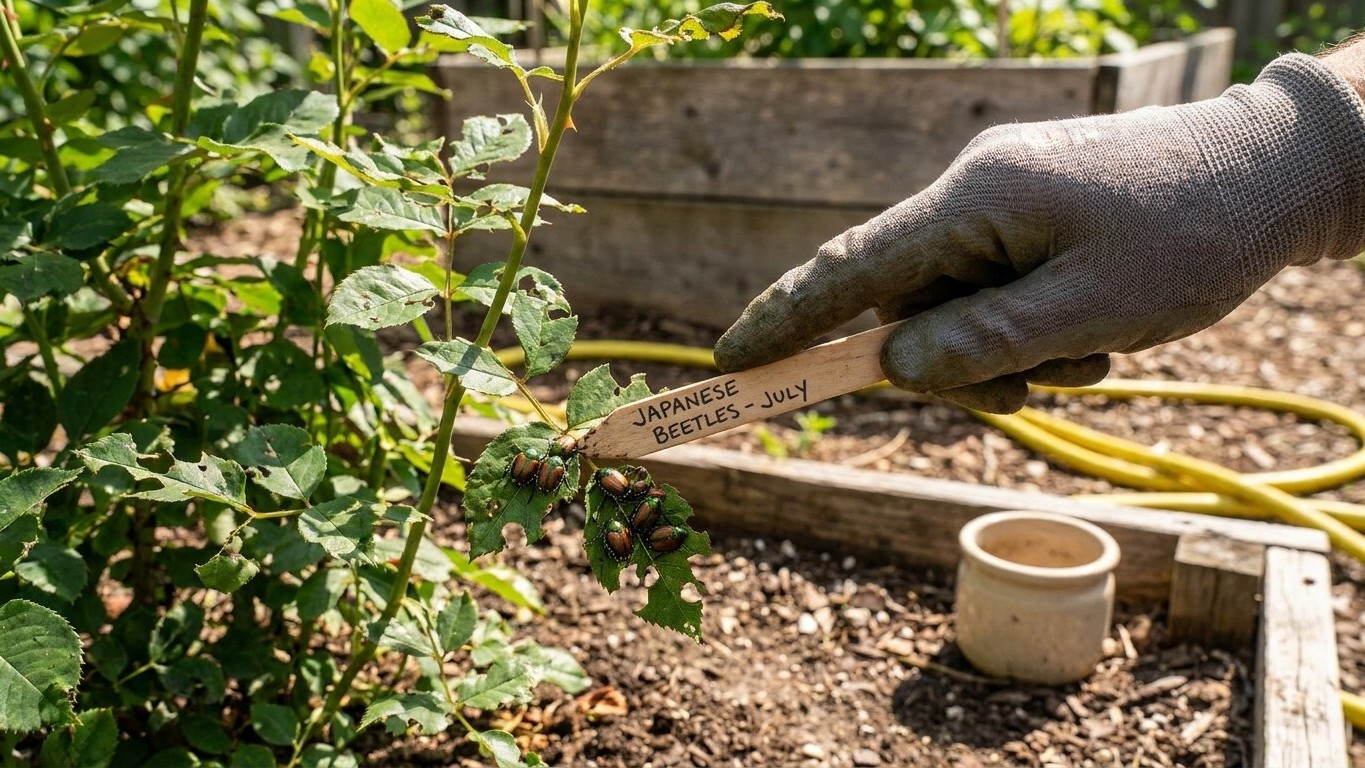
Adults feed in groups, skeletonizing leaves between the veins so the foliage looks lacy rather than chewed through. They favor roses, beans, grapes, and linden trees, and a heavy infestation can strip a plant of most of its leaf surface within days.
Brown marmorated stink bug

This one feeds on a wide range of vegetables and fruit, piercing rather than chewing, which leaves dimpled or discolored patches on tomatoes and peppers rather than holes. It also moves indoors in fall looking for a place to overwinter.
Jumping worms
These live in the top few inches of soil and mulch, and the damage shows up as soil turned into loose, grainy castings that no longer hold structure or water well. The thrashing behavior when disturbed is the fastest way to tell them from an earthworm without checking the clitellum.
Spotted lanternfly
Illinois Extension recorded the state’s first detection in Cook County in September 2023, so this one is newer to the list than the rest. It feeds on a wide range of trees and ornamentals, including grapevines, and leaves behind a sticky excretion called honeydew that attracts sooty mold.
Telling damage apart

The shape of the damage narrows things down faster than trying to spot the insect itself. Chewed leaf edges and skeletonized foliage point to a chewing insect like Japanese beetle or Colorado potato beetle, both of which leave visible bite marks or lacy leaf tissue. Stippled or dimpled fruit and leaves, without obvious holes, usually mean a piercing feeder like brown marmorated stink bug, which draws sap or juice out through a needle-like mouthpart rather than tearing tissue.
Insect, disease, or water stress
Wilting is the trickiest symptom because three different causes produce it. A squash plant that wilts from the tip down while the base still looks fine often has squash bugs feeding upstream of the wilted section. A squash plant that collapses suddenly at one runner, with a small hole and sawdust-like frass at the base, points to squash vine borer larvae inside the stem. A plant that wilts uniformly across the whole row despite normal soil moisture is more likely a soilborne disease or a watering problem, not an insect at all.
Sticky residue on leaves, called honeydew, is a strong sign of a sap-feeding insect rather than chewing damage or fungal disease. It often shows up with a black, powdery coating called sooty mold growing on top of it, which is a secondary fungus feeding on the honeydew rather than the plant itself. Soil that’s gone loose, grainy, and dry between the fingers, especially in shaded beds or under mulch, is the signature of jumping worms rather than a watering fault or a nutrient problem, and it’s worth checking the top few inches of soil for the worms themselves before assuming it’s drought stress.
When each one shows up
Timing tracks plant growth stage and soil temperature more reliably than the calendar, but Illinois Extension’s tracking, measured near Chicago, gives a useful frame: pest pressure runs late May through September statewide, heaviest from late June to August. Gardens in southern Illinois will generally see these stages arrive earlier than that, and northern counties later, so treat the ranges below as a starting point to adjust from rather than a fixed schedule.
Bagworm eggs hatch late May into mid-June, which is the only window when the young larvae are small and exposed enough for a contact treatment to reach them before they build a bag. Colorado potato beetle egg-laying peaks in mid-June, and the beetle runs two to three generations per season in Illinois, so a clean patch in June doesn’t mean the plant is safe in August.
Squash vine borer adults emerge late June into early July, which is when to start checking stem bases weekly rather than waiting for wilting to appear. Japanese beetle adults emerge in late June as well, but their numbers build through the season and peak in July and August, matching the general statewide pressure window that Illinois Extension tracks. Squash bug, stink bug, and jumping worm activity all fall within that same late May to September stretch without a single sharp emergence date, so steady weekly scouting through summer catches them better than watching for one event.
What actually works
Prevention beats intervention on nearly every pest on this list, mostly because by the time damage is visible, a generation of insects has already had a head start. Rotating squash, potato, and other host plants to a different bed each year disrupts overwintering populations that would otherwise emerge right next to last year’s crop. Row cover over young squash and potato plants keeps adults from laying eggs in the first place, though it has to come off once flowers open so pollinators can reach the blooms.
- Handpick beetles and egg clusters early in the morning when they’re slow to fly.
- Time planting to avoid the heaviest emergence windows where the crop allows it.
- Leave some flowering plants nearby to draw in predatory and parasitic wasps.
- Check mulch and potted plant soil before bringing it home, since jumping worms spread mainly through moved soil and compost.
- Prune and destroy bagworm bags by hand before eggs hatch in late May.
Once a pest is established, targeted treatments matter more than broad ones. Bacillus thuringiensis works on caterpillar-stage pests but does nothing against beetles, stink bugs, or squash bugs, since it only kills insects that ingest it while chewing leaf tissue. Insecticidal soap and horticultural oil can knock back soft-bodied nymphs of squash bug and stink bug if they make direct contact, but they don’t reach borers already inside a stem.
A few popular remedies do essentially nothing: dish soap sprays mixed at home rarely have enough surfactant concentration to kill on contact, ultrasonic pest repellers have no measurable effect on insects, and planting marigolds as a blanket squash bug deterrent hasn’t held up as a standalone fix. None of these replace scouting and physical removal as the first line of defense.
What control costs
Cost breaks down into money spent and hours spent, and the cheapest option in dollars is usually the most expensive in time. Handpicking and egg-crushing cost nothing but a weekly walk through the garden, which for a small vegetable patch runs to maybe fifteen or twenty minutes, repeated through the whole season since new generations keep arriving.
| Method | Money cost | Time cost | Repeat frequency |
|---|---|---|---|
| Handpicking / egg removal | Lowest | Highest, weekly | Weekly through season |
| Row cover / barriers | Moderate, one-time material | Low after setup | Reused each season if stored well |
| Biological controls (Bt, beneficial insects) | Moderate | Low to moderate | Reapplied after rain, per generation |
| Sprays (soap, oil, other insecticides) | Moderate to higher over a season | Low per application, adds up | Every 7 to 10 days during activity |
Row cover is a one-time material cost that gets reused for several seasons if it’s stored out of the sun over winter, which makes it the best value for squash bug and vine borer once the upfront purchase is made. Biological controls like Bacillus thuringiensis need reapplication after rain and don’t persist long on foliage, so a season with a lot of rain means buying it more than once. Sprays are the most repeat-dependent option on this list, since anything effective against an active infestation breaks down within a week or two and has to go back on before the next generation hatches, particularly with a pest like Colorado potato beetle running two to three generations in a single Illinois summer.
Local help
The University of Illinois Extension identifies specimens, tracks outbreaks including the spread of jumping worms, now confirmed in 49 of the state’s 102 counties, and the spotted lanternfly’s spread since its first Illinois detection in Cook County. A local county extension office is the right first call for anything that doesn’t clearly match the pests above, and for gardeners working across state lines, our Illinois guides cover other seasonal tasks tied to the same climate.
Common questions
Do I need to spray for Japanese beetles every year or just when I see them?
Spray or handpick only when you actually see feeding damage or beetles on the plant. Populations swing year to year, and treating preventively wastes money and can knock back the predatory insects that help keep numbers down the following season.
My potato plants look fine but the ones next to them got wiped out, why?
Colorado potato beetle spreads unevenly because adults walk and fly short distances rather than covering a whole bed at once. Check the undersides of leaves on the healthy-looking plants too, since eggs may already be there even without visible feeding yet.
Are jumping worms actually harmful or just annoying?
They change soil structure enough to affect plant roots and water retention, not just the look of the soil. If you find them, avoid moving soil, mulch, or potted plants from that bed to anywhere else in the yard, since that’s the main way they spread.
Is spotted lanternfly something I need to worry about yet if I don’t garden near Cook County?
It’s worth learning to recognize it regardless of where in the state you garden, since a single detection in one county doesn’t mean it stays contained there. States further east, including Delaware, have dealt with established populations longer, and Illinois Extension is still tracking how far it moves from the 2023 Cook County find. Neighboring states are watching their own spread too, as covered in our piece on garden pests in Indiana.