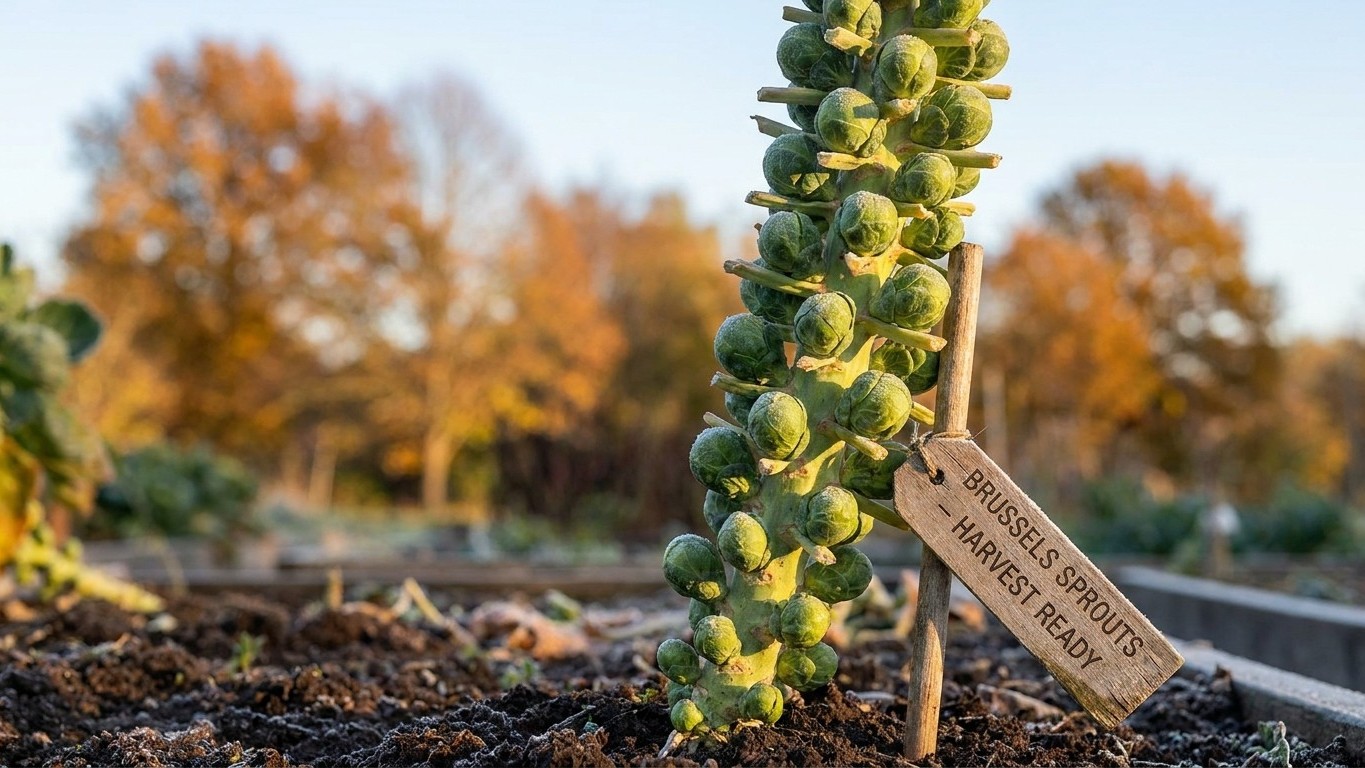

Brussels sprouts go into the ground in early summer, not spring, because they need to mature in autumn after the weather turns cold, not before it heats up. That’s the guidance from Utah State University Extension, whose Brussel Sprouts in the Garden bulletin flips the usual garden calendar: this is the one crop on this site timed backward from every other spring planting.
The short answer
Utah State University Extension states it plainly: Brussels sprouts should be “planted in early summer… for maturity in the fall.” That single line reorganizes everything a gardener thinks they know about starting a cool-season brassica. Broccoli, cabbage, and Cauliflower all get counted backward from the last spring frost. Brussels sprouts get counted forward from your first fall frost instead.
The reason is built into the plant itself. Brussels sprouts, according to the same source, “require a long time to mature.” That’s not a throwaway line, it’s the whole logic of the summer sowing. A crop that takes this long to finish can’t be squeezed into a spring window that closes when summer heat arrives. Instead, the plant needs to spend its early life in the heat of summer building leaves and root mass, then shift into sprout production exactly as the days cool down.
What that means for a home gardener: forget the seed packet’s generic spring dates and forget counting from your area’s last spring frost entirely. The number that matters is your local first fall frost date. Work backward from that date, giving the plant enough time in the ground to build “4-6 mature leaves and a well-developed root system” before it needs to shift into sprout-forming mode. Utah State’s bulletin frames the whole early-summer sowing window around getting transplants ready so that sprouts develop “when fall temperatures cool,” not before.
This is worth sitting with for a second, because it runs against instinct. Most gardeners see a brassica seedling in a nursery flat and assume it belongs in the spring lineup next to cabbage and broccoli starts. Brussels sprouts don’t. If you start them that early, they’ll try to form sprouts during the hottest stretch of summer, and the result is loose, leafy, bitter sprouts instead of the tight little heads you’re after. Utah State’s guidance exists precisely to prevent that mistake: sow in early summer, transplant when the plant is ready, and let the calendar’s back half, not its front half, do the finishing work.
What actually decides it

Two separate forces are at work here, and neither one is about how much heat the plant needs. Both are about timing the plant’s biology to fall’s arrival.
The long runway a Brussels sprout plant needs
Brussels sprouts are slow. Utah State University Extension calls the maturation time long, full stop, without hedging. Before a single sprout even begins to form, the transplant itself needs “6-7 weeks” of growth just to reach the stage of 4-6 mature leaves and a solid root system. That’s before it even goes in the garden. Add the additional months the plant needs afterward to build the tall stalk that carries the sprouts, and you’re looking at a growing season that stretches from early summer all the way into the cold months. There simply isn’t enough calendar between a spring frost and summer heat to fit all of that in. Fall, with its long slow cooldown, is the only stretch of the year long enough to host the finish.
Why frost is a feature, not a threat
This is the detail that trips up gardeners used to protecting crops from cold. Utah State’s bulletin notes that Brussels sprouts are “not seriously damaged by temperatures below freezing.” That tolerance isn’t incidental, it’s the whole point of aiming for a fall harvest. Cold doesn’t just fail to hurt the plant, it’s part of what makes the sprouts worth eating. As temperatures drop, the plant’s internal chemistry shifts, and the sprouts sweeten in response to the very frosts that would wreck a summer vegetable. That’s why the target date isn’t a month on a calendar at all, it’s your first fall frost. Sow too early, hit maturity in summer heat, and you skip the frost exposure that improves flavor. Sow with the fall frost in mind, and the cold that shows up late in the season becomes an asset instead of a hazard.
How to do it
- Start transplants indoors or in a nursery bed in early summer. Utah State University Extension notes transplants generally need “6-7 weeks” to reach 4-6 mature leaves with a well-developed root system. Count that window backward from your local first fall frost, not from spring.
- Wait for the plant stage, not the date. Move transplants to the garden once they’ve reached that 4-6 leaf stage with solid roots underneath. A plant that isn’t there yet won’t handle the transplant shock as well, and pushing it out too early just wastes the head start.
- Space plants generously. Utah State’s spacing guidance calls for “12-18 inches between plants in the row with rows 2 feet apart.” Brussels sprouts grow into tall, top-heavy stalks, and tight spacing chokes airflow around the developing sprouts.
- Let the plant build leaves through the heat of summer. This stretch is about foliage and root development, not sprout formation. Resist the urge to judge progress by looking for sprouts this early.
- Watch for lower sprouts beginning to form as the season turns. That plant-stage cue, not a date on the calendar, tells you the crop has shifted into its finishing phase as fall temperatures cool.
- Harvest after the plant has been through several frosts. Utah State’s guidance points to maturity happening in fall “after several frosts,” which is when sprouts firm up and their flavor sweetens.
What goes wrong

- Sowing on a spring schedule instead of a summer one. This is the single most common mistake, and it comes from treating Brussels sprouts like cabbage or broccoli. Start them in spring and they mature during peak summer heat instead of the fall cooldown, well outside the window Utah State University Extension describes for proper development.
- Loose, leafy sprouts instead of tight heads. This looks like a nutrient problem, and gardeners often respond by adding more fertilizer. It usually isn’t a shortage at all, it’s a transport-timing problem: the plant is forming sprouts during warm weather instead of the cool stretch that firms them up, so more feeding doesn’t fix what’s really a Temperature mismatch.
- Transplants that are rushed into the garden too young. Setting out seedlings before they reach the 4-6 leaf stage with a developed root system, described in Utah State’s guidance as taking roughly 6-7 weeks, sets the whole season back. The plant spends its early garden life catching up instead of building the size it needs.
- Crowded rows that choke airflow. Ignoring the 12-18 inch in-row spacing and 2-foot row spacing Utah State recommends leads to tall, top-heavy plants competing for light and air, which invites disease and uneven sprout development up and down the stalk.
- Harvesting too soon, before any frost. Pulling sprouts the moment they look ready skips the cold exposure that Utah State’s bulletin ties to fall maturity. The fix isn’t more time in general, it’s specifically time spent through frost, which is what develops the flavor gardeners are after.
Common questions
Can I start Brussels sprouts in spring like other brassicas?
No. Utah State University Extension is explicit that these are planted in early summer for a fall maturity, the opposite timing from spring-started brassicas like cabbage or broccoli on this same growing calendar.
How do I know when to plant if I shouldn’t use a month?
Count backward from your own first fall frost date, allowing enough time for the 6-7 week transplant stage plus the additional growth needed before sprouts begin forming as fall cools.
Does frost hurt Brussels sprouts?
No. Utah State University Extension states they’re “not seriously damaged by temperatures below freezing,” and frost exposure late in the season is part of what improves their flavor.
Do all Brussels sprouts varieties take the same time to mature?
No. Utah State’s bulletin names three varieties with distinct days to maturity: Long Island Improved at 90 days, Jade Cross at 100 days, and Diablo at 110 days.
Some gardeners also time this by the Moon: when to plant brussels sprouts by the moon, as almanac tradition rather than fact.