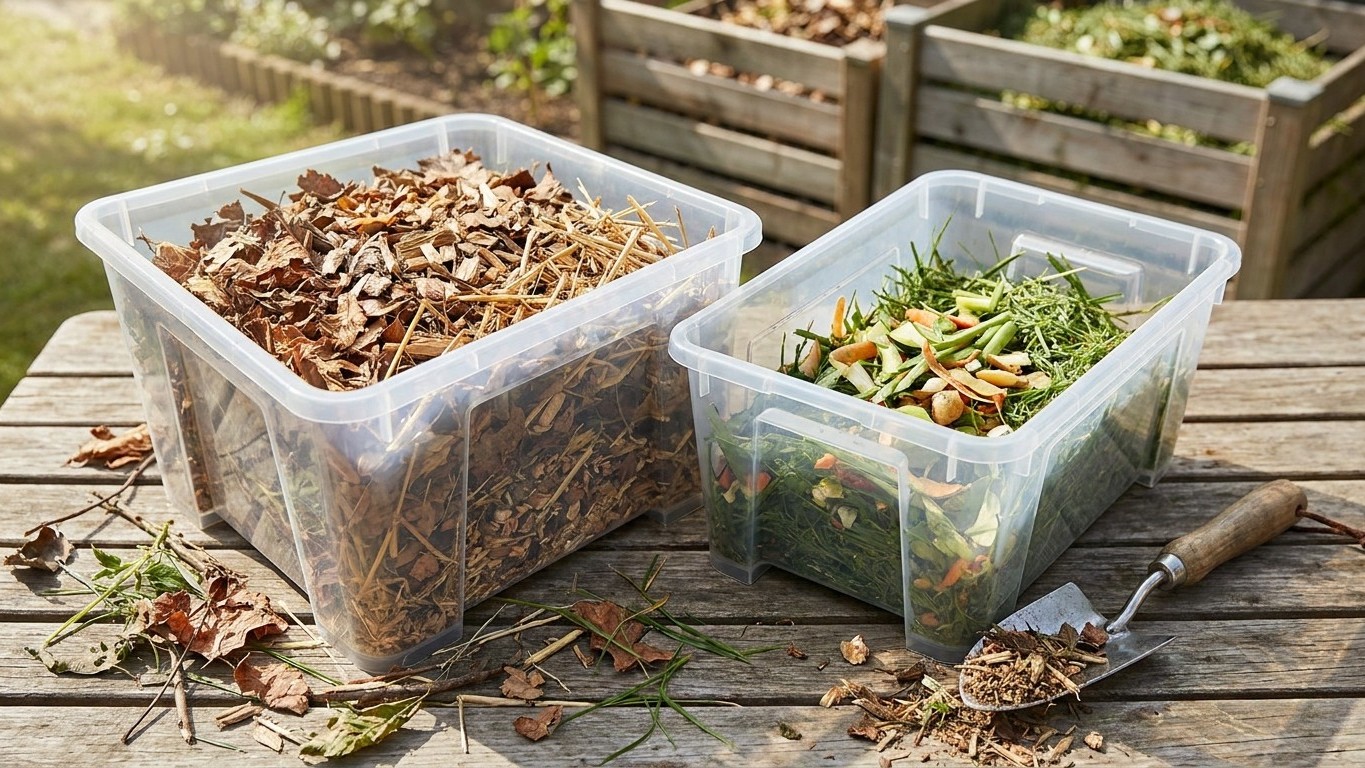

Two buckets of brown material to one bucket of green is the actual figure, and it comes straight from Utah State University Extension’s Backyard Composting in Utah guide. That 2:1 ratio measures volume, not chemistry. The 30:1 number that shows up in other places measures something different entirely, and it never appears in this source.
The short answer
Utah State University Extension states the proper compost mixture contains approximately 2 parts carbon-rich materials to 1 part nitrogen-rich material. Carbon shows up in dry, brown stuff: leaves, chipped woody brush, sawdust, straw. Nitrogen shows up in fresh, green material: yard and garden trimmings, vegetable scraps, livestock manures. Two shovelfuls of dead leaves to one shovelful of grass clippings or kitchen scraps gets you close to the target.
The confusion with 30:1 comes from mixing up two different measurements. A chemical carbon-to-nitrogen ratio counts individual atoms, and different materials carry wildly different amounts of carbon and nitrogen per pound. A volume ratio counts buckets, wheelbarrow loads, or shovelfuls of material as it sits in the pile, without weighing anything or running a lab test. Utah State’s guide works entirely in volume terms. It gives no chemical ratio, and nothing here should be read as one.
Why does the split matter at all? Microorganisms in the pile use carbon for both energy and growth, and nitrogen for growth and reproduction, according to the same USU Extension guide. Feed them mostly carbon with too little nitrogen, and they can’t reproduce fast enough to process the pile. Feed them mostly nitrogen with too little carbon, and they burn through the carbon supply before the nitrogen gets stabilized. The 2:1 volume split is the rough zone where both processes run without either one starving the other.
One practical wrinkle: volume isn’t weight. A bucket of dry leaves weighs far less than a bucket of wet grass clippings, so “two parts to one part” means two containers of roughly the same size, not two pounds to one pound. Anyone eyeballing loads from a leaf pile and a grass bin is already doing this correctly, whether or not they’ve ever heard the number 2:1.
What actually decides it
Getting the brown-to-green split close to right matters, but it isn’t the variable that makes or breaks a pile day to day. That distinction belongs to how often the pile gets turned. Turning controls oxygen supply, and oxygen is what keeps the microbial population working at full speed regardless of how carefully the greens and browns were measured going in.
Turning frequency: the dominant variable
A pile that sits untouched settles, compacts, and loses the air pockets microorganisms need. Turning breaks up that compaction, redistributes moisture, and moves material from the cooler edges into the hot center. Utah State University Extension notes a working pile runs in the 120 to 140 degree Fahrenheit range, distinct from the mesophilic range of 50 to 105 degrees and the thermophilic range above 105 degrees. A pile that’s turned regularly cycles through these ranges the way it’s supposed to. One that isn’t turned can stall out in the cooler mesophilic zone indefinitely, no matter how well-measured the brown and green materials were.
Moisture and particle size: secondary levers
After turning frequency, moisture and particle size do the next-most work. Material that’s too wet excludes oxygen the same way an untouched pile does; material that’s too dry starves the microorganisms of the water they need to function. Smaller particles break down faster than large ones because there’s more surface area for microorganisms to work on, which is why chipped brush behaves differently in a pile than whole branches.
Pile volume: the insulation factor
A pile’s overall size affects how well it holds heat. A small pile loses heat to the surrounding air faster than it can generate it, which keeps the whole mass stuck in the mesophilic range. A larger mass insulates its own core, letting the center climb into the 110 to 150 degree Fahrenheit band that Utah State University Extension identifies as the range that destroys more pathogens, weed seeds, and fly larvae. Volume matters, but it’s a background condition. Turning is the lever a person actually pulls week to week.
How to do it
- Sort materials into carbon and nitrogen piles first. Dry, brown material (leaves, chipped woody brush, sawdust, straw) goes on one side. Fresh, green material (yard and garden trimmings, vegetable scraps, livestock manures) goes on the other.
- Build in roughly a 2:1 volume ratio. Two containers of brown material for every one container of green material, measured by volume rather than weight.
- Check particle size before adding woody material. Chip or shred branches and brush rather than tossing them in whole; smaller pieces give microorganisms more surface area to work with and speed up the whole process.
- Check moisture with a squeeze test. Grab a handful of the mixed material and squeeze it. If it falls apart and won’t hold together, it’s too dry. If water runs out between your fingers, it’s too wet. Either extreme interferes with the oxygen supply the pile needs.
- Add nitrogen fertilizer only if the mix runs heavy on carbon. Utah State University Extension recommends approximately 1 pound of actual nitrogen for each cubic yard of material when extra nitrogen is needed, mixed into the pile as it’s being built rather than added afterward.
- Turn the pile on a regular schedule. Turning is the variable that does the most work once the mix is built, so it comes before worrying further about exact proportions.
What Goes Wrong
- Ammonia smell coming off the pile. This signals too little carbon relative to nitrogen. Utah State University Extension explains that with too little carbon, the available carbon gets fully used up without stabilizing all the nitrogen, which produces excess ammonia and unpleasant odors. The fix is more brown material worked into the mix.
- The pile just sits there, not breaking down. This is the opposite signal: too little nitrogen. Not enough nitrogen is available to support microorganism growth, and the whole composting process slows dramatically. The fix is more green material, or, if greens aren’t available, roughly 1 pound of actual nitrogen per cubic yard mixed in during construction.
- The pile never gets past lukewarm. If the mass stays in the mesophilic range (50 to 105 degrees Fahrenheit) and never climbs into the thermophilic range above 105 degrees, something is limiting microbial activity, usually a combination of too little nitrogen, too little turning, or too small a pile to hold heat.
- The pile heats up but weed seeds and pathogens survive. Reaching a mild working temperature isn’t the same as reaching the 110 to 150 degree Fahrenheit band that destroys more pathogens, weed seeds, and fly larvae. A pile that peaks below that range needs more volume, more nitrogen, or more consistent turning to push the core temperature higher.
Common questions
Do I need a scale to hit 2 parts brown to 1 part green?
No. Utah State University Extension describes this as a volume ratio, so a five-gallon bucket, a wheelbarrow load, or even a shovelful works as the unit of measurement, as long as the brown material fills roughly twice the space the green material does.
Is this the same as the carbon-to-nitrogen ratio I’ve seen elsewhere?
No, and this is the point of the distinction. The 2:1 figure from Utah State University Extension counts volumes of material as they’re loaded into the pile. The chemical carbon-to-nitrogen ratio measures something different, counted in different units, and it doesn’t appear in this source at all.
What if I only have brown material available, like a big pile of leaves?
Leaves alone lean heavily toward carbon with little nitrogen, which slows the process dramatically according to Utah State University Extension. Adding fresh green material, or working in nitrogen fertilizer at roughly 1 pound of actual nitrogen per cubic yard, corrects the imbalance.
My pile smells like ammonia even though I added plenty of leaves. What’s happening?
An ammonia smell points to too little carbon relative to nitrogen, per Utah State University Extension, meaning the green material is outweighing the brown even if leaves were added. Check that the brown portion actually fills roughly twice the volume of the green portion, not just that some browns were included.