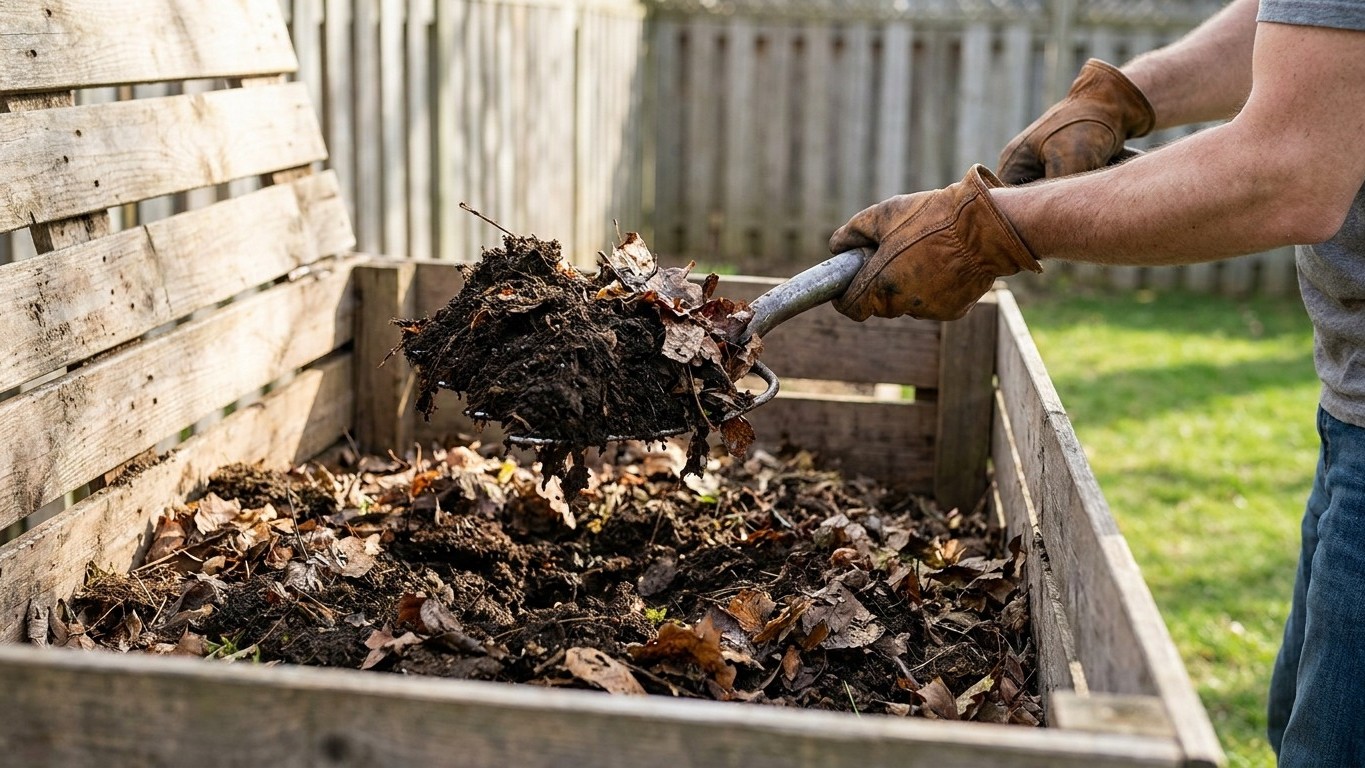

Turn a compost pile every week and it can finish in one to two months. Turn it once a month instead and expect four to six months. Skip turning altogether and the same pile of leaves and food scraps may sit there for six months to two years before it’s usable. That’s the range documented by Utah State University Extension’s Backyard Composting in Utah guide, and the gap between the fast end and the slow end comes down to one decision: how often you pick up a pitchfork.
The short answer
One to two months. Four to six months. Six months to two years. Those three numbers, all drawn from Utah State University Extension, describe the exact same pile of organic material under three different turning schedules. Turn weekly and you’re in the fast lane. Turn monthly and you’ve roughly tripled the wait. Don’t turn at all and the timeline stretches out to as much as twelve times longer than the weekly schedule, with no guarantee it ever finishes on its own.
Utah State University Extension is blunt about why the spread is so wide: “Aeration is generally the main factor affecting the time necessary to produce finished compost.” Not moisture, not the mix of materials, not the size of the bin. Aeration, meaning how much oxygen reaches the microorganisms doing the actual work, sits at the top of the list. Everything else in a compost pile is secondary to that one variable.
There’s a caveat worth catching before it causes frustration. The one-to-two-month result assumes weekly turning happens “with the right combination of materials and moisture level.” Turning frequency decides how fast a properly built pile finishes, but it can’t rescue a pile that’s bone dry, waterlogged, or lacking enough nitrogen-rich material to feed the microbes in the first place. Turning is the lever, but it only works if the rest of the setup is reasonably close to right.
What this means in practice is that the timeline is a choice, not a fixed outcome. A homeowner who wants finished compost before the growing season and is willing to turn the pile every week is working with a completely different clock than someone who builds a pile in a back corner and checks on it a few times a season. Neither approach is wrong. But they produce results that differ by close to a year, and knowing that upfront changes how you plan.
What actually decides it
Turning frequency dominates because of what it does at the microscopic level: it decides whether the pile stays aerobic or slides into an anaerobic state. Everything below this point in the ranking, moisture, the carbon-to-nitrogen mix, pile size, matters, but none of it overrides the effect of oxygen supply.
Oxygen supply and the aerobic-anaerobic switch
Composting, as Utah State University Extension defines it, is “the aerobic, or oxygen-requiring, decomposition of organic materials by microorganisms under controlled conditions.” Bacteria start the process, and their activity depends on a steady oxygen supply. The problem is that “aerobic composting consumes large amounts of oxygen, particularly during the initial stages.” If that oxygen isn’t replenished, “the composting process may turn anaerobic, which is a much slower and more odorous process.” Turning is what replenishes it. Skip that step long enough and the pile doesn’t just slow down, it changes character entirely, running on a different set of microorganisms that work at a fraction of the speed.
Heat as a byproduct, not a cause
The bacteria driving decomposition generate heat as part of their metabolism, and that heat is a signal the process is working, not a separate ingredient you need to add. An actively working pile typically runs in the 120-140 degree Fahrenheit range. That’s distinct from the broader mesophilic range of 50-105 degrees and the thermophilic range above 105 degrees, which describe different stages and populations of microorganisms as the pile heats up. A pile that never reaches the working range, or that cools and never reheats after turning, is telling you the microbial activity has stalled, usually because oxygen or moisture has run short.
Material ratio and moisture, ranked below turning
Utah State University Extension recommends building a pile from approximately two parts carbon-rich material to one part nitrogen-rich material, measured by volume, two buckets of dry leaves or straw to one bucket of grass clippings or food scraps, for example. Moisture matters too. But both of these factors set the stage; turning frequency determines how fast the play actually runs.
How to do it
- Build the pile at roughly two parts carbon to one part nitrogen, by volume. Use a bucket or bin to keep the ratio consistent: two loads of dry leaves, straw, or shredded paper for every one load of grass clippings, vegetable scraps, or other nitrogen-rich material.
- Check moisture with a squeeze test. Grab a handful from the middle of the pile. If water runs out between your fingers, it’s too wet. If it crumbles apart and feels dusty, it’s too dry. Either result means adjusting water or dry material before you rely on turning to do the rest.
- Decide on a turning schedule based on how fast you want finished compost. Weekly turning targets the one-to-two-month range. Monthly turning targets four to six months. No turning means accepting a wait of six months to two years, if it finishes at all.
- Turn the pile with a pitchfork or a mechanical turner. Lift and mix the materials so oxygen reaches the center, where microbial activity is highest and where oxygen depletes fastest.
- Move dry, outside material into the center of the newly-turned pile. Utah State University Extension specifically recommends this step: it exposes the driest, least-active material to the interior, where moisture and heat are highest.
- Track the internal Temperature over each cycle. A working pile in the 120-140 degree range signals active aerobic decomposition. Piles that spend time in the 110-150 degree band also destroy more pathogens, weed seeds, and fly larvae than cooler piles.
- Repeat the turning schedule consistently. A pile turned weekly for two weeks and then ignored for a month doesn’t average out to the four-to-six-month timeline. Consistency in the schedule is what produces the stated result.
What Goes Wrong
- An ammonia or rotten-egg smell. This signals the pile has gone anaerobic, usually from too little oxygen reaching the interior, often paired with excess moisture or compaction. Turn it immediately and mix in dry, carbon-rich material to open up air pockets.
- The pile just sits there, cool and unchanged. This is a different signal than odor: it usually means turning has been too infrequent, or the pile lacks enough nitrogen-rich material to fuel bacterial activity. Increase turning frequency and check whether the two-to-one carbon-to-nitrogen ratio has drifted too far toward carbon.
- Dry, crumbly texture that won’t break down. Without enough moisture, bacteria can’t function even with regular turning. Add water each time you turn until a squeezed handful feels damp but doesn’t drip.
- Soggy, matted material that clumps together. Excess water excludes oxygen from the pile even between turnings, pushing it toward the same anaerobic state described above. Mix in dry carbon-rich material and turn more frequently until the texture loosens.
Common questions
Does turning more than once a week speed things up further?
Utah State University Extension’s fastest documented timeline, one to two months, is tied to weekly turning. The source doesn’t provide a faster benchmark beyond that schedule, so weekly turning represents the quickest verified outcome.
Can a pile skip turning entirely and still finish?
Yes, according to Utah State University Extension, though it takes considerably longer, six months to two years, because the process shifts toward anaerobic decomposition, which the source describes as slower and more odorous than the aerobic process turning maintains.
Is a hot pile always a fast pile?
Heat indicates active microbial metabolism, and a working pile in the 120-140 degree range is a sign the aerobic process is running well. But heat alone doesn’t override turning frequency; a pile that heats up once and then cools without follow-up turning won’t sustain the one-to-two-month timeline.
What’s the fastest way to fix a smelly pile?
Turn it right away. Utah State University Extension links odor directly to oxygen limitation and the shift to anaerobic decomposition, so restoring airflow with a pitchfork or mechanical turner addresses the cause rather than masking the smell.