
The answer has nothing to do with weeks or a planting date. According to Utah State University Extension, you wait two full years after planting before pulling a single stalk. The third year allows a short harvest of 3 to 4 weeks. Only from the fourth year on does the plant give you the full window, 6 to 10 weeks, and it keeps giving for a decade or more after that.
The short answer
Rhubarb isn’t started from seed in most home gardens. It’s planted as a crown division, a chunk of root with a bud or two attached, sometimes called a “start.” That distinction matters here because it changes the whole clock. There’s no germination phase, no seedling stage to baby along. The crown goes into the ground already carrying a year or two of stored energy, and everything that happens next is about protecting that reserve, not building it from scratch.
Utah State University Extension is blunt about the first stretch: don’t harvest any stalks for the first two years. Full stop. No exceptions for a vigorous-looking plant or a warm spring. The crown is spending those two years building a root system large enough to support repeated cutting later, and pulling stalks early drains the very reserves it needs to establish.
Year three changes the rule, but only a little. You can harvest, but for 3 to 4 weeks only, then you stop and let the plant recover for the rest of the season. It’s a trial run, not a green light.
The real payoff comes after year four. At that point the source allows 6 to 10 weeks of harvest, or until the plant itself signals it’s had enough by losing vigor. That’s a wide window, more than two months in a good year, and it’s the harvest schedule most established rhubarb growers actually live with.
What makes the wait worth it is longevity. A well-managed rhubarb plant can live in the garden for 10 to 15 years, producing between 4 and 12 pounds of stalks annually per plant once it’s mature. Two years of patience buys well over a decade of stalks. Measured against that timeline, the wait is short. Measured against a gardener’s first spring with a new crown in the ground, it can feel endless.
What actually decides it

The calendar year isn’t really the trigger. Three separate, measurable things decide whether a stalk should come off the plant, and each one carries a consequence disproportionate to its size.
Stalk length as the harvest signal
Utah State University Extension gives a physical marker rather than a date: stalks are ready for harvest when the petiole is 10 to 15 inches long. That single measurement replaces guesswork. A stalk shorter than that hasn’t finished building the sugars and structure that make rhubarb worth eating, and pulling it early just wastes the plant’s effort. Wait for the length, not the week.
The one-third rule
Even on an established plant well past its second year, you never take everything. Leave one-third of stalks at any given time to maintain plant health. That fraction is the difference between a rhubarb plant that keeps producing for a decade and one that declines within a few seasons. Strip a plant down to bare crown repeatedly, even in year five or six, and you’re recreating the same stress that harvesting in year one would cause.
How the stalk comes off
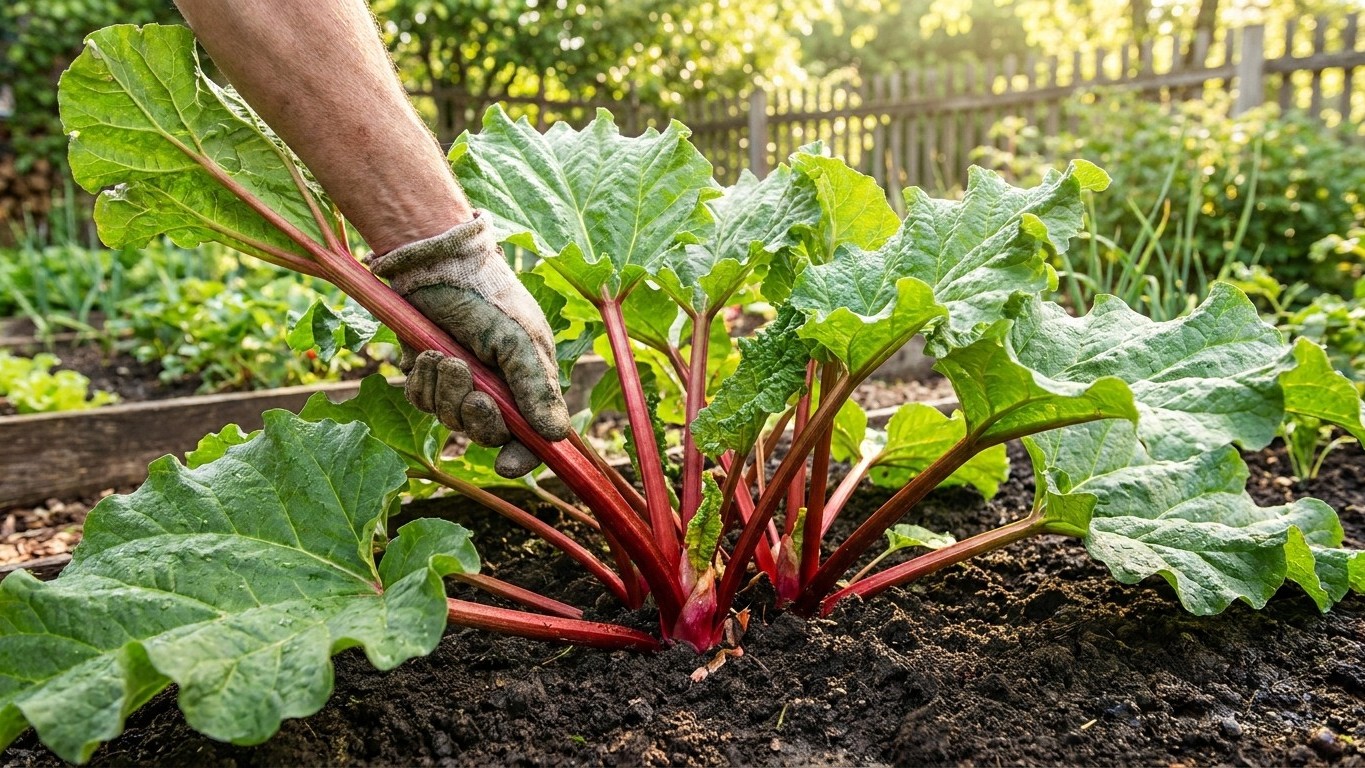
The technique matters as much as the timing. Grasp the stalk just below the leaf and pull upward and to one side, twisting it free from the crown. Never cut stalks from the base of the plant. A cut leaves plant tissue open as a disease entry point, an invitation for rot and pathogens to get into tissue that a clean pull seals almost immediately. This one habit, pull versus cut, has more influence on a plant’s long-term survival than most gardeners assume.
How to do it
Because rhubarb’s harvest rules stretch across years rather than weeks, the practical approach is to treat it as a multi-year schedule rather than a single season’s checklist.
- Year one, planting year: set the crown division in the ground in early spring, before new growth begins. Do not fertilize during this first year of establishment; the crown is drawing on its own stored reserves and doesn’t need or benefit from added nutrients yet. Do not harvest any stalks.
- Year two: let the plant grow undisturbed again. Still no harvest. This is the year the root system expands enough to support future cutting, and it’s the step most often skipped by impatient gardeners.
- Starting in year two’s following spring and every year after: apply about 1/2 cup of 16-16-16 granular fertilizer around the base just before leaves begin to emerge in the spring. This becomes an annual step from here forward.
- Year three: begin a limited harvest. Pull stalks once they reach 10 to 15 inches in petiole length, using the grasp-and-pull method below the leaf, never cutting at the base. Harvest for 3 to 4 weeks only, then stop for the season and let the plant recover.
- Year four and every year after: extend the harvest window to 6 to 10 weeks, or stop earlier if the plant begins to lose vigor. At all times, leave one-third of stalks on the plant rather than stripping it completely.
- Every following season: repeat the annual fertilizing step and the same harvest limits. A healthy plant will keep producing on this rhythm for 10 to 15 years before it needs dividing or replacing.
What goes wrong

- Harvesting in the first or second year. The crown hasn’t built the root reserves needed to recover, and stalks pulled this early can stunt or even kill a young plant. The fix is simple discipline: leave it alone for two full years no matter how tempting the stalks look.
- Cutting stalks at the base instead of pulling. A knife cut leaves an open wound in plant tissue that becomes an entry point for disease. Grasp the stalk below the leaf and pull upward and to one side instead; this seals the wound naturally.
- Stripping the plant bare during harvest. Taking every stalk, even from a mature plant well into its productive years, ignores the one-third rule and weakens the crown over successive seasons. Always leave a third of the stalks standing.
- Fertilizing too early. Applying fertilizer during the first year of establishment doesn’t help the plant and can work against the root development it needs. Wait until year two’s spring emergence, then apply about 1/2 cup of 16-16-16 granular fertilizer annually from that point forward.
- Eating or feeding the leaves. Rhubarb leaves contain oxalic acid and are toxic if ingested, causing sickness and, in serious cases, kidney failure. Livestock are susceptible too. The stalks are safe and are the only part meant for the kitchen; the leaves should be removed and discarded, never composted into feed or left where animals can graze them.
- Thin, weak stalks on an otherwise established plant. This symptom has more than one possible cause. It can mean the plant was over-harvested past the one-third limit the previous season, that annual fertilizing was skipped, or that the plant has simply reached the end of its 10 to 15-year productive life and needs dividing. Check harvest history and fertilizing records before assuming the plant is failing.
Common questions
Can you eat rhubarb leaves if you cook them first?
No. The leaves contain oxalic acid regardless of cooking, and ingestion can cause sickness or kidney failure. Only the stalks are edible; the leaves should always be discarded.
Why can’t I harvest rhubarb the first year after planting a crown?
Because the crown division needs its first two years to build a root system strong enough to support repeated cutting. Harvesting early draws down reserves the plant hasn’t replaced yet, weakening or killing it.
How long will one rhubarb plant keep producing?
Utah State University Extension notes rhubarb can live in the garden for 10 to 15 years, yielding between 4 and 12 pounds of stalks annually per plant once mature, provided the one-third rule and annual fertilizing are followed.
How long should I process canned rhubarb, and does altitude matter?
Yes, altitude changes processing time nationally: 20 minutes at elevations between 1,000 and 6,000 feet, and 25 minutes above 6,000 feet.