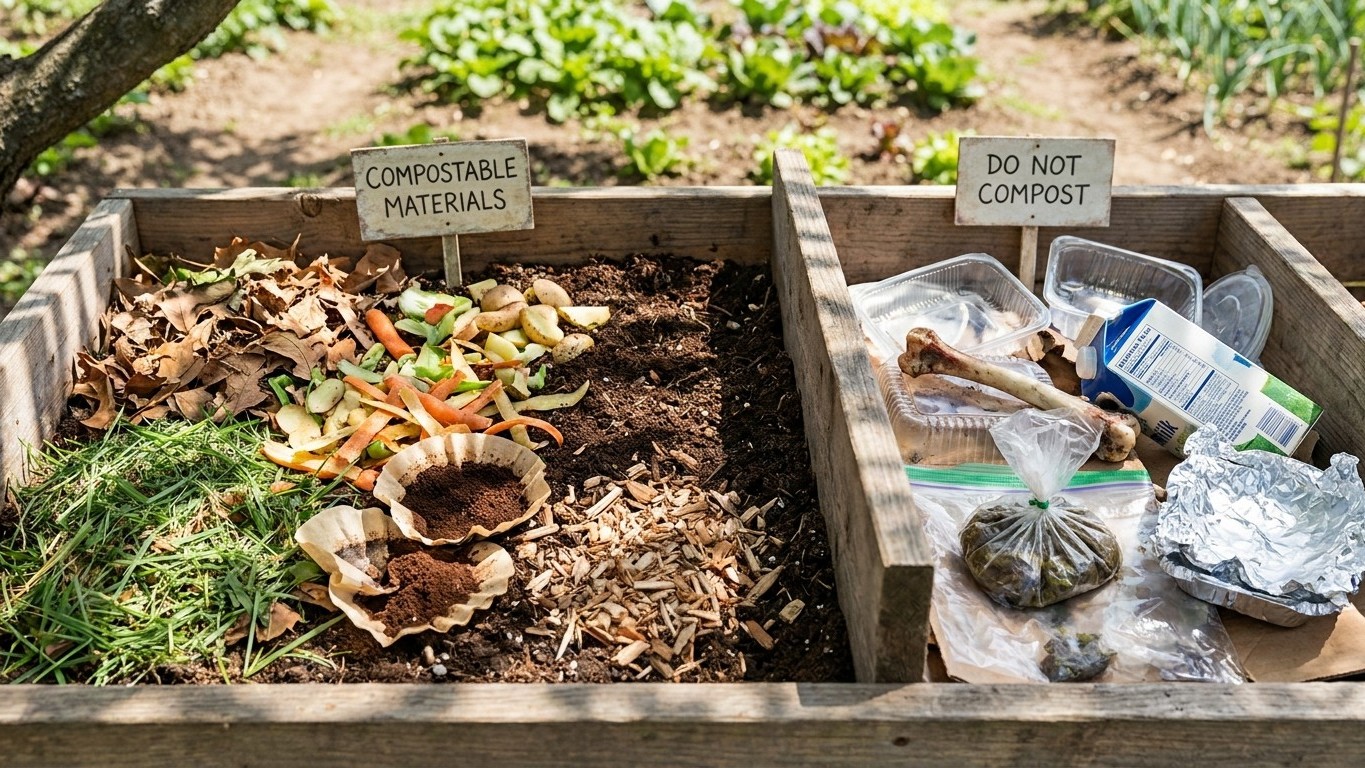

Compost accepts eight categories of household and yard waste: grass clippings, leaves and weeds, manures, coffee grounds, wood chips and sawdust, bark, stems and stalks, garden and canning waste, and fruits and vegetables. Utah State University Extension’s guide Backyard Composting in Utah excludes seven others: meats, bones, large branches, dairy products, synthetic products, plastics, and pet wastes. That list is not arbitrary. Each excluded item either draws pests or carries pathogens that survive the composting process.
The short answer
Knowing the two lists only gets you started. The scale of the problem is what makes the sorting matter: during the growing season, 30% or more of what goes into a landfill is organic yard refuse, according to Utah State University Extension. That’s grass clippings, fallen leaves, and garden trimmings that could have gone into a bin in the backyard instead of a truck headed for a landfill cell. The acceptable list exists because those materials, once composted, do something a landfill never will. They build soil tilth, fertility, water holding capacity, aeration, and drainage when worked back into a yard or garden bed.
What changes the answer is not the ingredient itself but its condition when it goes in. Wood chips, branches, twigs, and paper are on the acceptable list, but Utah State University Extension is specific about a catch: those woody materials can take up to two years to break down unless they’re finely chipped or shredded first. Chop garden trimmings with a shovel or machete, or run them through a chipper or lawnmower, and the clock speeds up dramatically. The guide names an optimum range for this: particle sizes between 1/8 and 2 inches in average diameter give the fastest results. A branch tossed in whole is technically “acceptable,” but functionally it behaves like something that doesn’t belong, because it will still be sitting there next season.
The seven exclusions carry a second layer worth separating out. Meats, bones, and dairy products are excluded for the same underlying reason: they attract pests and can carry pathogens that survive the composting process. Synthetic products and plastics don’t decompose at all, so they simply accumulate as contamination in finished compost. Large branches are excluded for the practical reason already covered: they take too long unprocessed. Pet wastes stand alone on this list. Utah State University Extension states the rule twice in the same publication, in near-identical language both times: do not put pet wastes in your compost pile. That repetition is not an editing accident. It signals a pathogen risk the guide treats as non-negotiable, unlike, say, a branch that’s merely slow.
What actually decides it
Sorting materials correctly gets a pile started. Whether that pile actually finishes into usable compost, and how fast, comes down mostly to one variable: how often it gets turned. Turning controls oxygen supply, and oxygen supply controls which microbes are active and how hot the pile runs. Get the turning schedule right and a well-mixed pile of acceptable materials will move through its stages on its own. Neglect it and even a perfectly sorted pile stalls.
Turning frequency
A pile that’s turned regularly stays aerated, which keeps the thermophilic organisms (the ones that drive the fastest breakdown, active above 105 F) supplied with the oxygen they need to keep working. A pile left untouched tends to compact, push out oxygen, and drop into a slower, cooler state where breakdown crawls rather than runs. Turning is also what allows a pile to reach and hold the 110 to 150 F band that Utah State University Extension identifies as the range that destroys more pathogens, weed seeds, and fly larvae than lower temperatures manage. Skip the turning, and that pathogen-killing window may never open.
Particle size, ranked second
Below turning frequency, particle size is the next biggest lever. The 1/8 to 2 inch range isn’t a suggestion so much as the boundary between a pile that composts on a reasonable timeline and one that ties up woody material for up to two years. But particle size only matters once the pile is being turned and aerated; a finely shredded pile that never gets turned still stalls.
Material ratio, ranked third
Utah State University Extension recommends approximately 2 parts carbon-rich materials to 1 part nitrogen-rich material, measured by volume, roughly two buckets of browns (leaves, wood chips, sawdust, bark, stems, stalks) to one bucket of greens (grass clippings, manures, coffee grounds, garden and canning waste, fruits and vegetables). This ratio shapes how quickly a pile heats and how long it holds that heat, but it operates underneath turning frequency and particle size. Get the volume ratio right in a pile that never gets turned, and it still sits cold.
How to do it
- Sort incoming material into the two groups. Set aside carbon-rich browns (leaves, wood chips and sawdust, bark, stems and stalks) separately from nitrogen-rich greens (grass clippings, manures, coffee grounds, garden and canning waste, fruits and vegetables), and screen out any of the seven excluded categories, especially pet wastes, before anything goes into the pile.
- Reduce particle size before adding woody material. Chop garden trimmings with a shovel or machete, or run branches, twigs, and paper through a chipping machine or lawnmower. Test for particle size, not appearance: aim for pieces averaging 1/8 to 2 inches in diameter, which Utah State University Extension identifies as the optimum range for composting conditions.
- Combine browns and greens at roughly a 2-to-1 volume ratio. Two parts carbon-rich material to one part nitrogen-rich material, by volume, is the proportion Utah State University Extension recommends, so measure by bucket or bin load rather than guessing.
- Turn the pile on a regular schedule. This is the step that keeps oxygen flowing to the microorganisms doing the actual breakdown, and it’s the single factor that most determines how fast the rest of the process moves.
- Track the pile’s Temperature range. A working pile typically runs 120 to 140 F. Understand the difference between mesophilic activity (50 to 105 F) and thermophilic activity (above 105 F), and aim to hold the pile in the 110 to 150 F band long enough to destroy pathogens, weed seeds, and fly larvae.
- Keep excluded materials out permanently, not just at the start. Meats, bones, large branches, dairy products, synthetic products, plastics, and pet wastes should never be added mid-process either, even after the pile is established and running hot.
What Goes Wrong
- Ammonia smell coming off the pile. This signals too much nitrogen-rich material relative to carbon, often from overloading grass clippings or manure. Add more carbon-rich browns (leaves, wood chips, bark, stems and stalks) to bring the volume ratio back toward the recommended 2-to-1 proportion.
- The pile just sits there, cold and unchanging. This is the opposite signal from the ammonia smell, and it usually means the pile isn’t being turned often enough, has gone too dry, or is short on nitrogen-rich greens. Turn it, moisten it, and mix in more nitrogen-rich material.
- Branches and woody chunks are still whole months in. This is a particle size failure, not a ratio failure. Pull them out, chop or shred them down toward the 1/8 to 2 inch range, and return them to the pile rather than waiting out the full two years unshredded material can take.
- Animals or insects are digging into the pile. This almost always traces back to one of the seven excluded materials sneaking in, most commonly meat, dairy, or pet waste. Remove the contaminating material immediately; Utah State University Extension is explicit that pet wastes in particular should never go in at all.
- Finished compost still has plastic fragments or synthetic debris in it. These materials don’t decompose regardless of turning frequency, particle size, or ratio, since they were on the excluded list from the start. Screen them out at collection, not at the end.
Common questions
Can I compost weeds along with regular yard waste? Yes. Utah State University Extension lists leaves and weeds together as acceptable material in the same category.
Why is pet waste treated differently from other animal-related exclusions? Utah State University Extension states the prohibition twice, in near-identical wording, which sets it apart from items like meats or bones that are covered once under the general pest-and-pathogen explanation. The repetition points to a pathogen concern the source treats as firm rather than conditional.
Does chopping material change what’s acceptable, or just how fast it breaks down? Only speed. Wood chips, branches, twigs, and paper are acceptable either way, but unshredded they can take up to two years to decompose, while pieces in the 1/8 to 2 inch range hit optimum composting conditions.
Is coffee grounds a carbon-rich or nitrogen-rich material? Utah State University Extension lists coffee grounds as an acceptable material alongside other nitrogen-rich items like grass clippings and manures, so it belongs on the greens side of the roughly 2-to-1 carbon-to-nitrogen volume ratio.