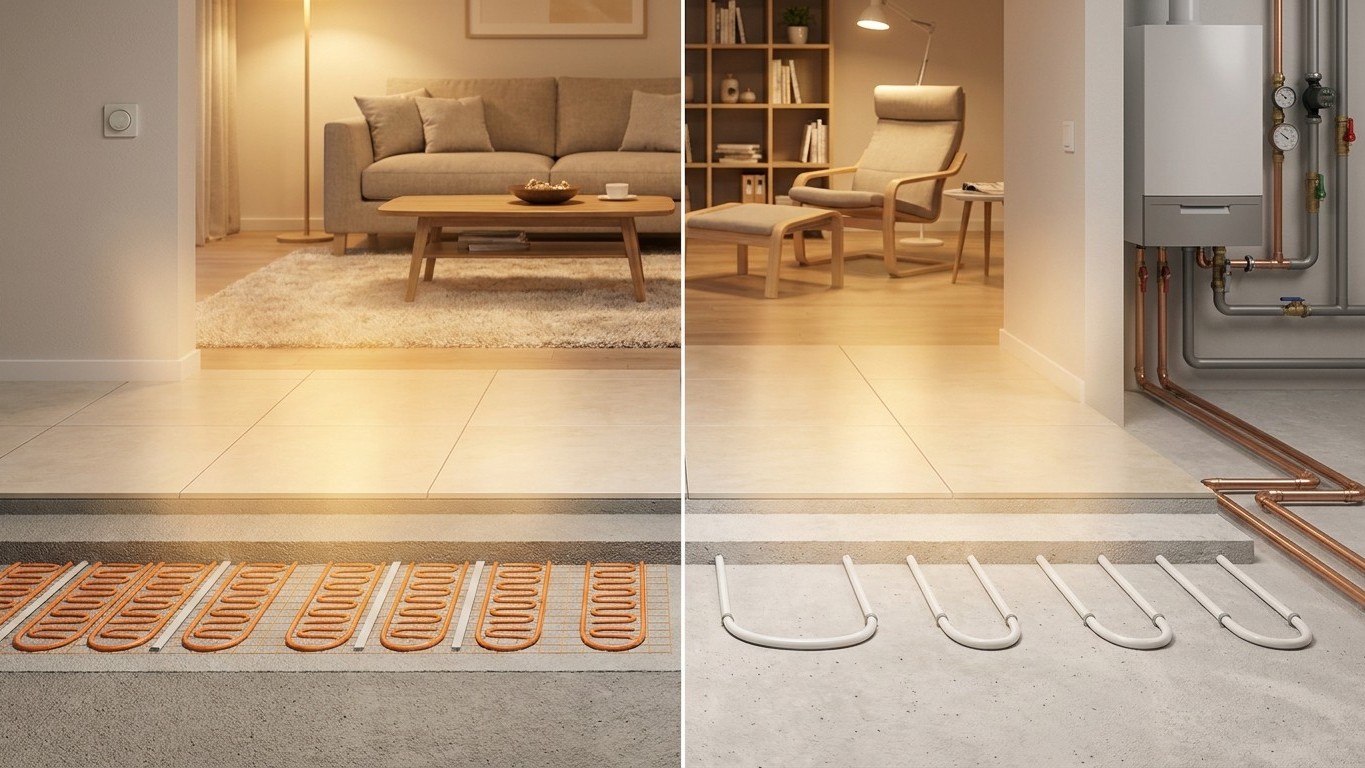

Radiant Floor Heating has no running cost of its own. What you pay depends entirely on what feeds the system: an electric floor costs whatever your electric rate is per kilowatt-hour, and a hydronic floor costs whatever your boiler burns, whether that’s natural gas, propane, or oil. The floor itself is neutral. What changes the bill is everything around it.
The floor is a distributor, not a fuel

Ask “how much does radiant floor heating cost to run” and the honest answer is another question: run on what? There are two systems that share a name and little else. Electric radiant floor heating uses resistance cable or thin mats installed under tile, laminate, or engineered wood. It draws power directly, the same way a toaster does, just spread across a room instead of concentrated in one spot. Hydronic radiant floor heating circulates warm water through tubing embedded in or under the floor, and that water gets its heat from a boiler burning gas, propane, or oil, or in some setups from a heat pump.
That distinction matters more than any number you’ll find in a brochure. An electric floor is a heating appliance. A hydronic floor is a distribution network, part of a larger system whose fuel and efficiency live somewhere else entirely, usually in a mechanical room you never think about. Two houses with identical hydronic tubing can have wildly different heating costs if one has a boiler installed a decade apart from the other, or if one is fed by a utility with a different rate structure.
The other thing that changes how you should think about cost is thermal mass. A radiant floor doesn’t heat the air first. It heats the slab, or the subfloor assembly, and that mass then radiates warmth into the room over hours, not minutes. Turn it on and you won’t feel a difference for a while. Turn it off and the floor keeps giving off heat long after the system has stopped calling for it. That’s not a flaw to work around. It’s the defining property of the system, and it’s why radiant floors are almost always paired with programmable or outdoor-reset controls rather than a thermostat you nudge up and down like you would with forced air.
None of this tells you a dollar figure, because none of it can. What it tells you is where to look: your utility bill if the floor is electric, your fuel bills and boiler efficiency if it’s hydronic. The floor is the last three feet of the system. Everything that determines cost happens before the water or the current ever reaches it.
Where it genuinely saves
The real advantage of radiant floor heat isn’t magic efficiency baked into the tubing or the cable. It’s temperature. Because the entire floor surface is emitting heat, rather than a single radiator or a handful of forced-air registers, the room reaches comfortable conditions at a lower air temperature than it would with other systems. People report feeling just as warm at a lower thermostat setting, because warmth is coming from underfoot across the whole space rather than from one hot source across the room. Lower air temperature demanded means less heat that has to be generated in the first place.
For hydronic systems specifically, this is where radiant floors intersect with one of the more consequential mechanical decisions in a home: the boiler itself. Radiant floors operate on low supply water temperatures compared to baseboard or old cast-iron radiators, which typically need much hotter water to push enough heat into a room quickly. That low-temperature operation is exactly the condition a condensing boiler needs to actually condense, the process that recovers extra heat from flue gases and is where most of a condensing boiler’s efficiency gain actually comes from. Pair a condensing boiler with baseboard radiators demanding hot water, and it may rarely condense at all, running more like a standard boiler with a fancier badge. Pair the same boiler with radiant floor tubing, and it can spend most of the heating season in its efficient range.
Getting that pairing right depends on how the system is controlled, not just how it’s installed. An outdoor reset curve, which adjusts the boiler’s water temperature automatically based on the outdoor temperature, is what keeps a radiant floor system running cool enough to condense on a mild fall day and warm enough to keep up during a cold snap. Without a properly tuned reset curve, a radiant floor system can be installed correctly and still run hotter than it needs to, quietly giving back the efficiency the low-temperature design was supposed to capture. This is the piece homeowners tend to skip, because it happens in a controller nobody looks at, not in the visible tubing under the tile.
So the savings are real, but they’re conditional on two things working together: a heat source designed to reward low water temperature, and controls tuned to actually deliver low water temperature most of the time. A radiant floor bolted onto a boiler that isn’t condensing, run by a control strategy that isn’t resetting, is just an expensive way to distribute the same heat a radiator would have delivered.
And where it does not
Every advantage above assumes something that’s easy to skip during a renovation and expensive to fix afterward: insulation. A radiant floor slab with nothing insulating it from the ground below, or a room with poor wall and window insulation around it, doesn’t stop working. It just starts heating the wrong things. Heat follows the path of least resistance, and an uninsulated slab will happily send warmth down into the earth or out through an uninsulated perimeter wall just as readily as it sends it up into the room. You end up paying to warm your yard, slowly, forever.
There’s also a hard physical ceiling on what a radiant floor can deliver, and it has nothing to do with the boiler or the electric mat’s power rating. Floor surface temperature is limited by what’s comfortable to walk on and by what the flooring material itself can tolerate without warping, drying out, or degrading over time. That ceiling caps how much heat can be pushed out of every square foot of floor, regardless of how much energy you’re willing to feed the system. A well-insulated room sits comfortably within that ceiling. A poorly insulated room, one losing heat faster than the floor’s maximum output can replace it, will simply never catch up. The thermostat calls for heat, the floor is already running at its maximum safe surface temperature, and the room still doesn’t reach setpoint. At that point no amount of running time or added cost solves the problem, because the limitation isn’t fuel or electricity, it’s square footage and surface temperature.
This is precisely the scenario that makes radiant floors a poor match for a retrofit into an existing, older, poorly insulated structure without addressing the building envelope first. Adding radiant tubing under the floor of a drafty room with single-pane windows and no wall insulation doesn’t fix the underlying heat loss. It just gives that heat loss a more elegant, more expensive way to happen. The homes where radiant floors perform best are the ones where insulation was addressed as part of the same project, not left for later. Get that order backwards and the floor becomes the scapegoat for a problem that started in the walls.
Common questions
Does radiant floor heating use more electricity than baseboard heat?
It depends on which radiant system and what it’s compared against. An electric radiant floor draws power directly, similar to any resistance heater, and its consumption is a function of the room’s heat loss and how much floor area is covered. Because it lets the room feel comfortable at a lower air temperature, an electric radiant floor in a well-insulated room can call for heat less often than electric baseboard covering the same space, but in a poorly insulated room that advantage narrows or disappears.
Can I put a rug on a radiant heated floor?
This depends on the flooring manufacturer’s own guidance for the specific material installed over the tubing or cable, since some finishes and rug pads can trap heat and affect both comfort and floor life. General fire safety guidance applies regardless of the flooring: the U.S. Fire Administration advises to “keep anything that can burn at least 3 feet from all heat sources including fireplaces, wood stoves, radiators, space heaters or candles,” and while a low-temperature radiant floor isn’t a space heater, it’s worth confirming rug and furniture placement against the flooring manufacturer’s clearance recommendations before assuming any covering is safe.
How long does it take a radiant floor to warm up a room?
Hours, not minutes, because the system is heating the thermal mass of the slab or floor assembly before that mass radiates warmth into the room. This is why radiant floors are typically run on a steady schedule or an outdoor reset curve rather than switched on and off like a forced-air thermostat, which would leave rooms cold while waiting for the floor to catch up.
Is electric or hydronic radiant floor cheaper to run?
Neither is inherently cheaper; it comes down to local energy prices. An electric floor costs whatever your electricity rate is per kilowatt-hour applied to the floor’s draw. A hydronic floor costs whatever your gas, propane, or oil bill reflects, filtered through your specific boiler’s efficiency and how well its controls are tuned to run at low water temperature. Comparing the two means comparing your own utility rates, not the systems in the abstract.