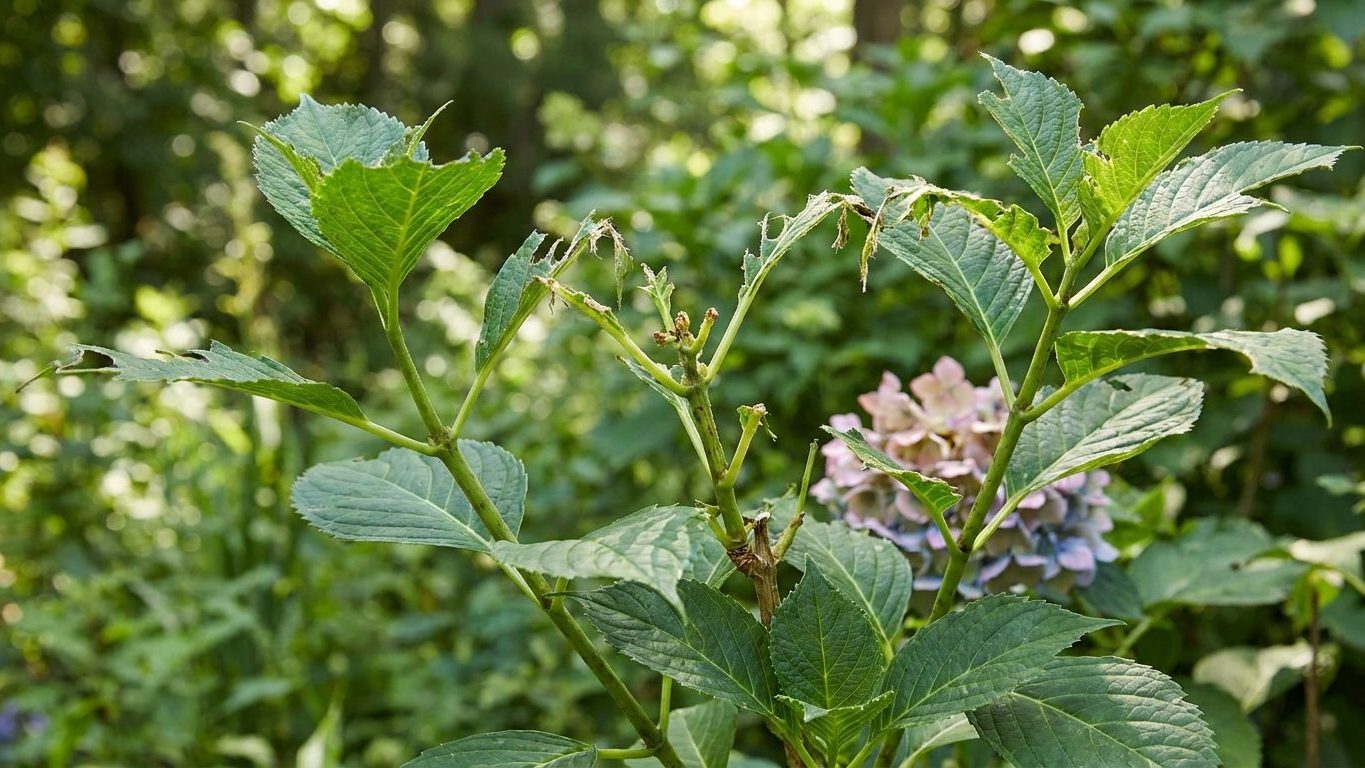

Deer browsing on Hydrangeas is real and well documented, not a garden myth. The plant carries no genus-wide protection against them, and a hungry deer will strip leaves, buds and stem tips from a bigleaf, panicle, smooth or oakleaf hydrangea with equal enthusiasm. What changes the outcome is which type got hit and when in its growth cycle the damage happened. That is the piece most gardeners miss.
What the damage looks like
The detail that gives deer away before you name anything else: the tears are ragged, not clean. Deer have no upper incisors. They grip a leaf or stem between their bottom teeth and a hard upper palate, then yank, which shreds the tissue instead of slicing it. Look closely at a damaged leaf edge and you will see frayed, irregular fibers rather than a crisp line. That single texture separates deer from almost every other agent that touches this plant.
Height is the second tell. Deer feed from roughly waist level up to about six feet, depending on the animal’s size and whether it is reaching. A browse line at that height, where leaves and stem tips vanish uniformly across several branches while the lower growth is untouched, points straight at deer. A single night can strip a young plant of most of its new growth, because deer move through a garden and sample several plants rather than settling on one.
What is missing matters as much as what is torn. Deer take whole leaves, whole flower buds and the soft tips of new stems. They do not leave the kind of lacy, skeletonized leaf you get from a chewing insect, and they do not leave sticky residue or discoloration the way a sap-feeder does. If you find bare stems with jagged, splintered ends and buds gone entirely, along with fresh leaves missing from the mid and upper canopy but the lower branches intact, that is a strong deer signature.
Toxicity is worth mentioning plainly here, because it changes how much this damage should worry you: only the bigleaf hydrangea (Hydrangea macrophylla) is documented as toxic, and only if eaten in large quantity, causing nausea, stomach pain, vomiting and sweating in animals and people. In practice this does nothing to protect the plant. Deer browse macrophylla anyway, in the same yards where the damage shows up on every other type. Do not count on the plant defending itself.
Making sure it is this and not something else
Before treating for deer, rule out the two conditions people confuse it with most often. Both leave missing plant material too, which is where the confusion starts, but the pattern of what is gone and where tells them apart quickly.
Rabbits and voles
Rabbits and voles feed low, almost always under two feet, and they leave a clean, angled cut rather than a torn one. A rabbit clips a stem at roughly 45 degrees, almost as if snipped with pruners. If the damage sits close to the ground and the cut edges are smooth, you are looking at a rabbit or a vole working at the base, not a deer working the canopy.
Insects (aphids, scales, mites)
These sap-feeders, named among the pests that affect hydrangea, are described in the source material as rarely a problem on this plant. Their damage looks nothing like a deer’s: leaves curl, yellow or develop a stippled, dusty look, and you may find sticky honeydew or fine webbing. Nothing large is missing from the plant. Tissue is compromised, not torn away.
Leaf spot and other disease
Leaf spot, bacterial wilt and powdery mildew show up as discoloration, lesions or a powdery coating on leaf surfaces that remain otherwise intact. If every leaf is still attached and the damage is cosmetic staining rather than missing tissue, you are dealing with disease, not an animal.
The single test that resolves most doubt: check the cut. Ragged and torn means deer. Clean and angled, low to the ground, means rabbit. Discolored but whole means disease or a sap-feeding insect.
When it shows up
Deer pressure tracks the plant’s growth stage rather than the calendar. The most attractive window is when tender new growth is emerging, soft shoots, unfolding leaves and developing flower buds carry less fiber and more moisture than mature foliage, and deer key in on exactly that softness. A hydrangea pushing new growth after a dormant period is at its most vulnerable stage, regardless of which region it is growing in.
The second high-risk stage is dormancy itself, when browse is scarce. In a hard season with little else green or palatable, deer will strip bark, buds and stem tips from a dormant hydrangea simply because there is nothing better available nearby. This matters most for old-wood bloomers such as bigleaf, oakleaf, mountain and climbing hydrangea, since the flower buds for the coming season are already set on that existing wood and browsing removes an entire year’s bloom in one visit.
Newly planted and young specimens face pressure at every stage, simply because they are smaller, more tender throughout, and easier for a deer to reach in full. An established plant with several seasons of woody structure behind it usually has enough mass that one browsing event is a setback rather than a loss. Which stage matters most for your plant depends on its type: a panicle or smooth hydrangea, both of which flower on the current season’s growth, can push new flowering wood even after a rough dormant-season browsing, while an old-wood type simply loses that year’s flowers if its buds are gone.
What to do now
- Fence the individual plant first. A simple cage of welded wire or hardware cloth around a young or newly planted hydrangea, tall enough to sit above a deer’s reach, is the cheapest and most reliable fix available to a home gardener. It costs little, requires no reapplication, and works regardless of weather.
- Use netting over vulnerable new growth. Lightweight deer netting draped over a plant during its tender flush of spring growth blocks browsing without smothering the foliage, and it comes off easily once the wood has matured.
- Apply a taste- or scent-based repellent. Commercial repellents built around egg solids, capsaicin or predator scent are genuinely available at garden centers and hardware stores, and they work by making the plant unpleasant rather than harming the deer. Reapply after heavy rain, since these products wash off, and rotate between formulations occasionally so deer do not habituate to a single scent.
- Add a motion-activated deterrent for repeat visitors. A motion-triggered sprinkler or light near the planting disrupts the routine of deer that keep returning to the same yard, and it needs no chemical input at all.
- Install perimeter fencing only if pressure is constant. For a yard with heavy, repeated deer traffic across many plants, a taller perimeter fence around the whole bed or garden is the most drastic step, and the one to reach for last, once smaller measures have proven the pressure will not let up.
There is no pesticide or chemical control aimed at deer the way there is for an insect, since the goal is deterrence, not eradication. Everything above works by making the plant harder to reach or less appealing, not by treating a pest population directly.
Stopping it coming back
- Put fencing or netting up before new growth emerges each year, rather than after the first bite marks appear, since tender spring shoots are the highest-risk stage.
- Do not rely on any hydrangea type being deer-resistant. The plant is listed among species deer damage, and browsing has been observed across bigleaf, panicle, smooth and oakleaf types alike, regardless of what a plant tag claims.
- Protect newly planted specimens through their first two or three seasons especially closely, since a young plant with limited woody structure has far less to lose before real damage sets in.
- Know which type you are growing before you decide how worried to be about winter browsing. An old-wood bloomer (bigleaf, oakleaf, mountain, climbing) that loses its buds to deer over dormancy loses that year’s flowers entirely, while a new-wood bloomer (panicle, smooth) can still push flowering growth the following season.
- Rotate repellent products through the season rather than sticking with one, since deer that encounter the same scent repeatedly tend to grow tolerant of it.
- Leave dead hollow stems standing at 12 to 24 inches after cutting back, since native bees nest in them; a fencing strategy that protects new growth without disturbing this stubble supports both goals at once.
Common questions
Are Hydrangeas deer resistant? No, not reliably. The plant is named among species deer damage, and observed browsing spans every common type. Any claim of deer resistance for hydrangea should be treated with skepticism rather than relied on for garden planning.
Does the toxicity of bigleaf hydrangea keep deer away? Not in practice. Only Hydrangea macrophylla is documented as toxic, and only when eaten in quantity, causing nausea and stomach upset. Deer still browse it in yards across the country, so the toxicity offers no real deterrent value.
Which hydrangea type recovers best after deer browsing? New-wood bloomers, panicle and smooth hydrangea, have the advantage, since they flower on the current season’s growth and can push new flowering wood after a browsing event. Old-wood types, bigleaf, oakleaf, mountain and climbing hydrangea, lose that year’s flower buds if deer strip them during dormancy.
Will one bad season of deer browsing kill an established hydrangea? Rarely. An established plant with several years of woody structure typically survives browsing as a lost season of blooms rather than a lasting injury. Young and newly planted specimens carry far more risk, since they have less mass and fewer reserves to draw on while regrowing.