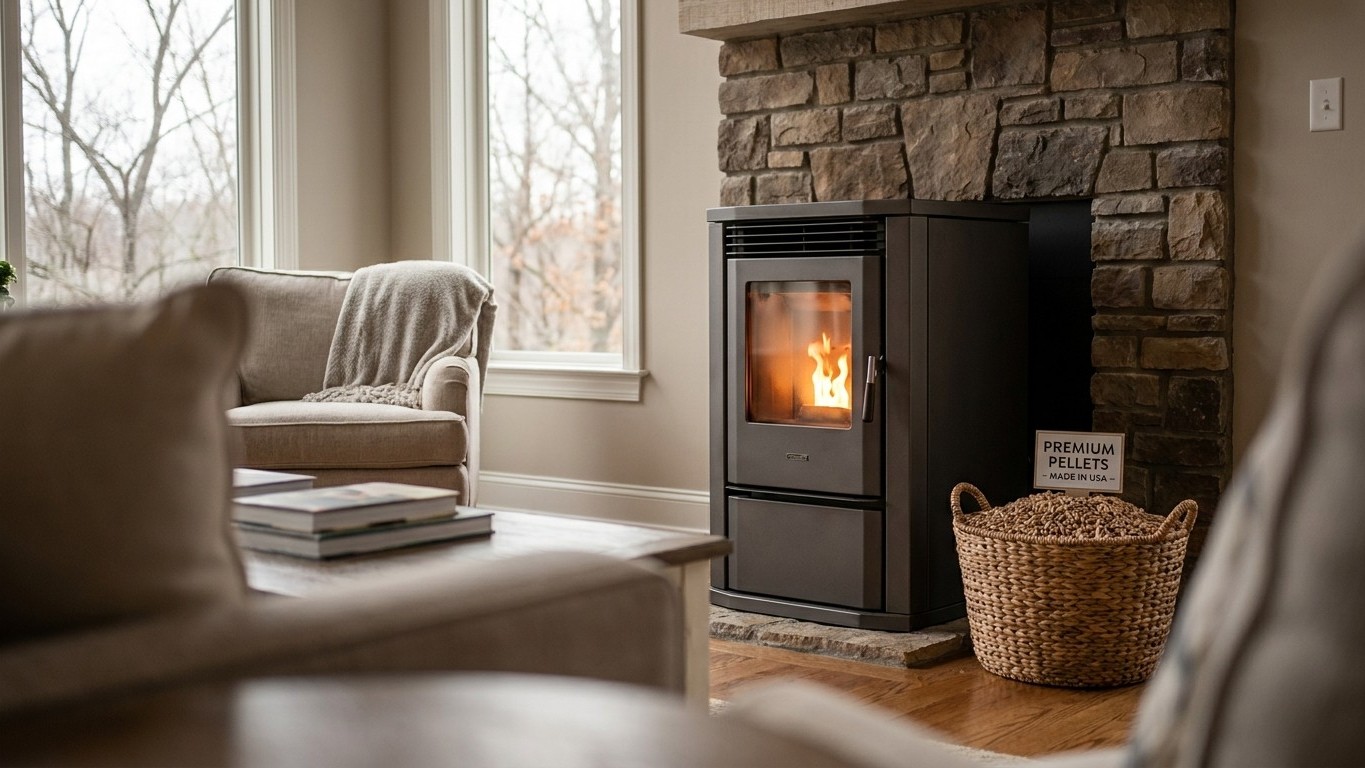

A pellet stove in Florida is almost never the main heat source. With roughly 1,228 heating degree days a year at the Jacksonville reference station, the state’s heating load is a fraction of what a Northeast or Midwest home carries. Expect a stove that runs on cool mornings and cold snaps from November through April, burning maybe a few hundred pounds to a ton or two over a mild season, not the four or five tons a colder climate demands.
How hard the winter works here

Jacksonville’s climate normal puts the city at about 1,228 heating degree days a year, measured against the standard 65 F base NOAA uses for every station in the country. That number is small. Compare it to a city in the upper Midwest, where degree-day totals often run five or six times higher, and the picture is clear: Florida homes lose very little heat to the outside air over the course of a year. A pellet stove here isn’t fighting a losing battle against cold the way it would in Minnesota or Maine. It’s topping off a house that barely needs help.
The length of the season tells a different story than the depth. Heating demand at Jacksonville starts in November, the first month whose average temperature (62.3 F) dips below that 65 F threshold. It climbs through December, peaks in January at 350 degree days, the single coldest month, then fades through February and March before dropping close to zero by April. That’s five months where a stove could plausibly run, even if most of those days only call for an hour or two in the morning. A long, mild season and a short, brutal one can post the same annual total, but they feel completely different to a homeowner. Florida’s is the long, mild kind.
That distinction matters for anyone deciding whether a pellet stove is worth installing at all. With degree-day numbers this low, the honest answer is that a stove here functions as comfort and atmosphere, a way to take the edge off a 45-degree morning or heat one room without running central air in reverse, rather than as a primary heating system carrying the household through winter. Buyers who go in expecting a wood-stove-style workhorse will be disappointed by how little the appliance actually gets used most years.
One caution worth repeating: Jacksonville is one city, not the whole state. Florida stretches nearly 450 miles north to south, and the panhandle sees noticeably colder nights than Miami-Dade or the Keys ever will. A homeowner in Tallahassee or Pensacola should expect a heavier heating load than this figure suggests, while someone in South Florida will use even less than the Jacksonville number implies. Anyone serious about sizing a stove should look up the degree-day normal for the station closest to their own town rather than assuming a single statewide figure applies everywhere.
How many tons a winter takes here
Nobody publishes a tons-per-winter figure for Florida, and no territorial page honestly can, because a bag of pellets is a fixed 40 pounds and a ton is fifty bags, but how many tons a given house burns depends entirely on how much heat that house actually needs to replace. That’s exactly what the degree-day figure above measures, and it varies from one property to the next even on the same street.
Start from the chain that does hold steady: 40 pounds a bag, 50 bags a ton, and a stove that draws down the hopper at a rate set by the thermostat setting and the size of the space it’s heating. From there, three things swing the total more than anything else:
- How well the house holds heat — a newer, well-insulated home with tight windows burns a fraction of what an older, drafty one does for the same comfort level.
- Whether the stove is the only heat or a supplement — a household running the stove alongside central heat pump or furnace backup will burn far less than one relying on it exclusively for the coldest weeks.
- The setting it runs at — a stove left on a low or medium setting for ambiance burns at a completely different rate than one cranked up to replace the central system during a cold snap.
Given that spread, two houses in the same Jacksonville zip code can burn twice as much fuel as each other depending on insulation, thermostat habits, and whether the stove is decorative or doing real work. Any number quoted without knowing those three variables is a guess dressed up as data.
The only figure worth trusting is the one measured, not estimated. Buy a modest supply for the first season, say ten to fifteen bags to start, track how fast the hopper actually empties across a typical week of use, and treat that as the household’s real baseline going forward. One measured winter, in one specific house, beats every published estimate or online rule of thumb, because it accounts for the insulation, the habits, and the setting all at once. For the broader mechanics of how consumption scales with degree days and house size nationally, the national page on how many pellets a winter takes walks through the math in more depth.
Buying and storing them in this climate
Heating demand at the Jacksonville reference station starts climbing in November and doesn’t fall off until April, which means the window to buy ahead sits squarely in late summer and early fall, before that five-month stretch begins. Pellets are typically cheapest and easiest to find outside the heating season, and a regional cold snap, the kind that occasionally pushes into North Florida in January, can empty local shelves fast in a state where most retailers don’t stock deep inventory year-round. Buying a season’s supply in September or October avoids that scramble entirely.
Storage is where Florida’s climate actually works against the fuel, more than the mild winters ever do. Pellets are compressed sawdust held together by the wood’s own lignin, with no added glue, which means they’re built to resist handling but not moisture. Florida’s summers run long and humid, and a bag left in a garage or shed without a vapor barrier underneath it will pull ambient dampness straight through the paper packaging. Once that happens, pellets swell, lose their shape, and crumble into sawdust that clogs an auger feed instead of burning cleanly.
A concrete garage floor is a particular risk in this climate. Slabs sweat when humid outside air meets a cooler floor, and a stack of bags sitting directly on that concrete can wick moisture up from underneath even in a covered, seemingly dry space. Raising pallets or bags off the floor on boards or a shelf, and keeping them away from exterior walls where condensation collects, matters more here than in a drier climate where humidity swings are less extreme.
On the buying side, the only number worth comparing between suppliers is price per ton, since bag counts, bag weights, and delivery minimums vary enough between retailers that a per-bag price alone can mislead. For the details on grading pellets by ash content and hardness, and for a full storage walkthrough that applies regardless of region, the national storage guide and the pellet quality and grading page cover ground this section won’t repeat.
What a winter outage means here
A pellet stove depends on electricity to work at all. Unlike a wood stove, which burns on gravity and draft alone, a pellet appliance uses an auger motor to feed fuel into the burn pot and a fan to move heated air into the room. Cut the power and the stove goes cold within minutes, no matter how full the hopper is.
How much that matters depends entirely on the degree-day figure above. In a state where the annual total sits around 1,228, an outage during a January cold snap is an uncomfortable evening under extra blankets, not the life-safety emergency it becomes in a climate with five or six times the heating load and genuinely dangerous overnight lows. Florida’s mild winters lower the stakes of losing the stove, even though hurricane season itself brings its own outage risks that have nothing to do with cold.
When the power does go out, most Florida households fall back on the same systems they already use for everyday heating. State survey data shows 66% of homes here rely on electricity as their main heating fuel, split between furnaces (33%) and central heat pumps (31%), with natural gas covering just 5% and steam or hot-water boiler systems and fuel oil or kerosene both too rare in the state to even register a published figure. That mix means the backup for most Florida homes isn’t a wood stove or an oil furnace waiting in reserve, it’s another electric system that goes down at the exact same moment the pellet stove does. A generator or battery setup sized to run the central system, or at least a portable heater, is the realistic fallback here, not a second fuel-burning appliance.
Sizing that backup power correctly is a job for the appliance’s own rating label, not a rule of thumb from an article. The national page on power outages and pellet heat walks through how to read those wattage numbers and match them to a generator or battery bank.