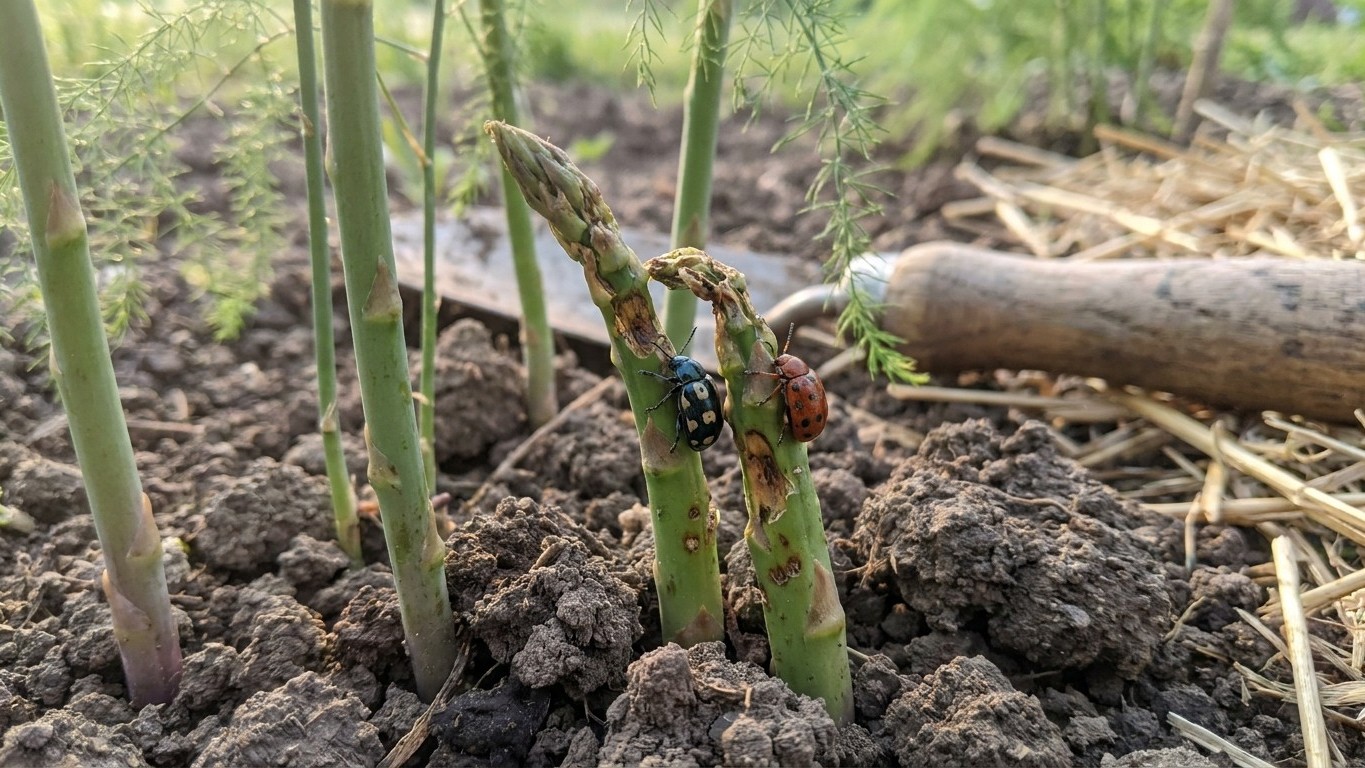

Asparagus beetles show up in New York as soon as spears break ground in spring, typically mid-April on Long Island and late April into May farther upstate, and they stick around through early fall feeding on fern growth. Two species do the damage here: the common asparagus beetle (Crioceris asparagi) and the spotted asparagus beetle (Crioceris duodecimpunctata). Cutting back old stalks each fall, encouraging the natural parasitic wasp that attacks their eggs, and hand-picking during the first two weeks of spear emergence stop most home infestations before they need a spray.
Two Beetles, One New York Garden

Gardeners in Suffolk County or the Finger Lakes region dealing with chewed spears are usually looking at one of two distinct insects that get lumped together under the same common name, but they behave differently enough that treating them the same way wastes effort.
The common asparagus beetle is the one that does real crop damage. It’s about a quarter-inch long, with a metallic blue-black body and cream or reddish squares along its wing covers. Adults chew directly into the spears you’re trying to eat, leaving brown scarring and sometimes bending the tips over, which ruins the marketable stalk even if the plant survives fine. This species overwinters as an adult, tucked into hollow old stalks, brush piles, or loose bark, then emerges right when soil temperatures climb into the 50s.
The spotted asparagus beetle is more of a nuisance than a threat to the harvest. Its twelve black spots on an orange-red back make it easy to tell apart, and its larvae feed almost exclusively inside the berries of female asparagus plants rather than on the spears or ferns. If you’re growing an all-male hybrid variety, which most commercial New York asparagus operations do specifically to avoid seed set, this species barely registers as a problem.
When It Shows Up Across New York
Timing tracks with soil warming, not the calendar, which means the same pest shows up on a rolling schedule as you move across the state.
On Long Island and in the lower Hudson Valley, where soils warm earliest, overwintered adults typically emerge in mid to late April, right alongside the first spear cuttings. In the Capital Region and central New York, expect activity to start one to two weeks later, often not until early May. The Western New York and North Country growing areas, including asparagus fields around the Lake Ontario plain, tend to see the beetles arrive last, sometimes not until mid-May in a cool spring.
A second generation follows in most seasons. Eggs laid on spears and later on fern growth hatch into slug-like gray-green larvae within about a week, and those larvae mature into new adults roughly three to four weeks after that. In New York’s growing season, that usually produces two full generations, with a partial third generation possible in warmer years or in the Hudson Valley’s longer frost-free window. The practical result is that beetle pressure doesn’t stop after the spring harvest ends. It shifts to the fern stage in June and July, when larvae strip chlorophyll from the ferns your plants need to rebuild root reserves for next year’s crop.
Cornell Cooperative Extension offices across the state track emergence through grower networks each spring, and local extension bulletins are the most reliable way to know whether beetles have started moving in your specific county before you go looking for them yourself.
What the Damage Actually Looks Like
Spotting the problem early makes the difference between picking a few beetles off by hand and losing a chunk of the harvest to feeding damage.
On spears, look for small brown scars, notched tips, or spears that have bent or hooked at the top. Adults feed at the growing tip because that’s the softest tissue, and even light feeding can make a spear unsellable at a farm stand even though the plant itself is unharmed. Eggs are the giveaway sign if you catch things early: small, dark, cigar-shaped specks stuck upright in rows along the spear or on fern needles, usually laid by females within a day or two of emergence.
On ferns later in the season, watch for a grayish, skeletonized look to the foliage. That’s larval feeding, and because ferns are what photosynthesize and store energy in the crown for next year’s spears, heavy defoliation in July can mean a weaker, thinner harvest the following spring even if this year’s crop looked fine. A bed that gets stripped repeatedly over two or three seasons can decline noticeably in yield, which is the real long-term cost of letting the second generation run unchecked.
Distinguishing Beetle Damage From Other New York Asparagus Problems
Not every chewed spear is a beetle. Slugs leave ragged, irregular holes and slime trails rather than the clean gouging beetles produce, and they’re most active on wet spring mornings rather than throughout the day. Asparagus rust, a fungal disease common in humid New York summers, turns ferns rusty orange rather than gray, and it spreads through spores rather than insect feeding, so fungicide timing and beetle control are separate decisions that shouldn’t be confused.
What Actually Stops Them
Control works best as a sequence rather than a single fix, starting before the beetles even show up and continuing through the fern stage.
Fall and Winter Sanitation
Since adults overwinter in old plant debris, cutting asparagus ferns down to the ground after the first hard frost and removing that material from the bed, rather than leaving it to compost in place, eliminates a huge share of the sheltering sites. Growers who till or mow the surrounding field edges in late fall report noticeably lighter spring emergence, because the beetles lose the brush piles and loose bark they’d otherwise tuck into.
Harvest Timing as Pest Control
Daily or every-other-day cutting during the harvest window does double duty. It’s how you’re supposed to harvest asparagus anyway for quality, but it also physically removes eggs before they hatch, since females lay directly on the spears you’re cutting and carrying away. Letting spears grow past harvest size, even for a day or two, gives eggs time to develop and gives larvae a head start on the crown.
Biological Control
A parasitic wasp, Tetrastichus asparagi, has established itself in asparagus-growing regions across the Northeast, including New York, and it parasitizes beetle eggs at rates that can knock down populations meaningfully without any spray. It’s already present in most established plantings, so the practical move is protecting it rather than introducing it: broad-spectrum insecticides applied without a real threshold kill the wasp along with the beetles, which can make infestations worse in following years as the natural check disappears.
Hand-Picking and Physical Removal
For home gardens and small plots, a few minutes each morning during peak spring emergence, knocking adults into a jar of soapy water, keeps populations low enough that spraying is never necessary. Beetles tend to drop off the plant when disturbed rather than fly, which makes them easier to catch than most garden pests. Checking the undersides of spears and the tips of new ferns for the black egg rows and scraping them off is just as effective and takes less time than most gardeners expect.
When Spraying Makes Sense
For larger plantings where hand-picking isn’t practical, treatment thresholds matter more than a fixed spray schedule. Extension guidance generally points to treating when 5 to 10 percent of spears show egg-laying or feeding damage during harvest, or when larvae are visibly feeding on more than a small percentage of fern tips after harvest ends. Products containing spinosad or pyrethrins are commonly recommended because they break down faster and are gentler on the parasitic wasp population than longer-residual broad-spectrum options. Any pesticide use on a food crop should follow the label’s pre-harvest interval closely, since asparagus is typically still being cut when beetle pressure is highest.
New York’s asparagus acreage sits mostly in a handful of counties along Lake Ontario, in the Hudson Valley, and on eastern Long Island, and growers in those areas have decades of local pest data through Cornell’s extension network. Home gardeners outside those core regions still deal with the same two species, just on a lighter scale, and the same fall cleanup and spring hand-picking routine that works on a five-acre field works just as well on a raised bed.