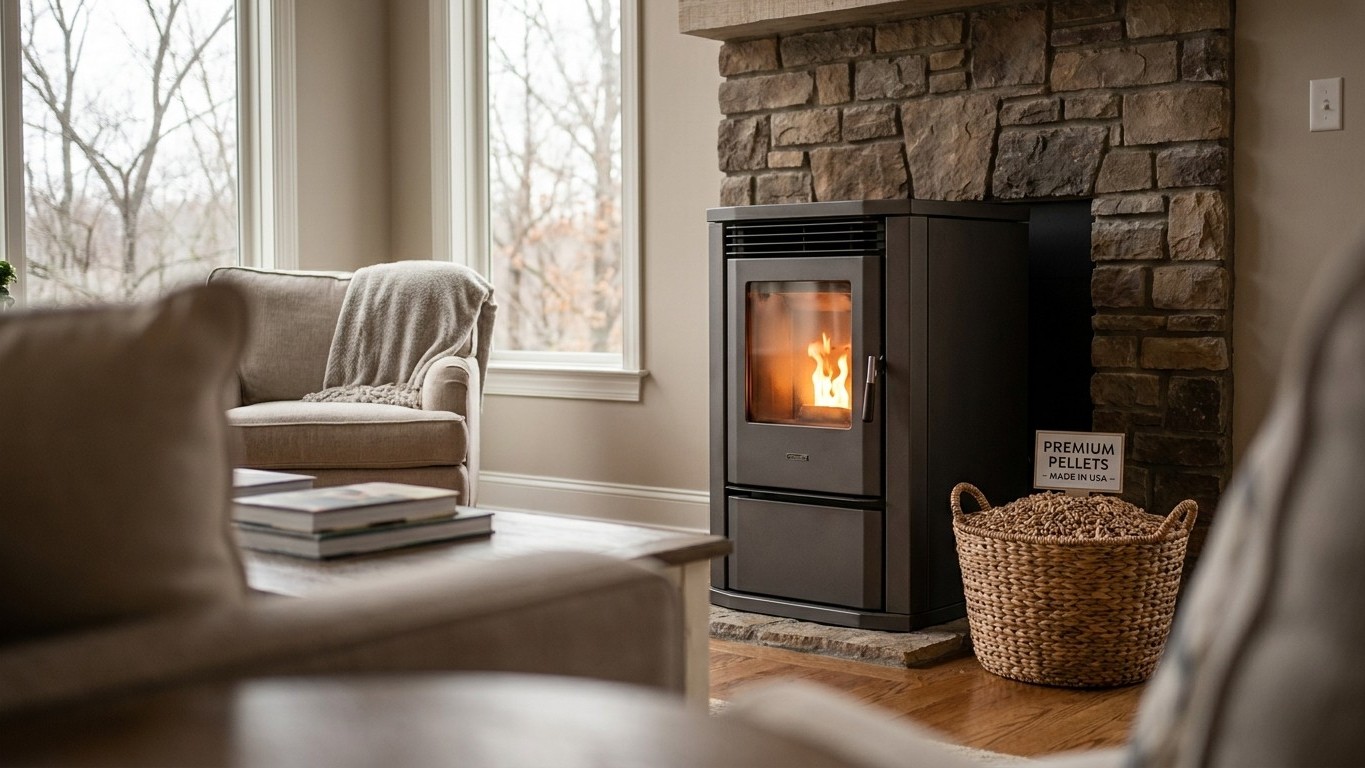

A pellet stove in Manitoba answers to Winnipeg Richardson Int’l A’s climate normals: about 5,648 heating degree days below 18°C every year, over a heating season that starts in September and doesn’t loosen its grip until July. That single figure decides almost everything else here, how many tons a winter actually burns, whether the stove carries the house or just softens one room, and how far ahead a pellet order needs to go in before a cold snap clears the shelves.
How hard the winter works here

Start with the number itself: 5,648 heating degree days below 18°C a year, recorded at Winnipeg Richardson Int’l A over the 1981-2010 normals period. Degree days translate a climate into a fuel bill in a fairly blunt way, roughly double the degree days, roughly double the fuel burned to hold the same house at the same temperature. A Manitoba winter, by this measure, is not a mild inconvenience. It’s a sustained, months-long demand for heat that a stove has to meet or supplement every single day.
The monthly breakdown shows where that demand concentrates. January carries 1,066 degree-days on its own, the hardest single month, with December close behind at 966 and February at 880. March still runs 737, and even April holds at 408. That’s the depth of the winter: four months where the furnace, the baseboards, or the pellet stove are working close to flat out.
The length is a separate question, and it matters just as much. Heating demand here starts in September, the first month whose normal mean temperature (12.7°C) drops below the 18°C base Environment and Climate Change Canada uses to count degree days. It doesn’t fully let go until July, when the mean finally climbs back above that line. That’s about ten months of the year where a house in Winnipeg needs some heat, even if only a little of it in the shoulder months of May, June, and August. A short, brutal cold snap is a different problem than a long, moderate one, and Manitoba delivers both: real depth in the dead of winter, real length on either side of it.
Why the station matters
Every figure above comes from one weather station: Winnipeg Richardson Int’l A. Manitoba stretches from the Minnesota and North Dakota border up past Thompson to Churchill on Hudson Bay, and the climate along that line is not one climate. A homeowner in Brandon or Portage la Prairie is probably close enough to Winnipeg’s numbers to use them as a working estimate. Someone heating a house in The Pas, Flin Flon, or further north should expect a colder, longer season than what’s described here, and would do better checking the normals for a station closer to home before sizing up a pellet order or a stove.
How many tons a winter takes here
Nobody can hand you a tons-per-winter figure for a specific address, and anyone who does is guessing. What you can do is work the chain that actually produces the number, using the pieces that are genuinely known. A standard bag of pellets weighs 40 pounds. Fifty bags make a ton. How many bags a winter burns through depends on how much heat the house needs to replace, which is exactly what the degree-day figure above measures: more degree days below 18°C, more heat lost, more pellets burned to replace it.
Between two houses in the same Winnipeg neighborhood, facing the identical 5,648 degree-days, consumption can still differ by a factor of two. Three things move that number:
- How well the house holds heat — insulation, air sealing, window quality, and whether the basement is finished all change how much fuel it takes to hold the same indoor temperature.
- Whether the stove is the only heat source or a supplement — a stove running alongside a forced-air furnace or electric baseboards (the two most common setups in Manitoba homes) burns far fewer pellets than one asked to carry the whole house on its own.
- The setting it runs at — a stove left on a low or medium burn to take the chill off a room uses a fraction of what the same stove burns wide open, all day, in January.
Given that spread, the honest approach isn’t finding a published average, no source breaks consumption down by province or territory, and none should be trusted if it claims to. The approach that actually works is counting bags through one real winter in the house in question, tracking what gets burned from September through the last cool nights of spring, and using that total as the baseline for every winter after. One measured season in your own house beats any estimate borrowed from someone else’s. For the general math behind that count, the site’s national page on how many pellets a winter takes walks through the same chain in more detail.
Buying and storing them in this climate
Timing matters more in Manitoba than in a milder climate, because the heating season here starts early and runs long. Demand climbs through September as temperatures fall below that 18°C threshold, and by the time a hard cold snap hits in December or January, local supply can tighten fast. Pellets are also cheapest out of season, in the summer months when degree-days sit near zero and dealers aren’t scrambling to restock. Buying ahead, before September rather than after the first freeze, is less about hunting a deal and more about not being the household calling around in November asking who still has stock.
Storage is the other half of the equation, and it’s shaped directly by what pellets are made of. A wood pellet is compressed sawdust, held together by the natural lignin in the wood itself, with no added glue or binder. That construction is efficient for burning and fragile against moisture. Damp air swells the wood fibers and breaks the pellet down into crumbs and dust, and once that happens the fuel doesn’t feed cleanly through an auger anymore.
Manitoba’s climate creates two separate risks for that. Winnipeg summers run humid enough that an uninsulated garage or shed can hold moisture in the air for weeks at a stretch, especially after a wet spell. Spring is the other pressure point: as the deep frost pulls out of the ground and snow melts, basements and garage floors in older homes often sweat or take on dampness that a stack of bagged pellets sitting directly on concrete will absorb. Raising bags off the floor and keeping them somewhere dry and well-ventilated matters more here than in a drier climate. When comparing what different bags or suppliers cost, compare by the ton, not by the bag, since that’s the only unit that lets you measure two offers against each other fairly. For the fuller rundown on moisture, pellet grades, and what “premium” actually means on a bag, the site’s national storage guide and pellet quality page cover that ground without repeating it here.
What a winter outage means here
A pellet stove is not a wood stove, and the difference shows up the moment the power goes out. Feeding pellets from the hopper into the firebox and pushing the warm air into the room both depend on electric components, an auger motor and a blower fan at minimum. Cut the power and the stove stops working, regardless of how many tons are sitting in the hopper or stacked in the garage.
How much that matters depends entirely on when it happens, and that’s where the degree-day figures come back into play. An outage in July, with the mean temperature already back above 18°C, costs a household an evening without the stove’s atmosphere and nothing more. An outage during a January cold snap, in the month carrying 1,066 of the year’s 5,648 degree-days, is a different kind of problem entirely, one that turns a power failure into a genuine heating emergency for a house depending on that stove.
Statistics Canada’s most recent count of primary heating systems in Manitoba shows a forced-air furnace as the main heat source in 67% of households, with electric baseboard heaters at 13% and a boiler with hot-water or steam radiators at 7%. Both the heat pump and heating stove categories weren’t published reliably enough to report a figure, which means the survey simply didn’t publish a number there, not that nobody in the province heats that way. What that mix tells a pellet stove owner is that most Manitoba homes already lean on an electricity-dependent furnace as their backup, and a forced-air furnace with an electric blower motor stops working in an outage too, right alongside the pellet stove. Baseboard heat goes dark for the same reason. A power failure here is rarely a problem for one household’s heating choice. It’s a problem for the electrical grid, full stop, and it’s worth planning around on those terms. For sizing backup power sensibly, the safest step is checking the wattage rating on the stove’s own appliance label rather than guessing, and working from there through the site’s national guide to pellet stoves and power outages.