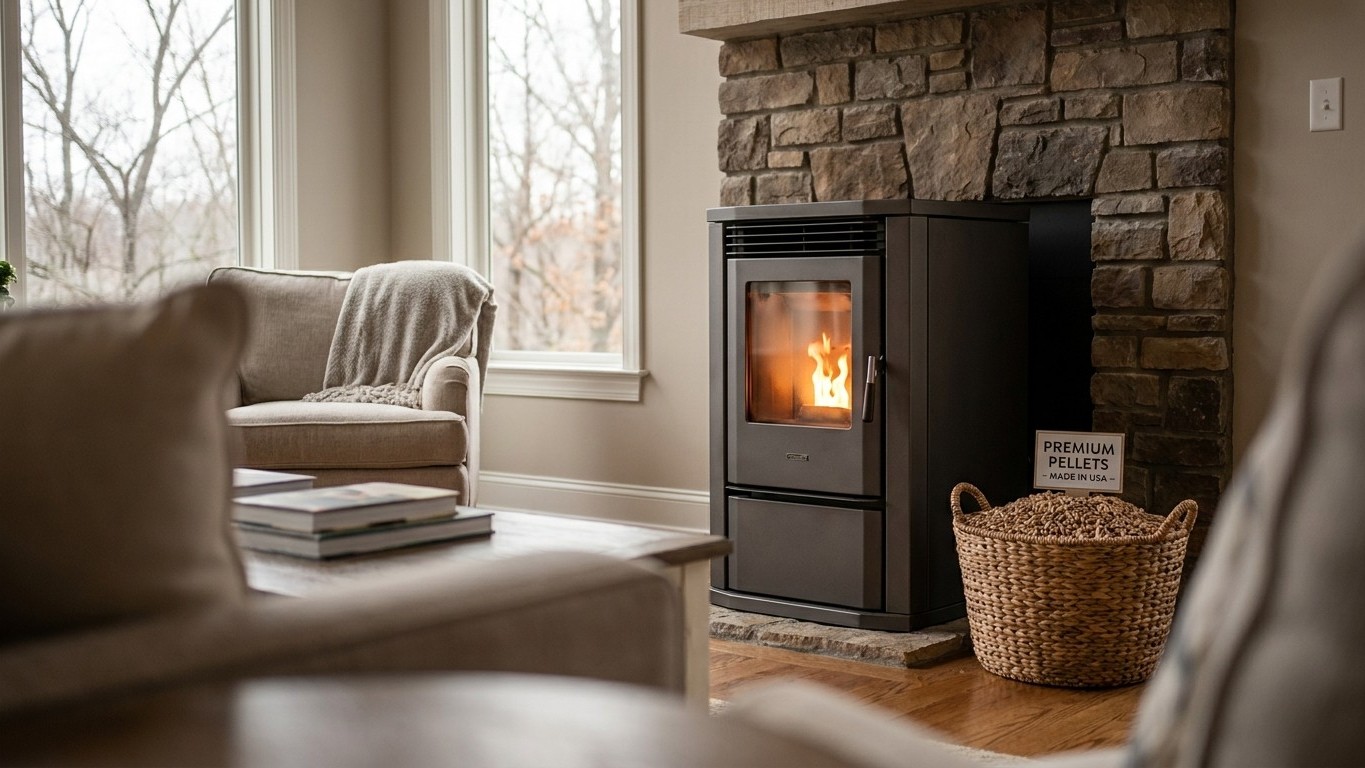

A Montana winter run on pellets is a long, cold haul rather than a quick top-up between mild days. At the reference station in Billings, the numbers point to real heating demand for the better part of ten months, with most homes leaning on furnaces and natural gas rather than a stove doing the whole job. Here’s what that means for tons burned, bags bought ahead, and what happens when the power goes out mid-January.
How hard the winter works here

Billings Logan International Airport, the closest full weather-normal station for this part of the state, logs about 6,754 heating degree days a year on the standard 65 F base. That figure is the whole story in one number: it’s the running total of how far the average daily temperature sits below 65 F, added up across all 365 days. Double the degree days, roughly double the fuel needed to keep a given house at the same temperature. A number this size sits well above what a mild-winter state posts, and it’s the reason a pellet stove in this part of Montana is doing real heating work, not just adding ambiance on a chilly evening.
The other half of the picture is duration, not just depth. Heating demand at this station starts in September, the first month whose normal mean temperature drops below the 65 F threshold, and it doesn’t let up until the average climbs back above that line in July. That’s a heating season stretching close to ten months. January carries the heaviest load, at 1,180 degree days for the month alone, with December right behind it at 1,158. But the season isn’t a short brutal spike followed by relief; it’s a long grind, with real heating demand showing up as early as September (168 degree days) and lingering into June before it finally tapers off.
Depth and length aren’t the same measurement, and it matters which one drives the decision. A place could post a similarly large annual total with a shorter, sharper cold snap and a quick spring thaw. Billings does neither. Cold arrives early, stays late, and never really lets go until midsummer. That combination is what pushes annual pellet demand higher than a headline number alone would suggest.
One caution worth repeating: this is a single station’s data, not a statewide guarantee. Montana runs from high plains to mountain valleys, and a household up in a higher-elevation county, or tucked into a mountain drainage, will see colder normals and an earlier start to the season than what Billings reports. Anyone outside the immediate Yellowstone County area should check normals closer to their own town before budgeting a winter’s fuel around this figure.
How many tons a winter takes here
Nobody can hand you a tons-per-winter number that fits your house, and any source that claims otherwise is guessing. What you can do is work the math the same way the fuel does. A standard bag weighs 40 pounds, and fifty bags make a ton. From there, consumption tracks the heat the house actually loses, which is exactly what the degree-day figure above measures. More degree days, more fuel burned to hold the same indoor temperature; that relationship holds whether you’re heating a drafty farmhouse or a tightly sealed new build.
Three things move that number more than anything else, and none of them show up in a published average:
- How well the house holds heat — insulation, air sealing, window quality, and even how many exterior walls a room has all change how many BTUs it takes to keep a space comfortable.
- Whether the stove is the only heat source or a supplement — a stove backing up a furnace burns far less than one asked to carry the entire house through a Billings-style January.
- The setting it runs at — a stove dialed down to a low, steady burn sips fuel compared with one run wide open to fight a cold snap, and most owners adjust the setting seasonally without tracking it closely.
Given how much those three variables swing consumption, sometimes by a factor of two between two houses on the same street, the only honest approach is to measure your own first winter. Count the bags you buy from the day you start burning in fall through the day you stop in spring, and use that total as your personal baseline going forward. One measured season on your own stove, in your own house, beats any estimate built from a state average or a neighbor’s guess. For the national math behind bag counts and burn rates, the guide on how many pellets a winter takes walks through the full calculation in more detail.
Buying and storing them in this climate
Timing the purchase matters more here than in places with a short, mild heating stretch. Since demand at the Billings reference station starts climbing as early as September, buying ahead means having pellets in the shed before that month, not scrambling once the first hard frost hits. Pellets are typically cheapest in late spring and summer, when demand is flat and dealers are moving product before storage fills up. Wait until a regional cold snap hits in October or November, and shelves can empty fast, leaving buyers paying more for whatever’s left, or driving further to find it.
Keeping bags dry through a long season
Storage matters just as much as timing. Wood pellets are compressed sawdust, held together by the natural lignin in the wood itself, with no added glue or binder. That means they’re vulnerable to moisture in a way solid firewood isn’t: a damp bag swells, softens, and eventually crumbles back into sawdust, which won’t feed properly through a stove’s auger.
Montana’s climate runs generally dry compared with humid coastal regions, but that doesn’t remove the risk. Garages and outbuildings still sweat with temperature swings between a cold night and a sunny afternoon, and snowmelt seeping under a shed door can ruin the bottom layer of a stack just as easily as summer humidity would elsewhere. Pallets or a raised platform under the stack, plus a tarp or sealed storage away from exterior walls that collect condensation, go a long way toward protecting a season’s supply. For a full rundown on stacking, ventilation, and shelf life, the national storage guide and the pellet quality guide cover the details that apply regardless of state.
On cost, skip anything quoted per bag when comparing options; the only number that lets you compare fairly across dealers or seasons is price per ton.
What a winter outage means here
A pellet stove isn’t a wood stove with a hopper bolted on. It depends on an electrical supply to run the auger that feeds fuel into the burn pot and the fan that pushes warm air into the room. Cut the power, and the stove stops working, regardless of how full the hopper sits.
That dependency matters a lot more in a place logging 6,754 heating degree days than it would somewhere mild. In a hard winter like the one this station reports, with heating demand running from September into July, a power outage during a January cold snap isn’t a minor inconvenience. It’s a heating emergency, especially for any household treating the stove as their primary source of warmth rather than a backup.
Worth knowing: state-level data shows most Montana households aren’t relying on a pellet stove alone in the first place. The furnace is the dominant equipment type at 65% of homes, with natural gas as the leading fuel at 59%, followed by electricity at 24%. Steam or hot-water boilers show up in about 10% of households, and propane in roughly 9%. That means, for most homes, a pellet stove functions as a supplement to a furnace-based system rather than the sole line of defense against the cold. Central heat pump and fuel oil figures weren’t published with reliable estimates for the state, so no claim can be made about how common (or rare) those setups are here.
None of that changes the basic electrical vulnerability, though. A furnace running on natural gas or propane still typically needs electricity to run its blower motor, so a whole-house power outage during a hard cold snap can leave both the furnace and the pellet stove offline at the same time. Rather than guessing at a generator size or battery capacity here, check the wattage draw listed on your stove’s appliance label, and see the national guide on pellet stoves during a power outage for how to plan backup power around that number.